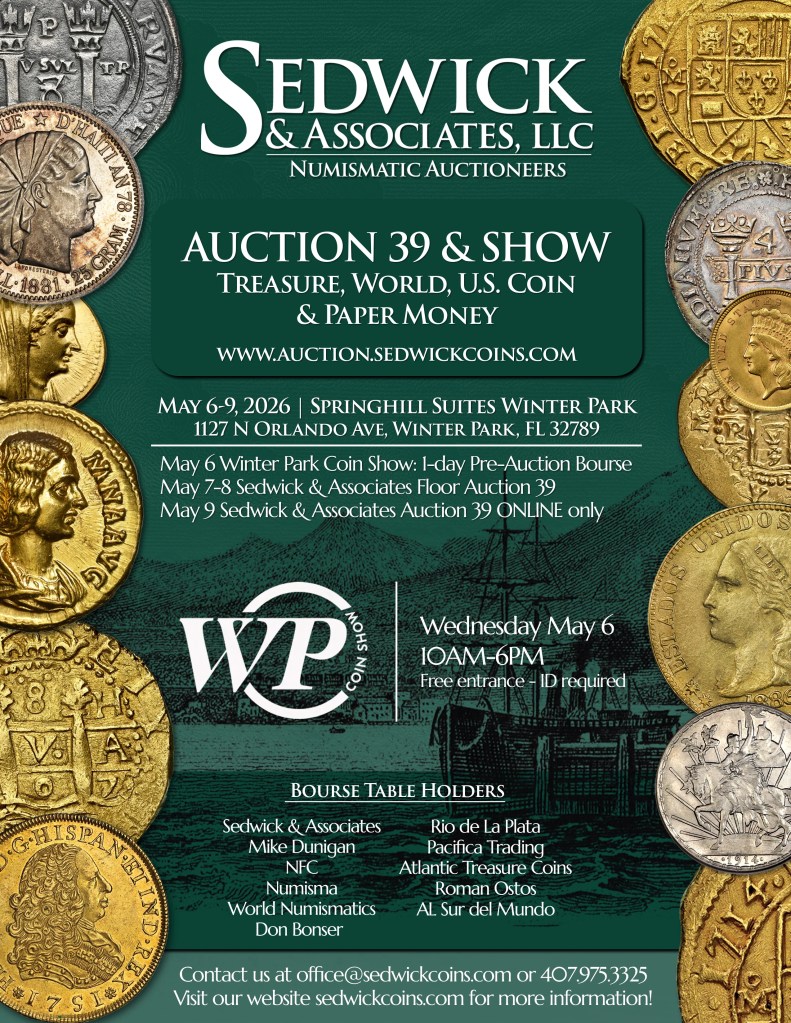
We’re excited to welcome you to this new event and bring everyone together in a relaxed, well-organized setting where dealers, collectors, and bidders can connect and do business comfortably. Our goal is to create a smooth, enjoyable experience with the right balance of professionalism and ease, making it worthwhile for everyone involved. Admission is free (ID required). Note: Space is limited, and all tables for this first edition are fully booked.
This is the inaugural edition of this event, and we are excited to introduce this new format. If everything develops as expected, we anticipate expanding into a significantly larger show next year upon the completion of a new event center adjacent to the Marriott. Show access for attendees begins on May 6 at 10:00 AM and continues until 6:00 PM.
If you wish to view lots in advance of the auction before the show, we can accommodate private viewing appointments at our office as follows. — Monday, May 4 — 9:30 AM to 5:00 PM — Tuesday, May 5 — 9:30 AM to 1:00 PM
Lot viewing will also be available during the show, next to the bourse.
The auction will take place in the same room, the day following the bourse: — Wednesday, May 7 — beginning at 9:30 AM, continuing into the evening — Thursday, May 8 — beginning at 9:30 AM, continuing into the evening
On Saturday, May 9, the online-only session will be held from 9:00 AM to 2:00 PM. Following its conclusion, we will begin closing out the event. Saturday will be primarily dedicated to packing and checkout.
We appreciate your participation in this inaugural event and are confident it will create valuable opportunities for dealers, bidders, and the auction as a whole. Please encourage your friends, clients, and other collectors to attend as well!
We look forward to welcoming you to Winter Park!
Bourse Table Holders: Sedwick & Associates Mike Dunigan NFC Numisma World Numismatics Don Bonser Rio de la Plata Atlantic Treasure Coins Pacifica Trading Roman Ostos Al Sur del Mundo
Note: Dealers who wish to reserve a table in the event of an expansion next year are invited to attend in person, where they may meet with fellow professionals and the show organizers.
Schedule
Wednesday May 6 Winter Park Coin Show: 1-day Pre-Auction Bourse
Thursday May 7 Floor Auction 9:30 AM until ends. Friday May 8 Floor Auction 9:30 AM until ends.
Saturday May 9
Express: Online Only 9:30 am until 1 PM
Featured Offerings: Important Collection of al-Andalus Coinage The Ugaz Collection of Lima Silver Cobs Exceptional Offering of Dated Colombian 2 Escudos Cobs Notable Collection of Bust Gold Minor Denominations Exceptional Collection of Potosí Shield-Type Silver Cobs Fine Selection of 1715 Fleet Gold and Silver Cobs
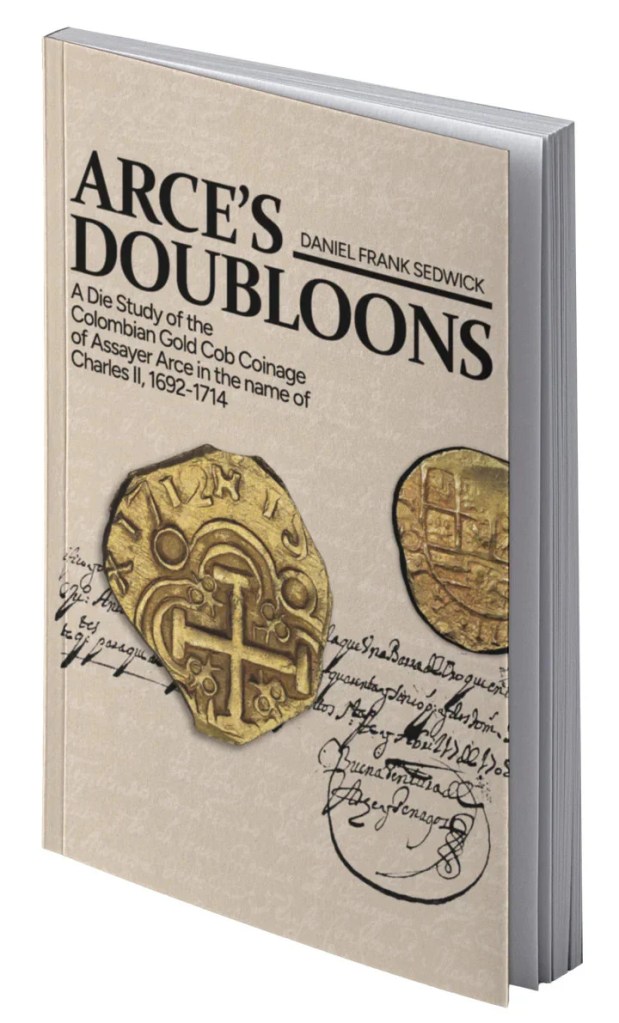
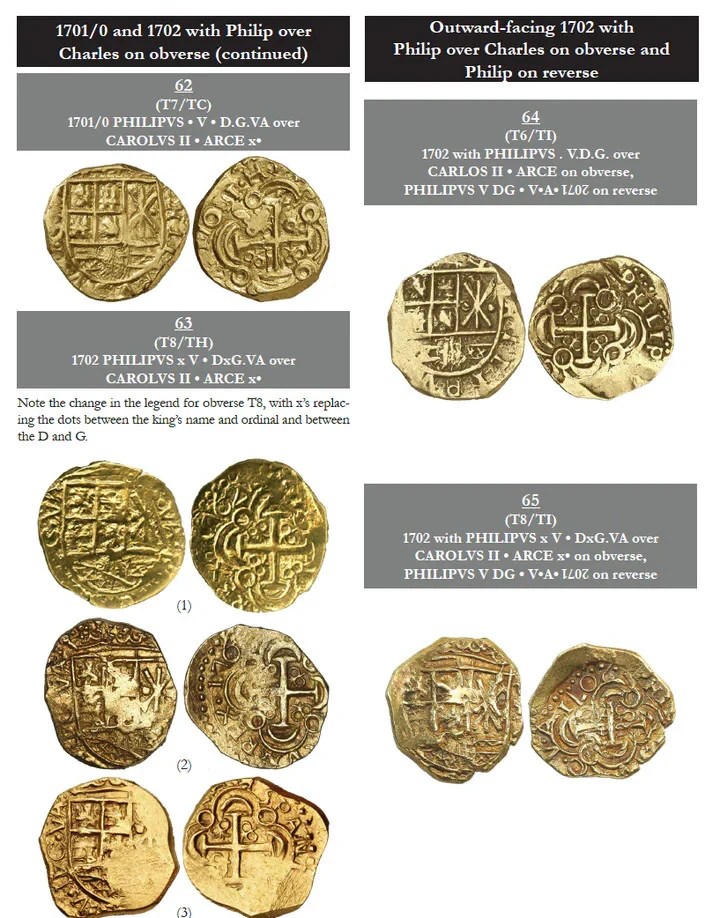
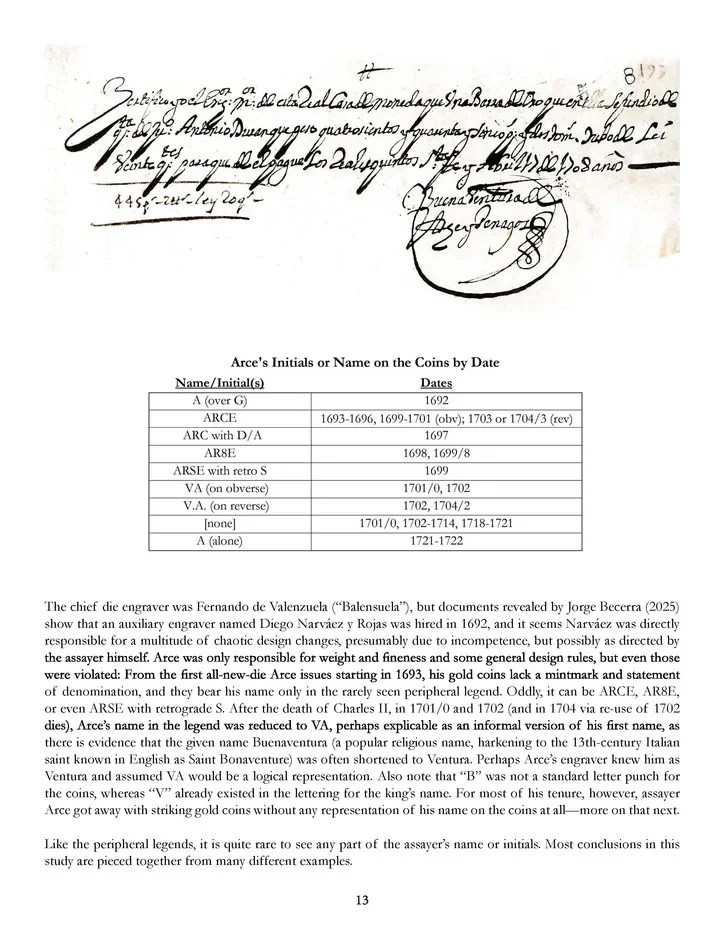
A major new reference has arrived for collectors and specialists of Spanish colonial gold. Arce’s Doubloons by Daniel Frank Sedwick is the first comprehensive die study devoted to Bogotá-minted 2 escudos produced under assayer Buenaventura de Arce Penagos between 1692 and 1714, all struck in the name of Charles II.
Built on the examination of hundreds of specimens, this work goes far beyond a traditional catalog. By reconstructing the chronological sequence of dies, it provides a clear framework for understanding how these coins were actually produced during one of the most dynamic periods in Spanish colonial history. The study spans the final years of Charles II, whose death in 1700 triggered the War of the Spanish Succession, a conflict that coincided with increased piracy across the Caribbean and ultimately the loss of fleets such as the famous 1715 Fleet.
A significant portion of the coins analyzed comes from modern recoveries of that very fleet off the east coast of Florida. Many of these pieces now reside in the State of Florida Collection, which the author studied extensively, giving this book an unusually strong foundation in both numismatic and archaeological evidence.
The book is organized into three principal phases of production:
Lifetime issues, 1692 to 1699
Transitional issues, 1700 to 1704
Post-Transitional issues, 1703 to 1714, with the overlap defined as Half-Transitionals
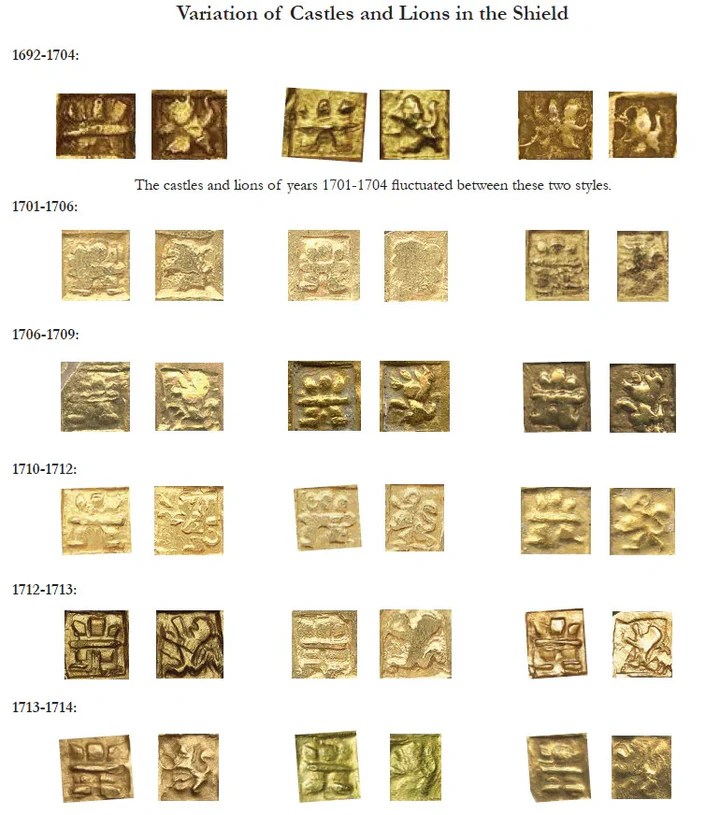
Each section presents detailed diagrams of obverse shield types and key reverse cross characteristics, accompanied by photographic plates and a complete listing of known die combinations. This structured approach allows collectors to attribute coins with a level of precision not previously possible.
Among the most important discoveries documented in this study are:
Clear evidence of muling between 2 escudo and 1 escudo dies
Systematic use of transposed and retrograde punches
Identification of a previously unrecognized debasement
Two appendices expand the scope further, covering Arce 2 escudos under Philip V from 1718 to 1722 and the full range of Arce 1 escudos from 1692 to 1722, making this an essential reference not only for doubloons but for Bogotá gold coinage of the era as a whole.
For collectors of shipwreck coins, especially those tied to the 1715 Fleet, this book provides critical insight into origin, classification, and rarity. For specialists, it establishes a new standard for die analysis in the Spanish colonial series.
Publication details Author: Daniel Frank Sedwick Format: Softcover and hardcover versions Pages: 132, fully illustrated ISBN: 979-8-9937390-0-7 Publication year: 2026
For me, beauty and interest outweigh value, although it’s satisfying when the first two intersect with the third. Years ago, I started researching a robust field of coins, the Charles and Joanna coinage of Mexico City, and my interest was quickly piqued. Not only was the story of the first mint in the New World compelling, but the coins minted there were extremely well struck and beautiful, unlike many of the coins that came after that period. I was also taken with the simple “castles and lions” shield on one side and “pillars and waves” motif on the other.
Like any hobbyist who aspires to fill in his or her collection in a purposeful way, I learned as much as I could about the coins that had caught my attention. I bought a copy of Robert A. Nesmith’s 1955 book, The Coinage of the First Mint of the Americas at Mexico City, 1536-1572, and read it cover to cover. It’s still a great reference 70 years after publication! I read the transcript of the Tello de Sandoval investigation into possible mint improprieties during the tenure of assayer G, Juan Gutiérrez, which gave me a lot of information about the inner workings of the mint and who was there. I read about Hernán Cortés’ conquest of the Aztecs, which set the stage for a mint to be established in Mexico in 1536. I read about the Spanish monarchy to know why the coins bear the names of two rulers: Charles and Joanna. The former was the son of the latter, who by all accounts was crazy and certainly wasn’t capable of ruling over an empire. It was like a soap opera!
I began to keep census of all the varieties of all the denominations of coins from what Nesmith termed the “Early Series” and the “Late Series” assayers. The pinnacle of my work came when we were privileged to handle the sale of the Clyde Hubbard collection of Mexican Charles and Joanna coins, several of which were plate coins in Nesmith’s book.
My collection is not exhaustive because I decided early on to concentrate on rare and sometimes unique varieties and smaller denominations, which are harder to find. I never chased grades because I find it more important to have a coin in whatever condition it was found if there are only one or two known. There are so many varieties that you could spend a lifetime trying to acquire each one! Like the coins, I hope the results of my years-long study—which should be available soon and will feature most of the coins in my collection—helps further interest by avid collectors and people like me who just happen to find these coins beautiful.
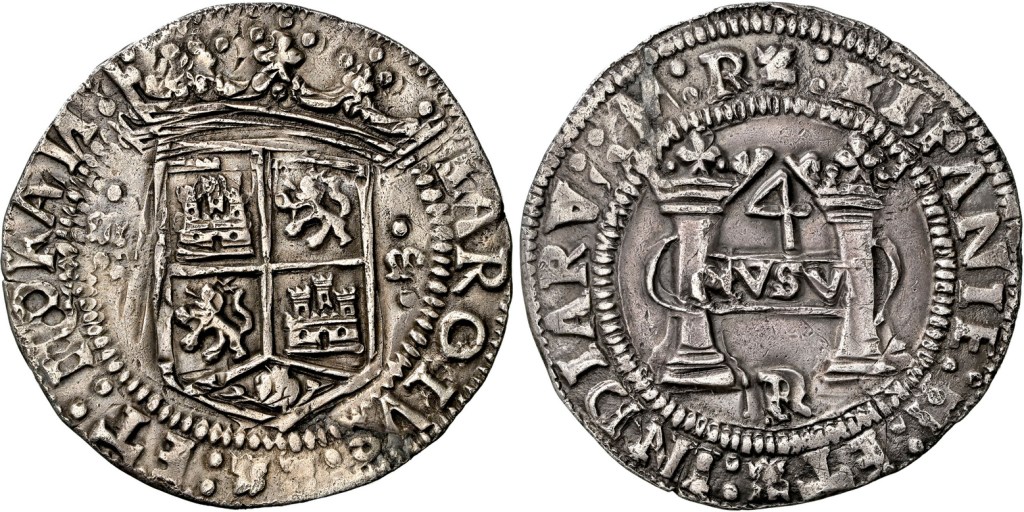
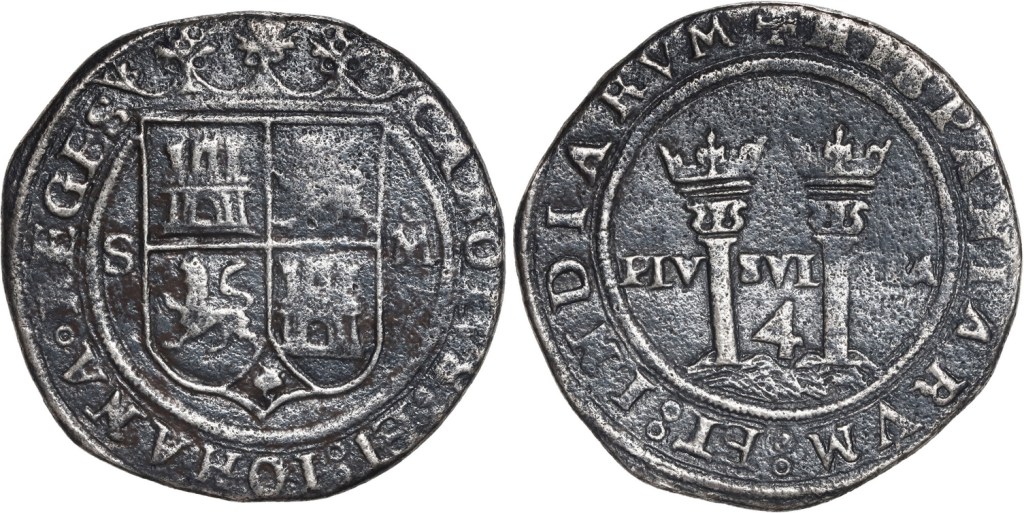
This exceptionally broad-flan four reales coin represents one of the earliest issues under Francisco del Rincón, the first assayer of the Mexico City Mint. Bearing a doubled R/R mark at the base of the pillars, it displays a bold strike with clear legends and a rich toning. The coin’s design—castles and lions on one side, pillars and waves on the other—captures the aesthetic ideals of the Early Series. Its die pairing reveals the reuse of shield dies by subsequent assayers, underscoring continuity in early minting practice. Pedigreed to the Sedwick–Downing Collection and graded NGC AU 50, it remains one of the finest known examples of the Rincón type.
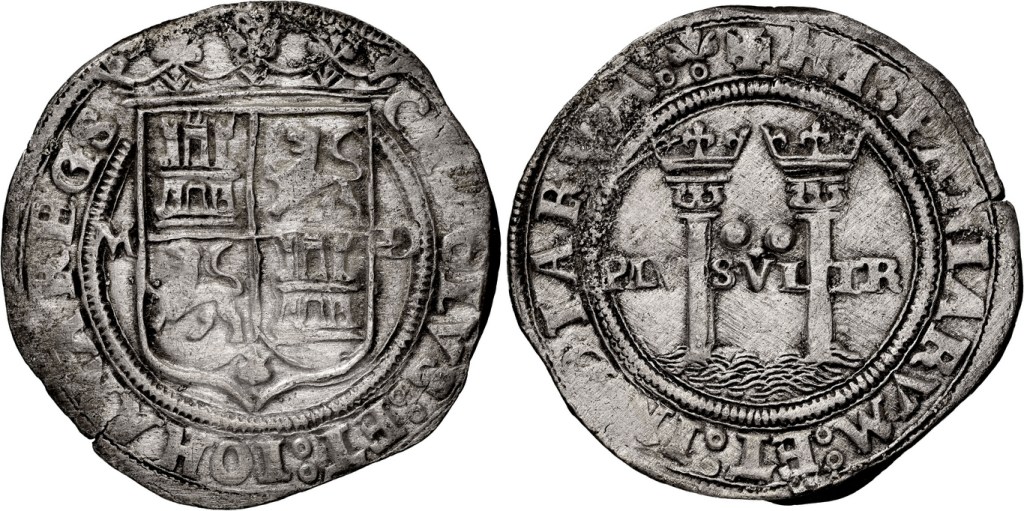
Among the rarest of the entire Charles and Joanna series, this 4 reales piece struck by the elusive Assayer F is both a Nesmith Plate Coin and a former holding of the Huntington Collection at the Hispanic Society of America. The issue, known by very few specimens, is distinguished by full legends, golden toning, and only minor surface corrosion. As one of the rarest assayers represented, it has been used in modern die-linkage studies to clarify the chronological sequence of early mint operations. The specimen is a cornerstone piece for understanding the earliest evolution of mint production following Rincón’s tenure.
This unique 2 reales coin exhibits an unprecedented rhomboid motto panel enclosing the inscription PLVS. The specimen, attributed to Assayer Rincón, is the only known example of its kind, pairing a rhomboid design with Gothic lettering and a later die used by Assayer P. Its discovery bridges stylistic transitions within the Early Series, providing crucial evidence of experimentation at the Mexico City Mint during the late 1530s. The coin’s rarity and stylistic innovation make it one of the collection’s most academically valuable pieces.
This 1 real coin represents a transitional issue showing evidence of an over-assayer strike, in which an earlier die from Assayer F was repurposed under Gutiérrez. The piece features full interiors, deep toning, and minimal wear. Its die linkage to both preceding and subsequent issues makes it a key specimen for understanding the mint’s workflow and reusability of dies. Such examples are indispensable for reconstructing chronological mint sequences of the Early Series.
A rare survivor of the 1554 Spanish Fleet wrecked off Padre Island, Texas, this 4 reales piece from the rare Assayer S illustrates the culmination of the Charles and Joanna coinage before the reforms of Philip II. Its well-preserved surfaces and dark patina testify to its maritime provenance. Few coins of this assayer are known, and its presence in this collection adds both archaeological and numismatic significance. Graded NGC VF details, it is one of the most compelling shipwreck-related specimens of the Late Series.
This intriguing 2 reales coin from the Late Series displays the assayer’s initial G punched upside down—a remarkable minting blunder known in only eight examples. The coin is cited in Dr. Peter Jones’s *The First Coins of the Americas* (2020) and is considered among the best preserved of its type. Its existence underscores the human variability inherent in early minting, as well as the challenges faced by the Mexico City engravers in maintaining die consistency under growing production demands.
While we always stress that numismatics is a hobby, there is no denying it can be financially profitable as well. Why? Obviously, soaring precious metal prices help, but there is more to the story. The answer is that rare old coins, paper money, ingots, and artifacts are limited commodities. They were made in a certain quantity and survived at a certain rate, but that’s it: No more will be made. So then it becomes a matter of demand, and when demand is high, there is no limit as to what something rare can be worth.
Our auctions are packed with unique or near-unique items whose current value depends on you, the bidders. Our consignors depend on us to present these coins and artifacts in their best light, but only the bidders can decide the prices. At a time when the world is very concerned about financial matters, this is the time for collectors to put idle money into rare assets.
Shipwreck items are particularly good performers these days. In many cases, certain items are only available from shipwrecks, hence their already limited population is further restricted by whether they were legally commercially recovered, hardly a sure bet these days. That is why original certificates (or those from qualified professionals) are such a big deal.
The other big concern for coins and paper money is quality, which is where third-party certification companies like NGC and PCGS come in. It is not an exact science, to be sure, but just having an unbiased professional opinion about relative quality posted in a public census adds significant value. Anything presented in our auctions with notations like “top pop” or “finest known in the XYZ census” has even more potential value beyond its baseline rarity and demand.
The moral of the story is that we at Sedwick & Associates run a tight ship with academic and ethical integrity, and we bring you the best the market has to offer with the cleanest pedigree and certification possible. Bid with confidence.
Several important collections stand out in this auction, literally from A to Z. Probably the most significant is the Almenara Collection of Colonial Peruvian Gold Coins, including Lima cobs and Potosí bust gold (as the latter mint fell under Peru in colonial times). The run of Lima cob 1 escudos seen here is the most complete ever offered, and the bust series from both Lima and Potosí contain many “finest knowns” and important pedigrees. And at the end of the alphabet you will find the Zbar Collection of Maravillas coins.
In addition, there are several important one-off coin trophies scattered throughout that should not be missed, even if you are not a buyer but want to witness numismatic history being made:
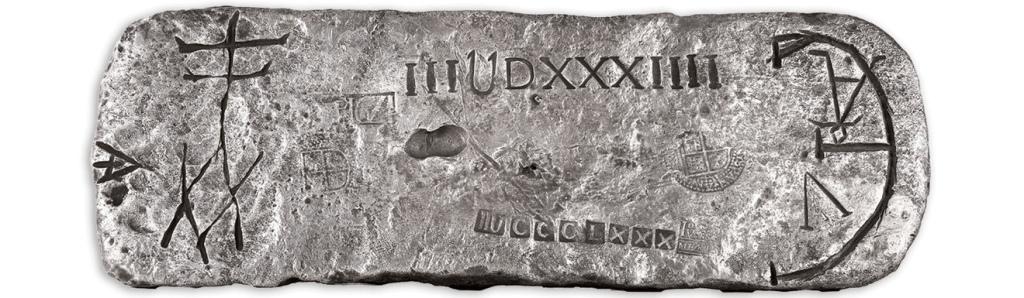
ngots include two massive (each almost 1000 troy oz) Atocha silver bars Class -Factor 1.0 (lots 92 and 93) as well as a 21.5-troy oz gold “finger” bar from the “Golden Fleece Wreck” (lot 85).
But best of all, a showpiece for the ages, is lot 1665, an ornate pendant (reliquary or noble neck-badge) made of gold, diamonds, and emeralds from the Tolosa (1724), a fabulous jewel that appeared in multiple publications in the late 1970s and early 1980s.
Many thanks to all our consignors, and best of luck to all our bidders. We hope you find your treasure!