Archive | paper money RSS feed for this section

Rare Banknote Highlights in our Auction 40

2 Nov

In our Treasure, World Coin & Paper Money Auction 40, we feature a rewarding selection of Latin American banknotes, led by important rarities of Chile and Colombia.

The Colombian offering includes the remarkable Banco de Colombia fifty pesos face proof of 1875, the Banco de Bogotá ten pesos of the same year, and a group of elusive private issues, several cataloged as unique. Chile contributes early Valdivia necessity money, rare private bank emissions and the fiscal overprints of 1898. Selected notes from Costa Rica, Guatemala, Mexico and the United States broaden the historical and geographical range.

Here are twenty rare banknotes featured in our upcoming sale that represent key opportunities for astute paper money collectors.

Four main rarities

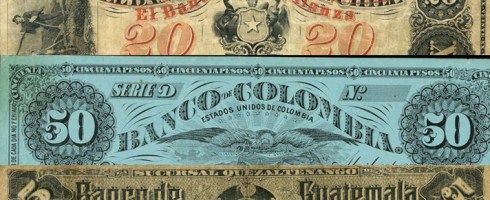
Lot 1475. COLOMBIA, Bogotá, Banco de Colombia, proof 50 pesos, 1-4-1875, serial D, unique, PMG AU 53, finest and only example in PMG census

Lot 1475: COLOMBIA, Bogotá, Banco de Colombia, 50 pesos face proof, 1 April 1875
Lot 1475. Photograph: Sedwick & Associates. Click to view the lot and bid.

Estimate: $9,000 to $13,500

DP-6723p; Pick-unlisted. A striking face proof for this Banco de Colombia note printed by Paredes of Bogotá featuring a large vignette of an Andean condor in a stylistic depiction of the arms of Colombia. Incredibly rare with no examples in the Eldorado Collection and this being the only example graded by PMG. The red seals against the blue paper stand out prominently and the black design is quite bold with only some handling noted in the corners. Pedigreed to the J. Cuartas Collection (stated on label).

View Lot 1475 and bid at Sedwick

Lot 1476. COLOMBIA, Bogotá, Banco de Bogotá, 10 pesos, 15-2-1875, serial C, serial 2584, unique, PMG Choice F 15, finest and only example in PMG census, Compendio Histórico del Papel Moneda en Colombia Plate Note

Lot 1476: COLOMBIA, Bogotá, Banco de Bogotá, 10 pesos, 15 February 1875
Lot 1476. Photograph: Sedwick & Associates. Click to view the lot and bid.

Estimate: $7,500 to $15,000

DP-6223; Pick-S274. The rarity of this note cannot be overstated since it is among the first notes issued by the Banco de Bogotá after its founding in 1870. Its ornate design, created by Perkins, Bacon and Co. of London, is sharply rendered in black ink with several circular red denominators throughout, the reverse showing a large design centered around the signature of the Cajero. While circulated with some stains and a small internal split near the left margin, the sharpness of the design suggests a higher grade than assigned. This is the only example recorded to date for this denomination and series issued during the existence of the Banco de Bogotá. Plated on page 449 of Compendio Histórico del Papel Moneda en Colombia (2014), by Danilo Parra Ariza.

View Lot 1476 and bid at Sedwick

Lot 1488. COLOMBIA, Sopetrán, José María Melguizo H., 1 peso, 19-1-1900, serial 5330, black overprint on a Banco de Sopetrán 1 peso remainder, unique, PMG VG 10 NET, finest and only example in PMG census, Compendio Historico del Papel Moneda en Colombia Plate Note

Lot 1488: COLOMBIA, Sopetrán, José María Melguizo H., 1 peso, 19 January 1900
Lot 1488. Photograph: Sedwick & Associates. Click to view the lot and bid.

Estimate: $6,000 to $9,000

DP-13580; Pick-S918. Rare local issue of José María Melguizo H., with a bold black overprint, date and serial number applied to a Colombia Banco de Sopetrán 1 peso remainder (Pick-S918). Previously mounted and well circulated, with the expected handling and surface wear for the grade, yet the principal design elements, overprint, date and serial remain readily legible. An unusually elusive Colombian private issue and a significant survivor from Sopetrán. Plated on page 1002 in the Compendio Historico del Papel Moneda en Colombia (2014) by Danilo Parra Ariza.

View Lot 1488 and bid at Sedwick

Lot 1455. CHILE, Santiago, Banco de la Alianza, 20 pesos, 13-12-1872, serial D2213, red overprint on a Banco Nacional de Chile 20 pesos remainder, extremely rare, PMG VF 20, finest and only example in PMG census, ex-Burstyn

Lot 1455: CHILE, Santiago, Banco de la Alianza, 20 pesos, 13 December 1872
Lot 1455. Photograph: Sedwick & Associates. Click to view the lot and bid.

Estimate: $3,500 to $5,000

Pick-S118. Overprinted on a Banco Nacional 20 pesos (Pick-S320). The Banco de la Alianza and Banco Nacional were owned by the same shareholders, and the former was founded to expand the authorized total amount to be issued. It was closed in 1879, after the crisis of 1878 triggered the end of the redeemability of the private bank issues in silver or gold. Nice, bold host note design and red overprint with vignettes of a plowing scene at left and the arms of Chile at center, a bit circulated yet eye-appealing with only some pinholes to note. Listed as rare in the Pick catalog and not priced at any grade. Pedigreed to the Leon Burstyn Collection.

View Lot 1455 and bid at Sedwick

Chile: early paper, private banks and fiscal currency

Lot 1472. CHILE, Valdivia, Tesorería y Aduana Unidas Valdivia, 4 reales, 1840, very rare, PMG Choice F 15 NET

Lot 1472: CHILE, Valdivia, Tesorería y Aduana Unidas, 4 reales, 1840
Lot 1472. Photograph: Sedwick & Associates. Click to view the lot and bid.

Estimate: $2,500 to $3,750

Among the earliest Republican bank notes of Chile, and rather choice for this local necessity issue. This series circulated in the southern Province of Valdivia, issued in denominations of 4 and 8 reales between 1840 and 1844, and recalled almost in its entirety. Unredeemed notes are unknown and presentable examples of this very scarce 4 reales denomination are rare. Circulated with a sewn horizontal split but otherwise quite presentable with bold printing of its basic design including several stamped seals on both sides, overall quite rare as one of just two notes in the PMG census below a VF 25 example and an appealing example of the first paper money of Chile.

View Lot 1472 and bid at Sedwick

Lot 1441. CHILE, Santiago, República de Chile, 10 pesos, serial G20161, 1-8-1898 black/red EMISION FISCAL overprint on a Banco Nacional 10 pesos, rare, PMG F 12

Lot 1441: CHILE, Santiago, República de Chile, 10 pesos, fiscal overprint of 1 August 1898
Lot 1441. Photograph: Sedwick & Associates. Click to view the lot and bid.

Estimate: $2,000 to $3,000

Pick-48. Overprinted on a Chile Banco Nacional 10 pesos (Pick-S334). The Fiscal issue of 1898 utilized remainder notes of the old private banks, with the overprint EMISION FISCAL LEI 1.054 DE 31 DE JULIO DE 1898 on the back. Very rare example of this provisional issue with a different date than documented in Pick (also unpriced at any grade). One of just two in the PMG census, the other only slightly finer at Fine 15. Bold host note design with faded but certain overprint (black on the obverse, red on the reverse), only a single pinhole at the center to note.

View Lot 1441 and bid at Sedwick

Lot 1450. CHILE, Rere, Banco de Rere, 20 pesos remainder, no date (1890s), series A, serial 17464, PMG VF 25 NET, finest known in PMG census

Lot 1450: CHILE, Rere, Banco de Rere, 20 pesos remainder, undated, 1890s
Lot 1450. Photograph: Sedwick & Associates. Click to view the lot and bid.

Estimate: $2,000 to $3,000

Pick-S389. The only two denominations made for the Banco de Rere, 10 and 20 pesos, are only known as remainders. Bold design printed by Waterlow & Sons with vignettes of a train at left and armored bust at right, fully framed with wide margins, some repairs done around the edges where some small paper pulls have occurred as well as partial erasure of added signatures and date. Very rare and the finer of just two in the PMG census.

View Lot 1450 and bid at Sedwick

Lot 1459. CHILE, Santiago, Banco Mobiliario, 20 pesos, 2-1-18XX (1880s), serial 47697, very rare, PMG F 12, finest and only example in PMG census

Lot 1459: CHILE, Santiago, Banco Mobiliario, 20 pesos, 1880s
Lot 1459. Photograph: Sedwick & Associates. Click to view the lot and bid.

Estimate: $800 to $1,200

Pick-S309. Very rare in issued form and probably the first time anyone has seen such an example; the Pick catalog only states “proof” for the type and the PMG census only indicates a few proofs and specimens graded there. Well-handled note though still possessing a bold face design with vignettes of an armored bust at left, an Andean condor at center, and a man with llamas at right. The bottom left corner is missing and a pair of staple holes are noted at left plus a few small rust spots along the top margin.

View Lot 1459 and bid at Sedwick

Lot 1460. CHILE, Santiago, Banco de Santiago, 10 pesos, 8-12-1883, series A, serial 53931, very rare, PMG Choice F 15, finest and only example in PMG census

Lot 1460: CHILE, Santiago, Banco de Santiago, 10 pesos, 8 December 1883
Lot 1460. Photograph: Sedwick & Associates. Click to view the lot and bid.

Estimate: $2,000 to $3,000

Pick-S414a. A fascinating rarity with a detailed design made by the American Bank Note Company featuring numerous vignettes with bank title and red denomination 10 at center, penned and stamped signatures at bottom along with stamped date. Wide margins on three sides with some edge damage localized to the right margin, a few tiny rust spots noted as well.

View Lot 1460 and bid at Sedwick

Lot 1467. CHILE, Valparaiso, Banco Consolidado, 5 pesos, 3-1-1877, serial 23055, rare, PMG Choice F 15, finest and only example in PMG census

Lot 1467: CHILE, Valparaiso, Banco Consolidado, 5 pesos, 3 January 1877
Lot 1467. Photograph: Sedwick & Associates. Click to view the lot and bid.

Estimate: $2,000 to $3,000

Pick-S188a. Very rare example of the “convertible” group of issues which were redeemable in gold and silver. Circulated note with some edge damage and paper pulls along with many pinholes and a few minor repairs yet still showing off its bold design graced by vignettes of an allegorical woman at left, cherubs in the center, and cherubs with a scroll at the right.

View Lot 1467 and bid at Sedwick

Colombia: banknotes, proofs and local money

Lot 1480. COLOMBIA, Medellín, Agencia Bancaria, 50 pesos, 29-3-1898, serial 79, unique, PMG VF 30, finest and only example in PMG census, Compendio Histórico del Papel Moneda en Colombia Plate Note

Lot 1480: COLOMBIA, Medellín, Agencia Bancaria, 50 pesos, 29 March 1898
Lot 1480. Photograph: Sedwick & Associates. Click to view the lot and bid.

Estimate: $2,500 to $3,750

DP-5540; Pick-unl. A key Colombian banknote rarity as the only known example, this large format Agencia Bancaria note possesses great eye appeal as the handling wear is modest and the printing is bold throughout. Numerous bank and government stamps are seen on both sides and the penned date is quite strong. The label notes a few minor rust spots but these do little to detract from this rare note. Plated on page 393 of Compendio Histórico del Papel Moneda en Colombia (2014), by Danilo Parra Ariza.

View Lot 1480 and bid at Sedwick

Lot 1481. COLOMBIA, Medellín, Banco Popular de Medellín, 5 pesos, 7-9-1899, series 2a, serial 13269, black overprint on a Banco Republicano 5 pesos, extremely rare, PMG F 12 NET

Lot 1481: COLOMBIA, Medellín, Banco Popular de Medellín, 5 pesos, 7 September 1899
Lot 1481. Photograph: Sedwick & Associates. Click to view the lot and bid.

Estimate: $3,000 to $4,500

DP-9181; Pick-unl. A handsome, colorful example of this very rare Banco Popular overprint across the reverse of a previously issued Banco Republicano 5 pesos note (Pick-S812a, DP-9281). Some repairs have been done in areas across the face and margins, which the PMG label notes as Repaired and Pieces Added. Much of the host note design is bold, with nice colors noted in the flags flanking the design, a popular feature found on this rare overprint-and-host combination.

View Lot 1481 and bid at Sedwick

Lot 1483. COLOMBIA, Bogotá, G. de Caycedo & Ca., 25 centavos, 1-1-1884, unique, PMG Choice UNC 63, finest and only example in PMG census

Lot 1483: COLOMBIA, Bogotá, G. de Caycedo & Ca., 25 centavos proof, 1 January 1884
Lot 1483. Photograph: Sedwick & Associates. Click to view the lot and bid.

Estimate: $2,000 to $4,000

DP-12430; PickS886Ap. A gorgeous proof example of the only denomination issued by this company based in Bogotá that contracted Howard and Jones of London to print it. Boldly printed with great centering and wide margins, nice paper quality.

View Lot 1483 and bid at Sedwick

Lot 1486. COLOMBIA, Hacienda Entre Rios, 10 centavos, 28 April 1900

Lot 1486: COLOMBIA, Hacienda Entre Rios, 10 centavos, 28 April 1900
Lot 1486. Photograph: Sedwick & Associates. Click to view the lot and bid.

Estimate: $3,500 to $5,000

Pick-unl; DP-unl. Exceptionally rare local hacienda issue, dated 28 April 1900 and printed by Eugenio Pardo of Bogotá, produced during the monetary disruption of Colombia’s Thousand Days’ War. Clear printing and strong signatures remain despite some staining and areas of thinning from circulation and handling. Unique, and at present the finest and only example recorded in the PMG census. Pedigreed to the Neil Shafer Collection of “Money of the People” in Lyn Knight Memphis Auction of June 2014, lot 5244.

View Lot 1486 and bid at Sedwick

Lot 1487. COLOMBIA, Málaga, El Rayo X, 10 centavos, September 1902, serial 0162, unique, PMG VF 20, finest and only example in PMG census, Compendio Historico del Papel Moneda en Colombia Plate Note

Lot 1487: COLOMBIA, Málaga, El Rayo X, 10 centavos, September 1902
Lot 1487. Photograph: Sedwick & Associates. Click to view the lot and bid.

Estimate: $3,000 to $4,500

DP-11100; Pick-unl. A fascinating small-denomination privately issued note that is plated in Compendio Histórico del Papel Moneda en Colombia (2014) and described there as the only example known. Circulated with a missing corner tip yet the black ink design, while crude, is readily legible. Plated on page 845 of Compendio Historico del Papel Moneda en Colombia (2014) by Danilo Parra Ariza.

View Lot 1487 and bid at Sedwick

Lot 1490. COLOMBIA, Palmira, Hacienda de la Manuelita, 20 centavos, (1900), extremely rare, PMG Choice F 15

Lot 1490: COLOMBIA, Palmira, Hacienda de la Manuelita, 20 centavos, 1900
Lot 1490. Photograph: Sedwick & Associates. Click to view the lot and bid.

Estimate: $3,000 to $4,500

The much rarer version of the only denomination issued by this private hacienda in 1900, this one printed by M. Saray & Ca. of Bogotá. Well circulated with a few small internal holes and paper pulls on the back from prior mounting yet possessing a clear front printing in black ink.

View Lot 1490 and bid at Sedwick

Beyond Chile and Colombia

Lot 1492. COSTA RICA, San José, Banco Internacional, 5 colones, 9-10-1918, series B, serial 52659, black overprint on 1-12-1916 5 colones, PMG VF 30, “top pop”

Lot 1492: COSTA RICA, San José, Banco Internacional, 5 colones, 9 October 1918
Lot 1492. Photograph: Sedwick & Associates. Click to view the lot and bid.

Estimate: $1,500 to $2,250

Tied with one other for finest known in the PMG census. Quite colorful with nice margins around the design and a bold overprint on the back, some stain spots on the reverse, quite rare in any grade.

View Lot 1492 and bid at Sedwick

Lot 1493. GUATEMALA, Quezaltenango, Banco de Guatemala, 5 pesos, 10-9-1896, serial 16378, PMG F 12, “top pop”

Lot 1493: GUATEMALA, Quezaltenango, Banco de Guatemala, 5 pesos, 10 September 1896
Lot 1493. Photograph: Sedwick & Associates. Click to view the lot and bid.

Estimate: $1,000 to $1,500

Pick-S149A. About Fine with missing lower-left corner plus a few pinholes, yet the design remains bold with clearly legible date, a very rare type for this bank with the text SUCURSAL QUEZALTENANGO at top, tied with one other for finest known in the PMG census.

View Lot 1493 and bid at Sedwick

Lot 1495. MEXICO, Chihuahua, Banco Minero Chihuahuense, 1 peso, 1880, serial 36441, with red VALE overprint

Lot 1495: MEXICO, Chihuahua, Banco Minero Chihuahuense, 1 peso, 1880
Lot 1495. Photograph: Sedwick & Associates. Click to view the lot and bid.

Estimate: $300 to $450

Frampton-M148a; Pick-S175a. With red VALE POR PESOS FUERTES A LA PAR. overprint. Considerably rare type from this banco with bold red overprint horizontally across its face. Bold Very Fine with a single pinhole in the upper left corner.

View Lot 1495 and bid at Sedwick

Lot 1508. UNITED STATES, Continental Congress, $2/3 “Fugio note,” February 17, 1776, serial 62954, plate B

Lot 1508: UNITED STATES, Continental Congress, two thirds of a dollar, 17 February 1776
Lot 1508. Photograph: Sedwick & Associates. Click to view the lot and bid.

Estimate: $250 to $375

FR-CC-22. Signed by Samuel Sellers. Very Fine example of the highest denomination issued in the iconic Fugio Continental dollar series, a design created by Benjamin Franklin. The obverse vignette depicts a sunface shining down on a sundial with the legend FUGIO and MIND YOUR BUSINESS beneath; the reverse shows thirteen rings, one for each of the colonies, around a sunburst with text AMERICAN CONGRESS and WE ARE ONE. Well printed with clear design throughout and bold signature, small split in margin of lower left corner and small residue spot at top.

View Lot 1508 and bid at Sedwick

What makes this offering worth studying

The strongest connection among these notes is the evidence they preserve. The Colombian plate notes can be matched to published references; the Chilean overprints record a change of issuing authority; the proofs distinguish printers and methods of production; and the local private issues preserve names that scarcely appear in ordinary national currency collections. Condition varies considerably, and repairs, missing paper and mounting traces should be weighed alongside rarity and provenance.

For us, the opportunity is to compare these different forms of survival in one sale. A colorful proof, a worn but documented private note and a plainly printed necessity issue can each represent a major acquisition for the right collection. We encourage bidders to examine both sides of every note and read the complete description before deciding where to concentrate.

Auction information

Sedwick & Associates, LLC
Treasure, World Coin & Paper Money Auction 40
Dates: November 5 to 7, 2026
Featured paper money: Session 5, Medals & World Paper Money
Session 5 begins: Friday, November 6, 2026, at 5:00 PM Eastern Standard Time
Buyer’s premium: 22% of the hammer price, plus applicable taxes, fees and shipping

All twenty lots featured here are in Session 5. The session begins with medals, so individual paper money lots will be offered later as the sale progresses. The full auction comprises nearly 1,950 lots across six sessions.

Contact: P.O. Box 1964, Winter Park, Florida 32790, USA
Telephone: +1 407 975 3325
Email: auction@sedwickcoins.com

Browse Session 5, register and bid directly at Sedwick

The individual lot pages are the definitive source for current descriptions, estimates, corrections, photographs, bidding and auction terms. Estimates and census statements in this preview reflect the information available at preparation.

Sources and further reading: The twenty original Auction 40 lot descriptions and photographs linked above; Danilo Parra Ariza, Compendio Histórico del Papel Moneda en Colombia (2014), plate references as cited in the auction catalog; PMG, Sedwick Offers PMG certified Vintage Rarities from Latin America; Chilean Gold Rarities and Three Great Collections in Auction 40.

Making a Bank Note: A Study of El Banco del Estado de Chihuahua Bromide Proofs

20 Dec

by Connor Falk

1397_2

The history of El Banco del Estado de Chihuahua (the Bank of the State of Chihuahua) is brief and steeped in the turbulent times of the Mexican Revolution. It was founded on December 12, 1913, as decreed by General Francisco “Pancho” Villa, military governor of the state of Chihuahua and commander of the División del Norte, an armed revolutionary faction. The bank’s stated purpose, in addition to issuing currency, was to “facilitate loans on properties that fully guarantee capital, especially poor farmers who need pecuniary elements to tillage their lands.” The bank’s capital was 10 million pesos, to be distributed in bank notes backed by gold.

notes

Work began quickly to locate a designer and printer for the bank’s notes, and after several unsuccessful forays, El Banco del Estado de Chihuahua contracted with the American Bank Note Company (ABNCo). Design work began in September 1914 with bank representatives choosing the vignettes to be used.

The accompanying lot, #1397, represents an interesting look at the bank note design process. The lot is a unique set of fourteen photographic proofs (also known as bromide proofs) made in 1914 by the ABNCo when designing notes for El Banco del Estado de Chihuahua. These prototypes consist of both obverses and reverses of all seven denominations issued by the bank, including the rare 1 peso denomination.

A variety of obverse vignettes were used for the notes; the reverse vignettes, with minor variations, feature the seal of Mexico. The obverse of the 500 pesos features an allegorical design of two women, “Work” and “Knowledge,” with two young boys and El Banco del Estado de Chihuahua’s monogram in the center. The obverse of the 100 pesos depicts an armored Ceres seated with two men representing agriculture and industry in front.

The obverse vignettes on the lower denominations depict scenes rather than allegorical designs. The 50 pesos features a train pulling into a station, the 20 pesos illustrates a harvesting scene, the 10 pesos shows a rancher driving cattle, and the 5 pesos displays a miner using a pneumatic drill.

Of interest is the 1 peso obverse, which features a logging scene as the central vignette. The same scene is found on the Canadian Bank of Ottawa 5 dollars note from 1906 (Charlton 565-20-06). The later issues from 1913 (Charlton 565-22-02 and 565-26-02) feature a similar scene with the bottom row of logs removed, possibly to avoid cluttering a smaller vignette space than the 1906 issue. However, for the Chihuahua peso, ABNCo designers removed six loggers that were standing on the log pile. On the bromide, this was achieved by pasting the reworked scene directly over the original vignette. Why this change was made is unknown, though it’s possible the six loggers, who are white, looked out of place on what was to become a Mexican bank note.

1397_pesoclose

The central vignette of the 1 peso (note the whiter paper pasted over the original design)

Other examples of “vignette sharing” were commonplace for ABNCo notes. The following issues share vignettes with El Banco del Estado de Chihuahua notes:

  • Canada, Union Bank of Canada, 5 dollars, 1903-1912, SCWPM-S1493 and S1495, same obverse vignette (harvest scene) as the Chihuahua 20 pesos
  • Haiti, Republique d’Haiti, 1 gourde, 1914, SCWPM-131, same reverse vignette (harvest scene) as on the obverse of the Chihuahua 20 pesos (an example of an overprinted provisional issue, SCWPM-140a is in this auction as lot 2305)
  • Venezuela, Banco de Venezuela, 20 bolívares, SCWPM-S286, S291, S301, and S311, 1910-1936, same obverse vignette (rancher scene) as the Chihuahua 10 pesos

This is not an exhaustive list and I encourage others to provide more examples.

The other interesting aspect about the 1 peso note is its rarity. Although initial plans called for printing one million 1 peso notes, bank officials put the denomination on hold. Instead, an additional two thousand of the 500 pesos note were printed to cover the one million peso shortfall. Although ABNCo received word that plates should be prepared for the denomination, none were ever printed. Just three proofs as well as the bromide in this set are known. What should have been the most common note in the series became the rarest one instead.

1397_500pesoerror

The greyed out “L” on the 500 pesos

The other denominations are more common, and this bromide set provides insight into their design process. Edits were made on the notes throughout production. The 500 pesos obverse bromide displays this best. Above the central vignette, a banner with the decree date reads PAGARA AL PORTADOR EN EFECTIVO SEGÚN DECRETO DEL 12 DE DICIEMBRE DEL MIL NOVECIENTOS TRECE. The second “DEL” should be “DE”; the ABNCo designers realized this and greyed out the erroneous “L.” On the printed notes, the sentence reads correctly and the letters are slightly shifted to fill in the space.

Another design change on the 500 pesos is the change in signatories. Spaces are available for the interventor del gobierno (government controller), the cajero (cashier), and the presidente (president of the bank); however, presidente is crossed out and gerente (manager) is written below. All printed notes display gerente printed in place of presidente.1397_500pesogerente

1397_oro

Changes were made to both the signatories and the gold backing clause.

A major change between the working copies and the printed notes is the valuation. On September 14, 1914, the valuation of the 10 pesos read ORO MEXICANO. The 5 pesos bromide displays a similar valuation stating VALOR ORO MEXICANO, but by October 1, 1914, this was changed to VALOR ORO NACIONAL, as seen on the rest of the bromides as well as the finished printed notes.

Although the notes were printed and delivered in early 1915, El Banco del Estado de Chihuahua would not exist much longer. Prendergast notes that “because of the depreciation of Villa’s currency after his defeat at Celaya (April 6-15, 1915), within a year the bank found it could no longer operate.” By November 23, the bank had closed, having never issued the notes both the ABNCo and bank officials had worked hard on. Instead, the series found new life first as advertising and novelty items, and now as numismatic pieces to be bought, sold and researched.

Acknowledgements

A full history of El Banco del Estado de Chihuahua written by Simon Prendergast can be found online at http://www.papermoneyofchihuahua.com. His work has been invaluable to my interest and research on this bank note series.

Mexican Paper Money by Cory Frampton, Duane Douglas, Alberto Hidalgo, and Elmer Powell is an invaluable tool for both El Banco del Estado de Chihuahua specialists as well as Mexican bank notes in general.

Notes can be seen and purchased following these links:

Mexico, Banco del Estado de Chihuahua, Bromide “Photographic” Proofs Set, 1914  

Rarities, shipwreck notes in Sedwick sale

6 Apr

Rare U.S., world and even shipwreck recovered bank notes will appear in Daniel Frank Sedwick, LLC’s Treasure, World, U.S. Coin and Paper Money Auction 21. The sale will be held live online on May 3-4 at auction.sedwickcoins.com.

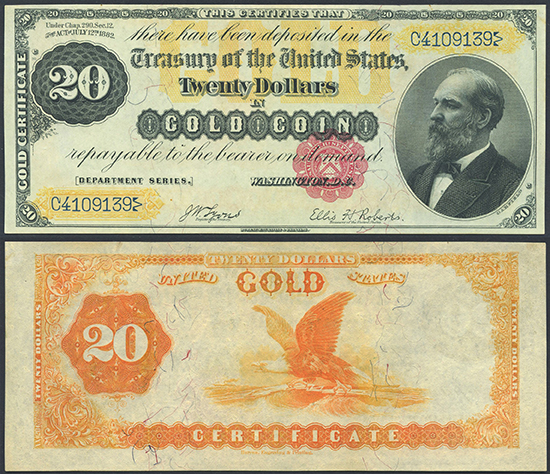
The U.S. paper money section contains federal and obsolete issues in addition to Texas, Confederate and Philippine notes. The top U.S. piece is lot 1782, an 1882 $20 gold certificate graded PCGS Apparent Gem New 65, estimated at $7,500 to $11,000. The note features then recently assassinated President Garfield on the obverse and an eagle on the reverse clutching electric bolts over the ocean, symbolizing the transatlantic telegraph lines of the time.

1782_press2

A 1882 $20 gold certificate graded PCGS Gem New 65 Apparent, estimated at $7,500 to $11,000.

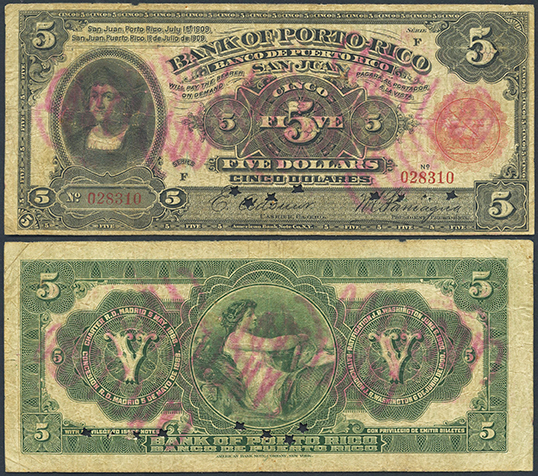
The world paper money section features a key Puerto Rican note: lot 1994, a 1909 Banco de Puerto Rico $5 graded PCGS Fine 12 and pedigreed to the Eric P. Newman collection. Newman collected Puerto Rican currency because of their close ties to U.S. history and this example, authorized just after the Spanish-American War, fits the bill. The note has an estimate of $2,000 and up.

1994_press2

A 1909 Banco de Puerto Rico $5 graded PCGS Fine 12 and pedigreed to the Eric P. Newman collection, estimated at $2,000 and up.

A high grade 1922 Canadian La Banque Nationale specimen set will also appear in the sale as lot 1845. The set features all five denominations certified by PMG in grades ranging from UNC 62 to 66 and has a $2,000 to $3,000 estimate.

1869_press2

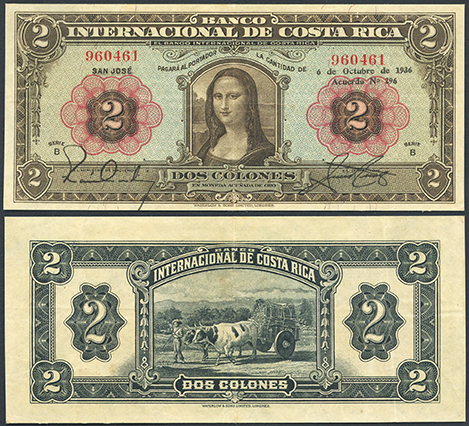
A 1936 Costa Rican 2 colones “Mona Lisa” note graded PCGS VF 30, estimated at $1,750 to $2,500.

Other important lots in the sale include:

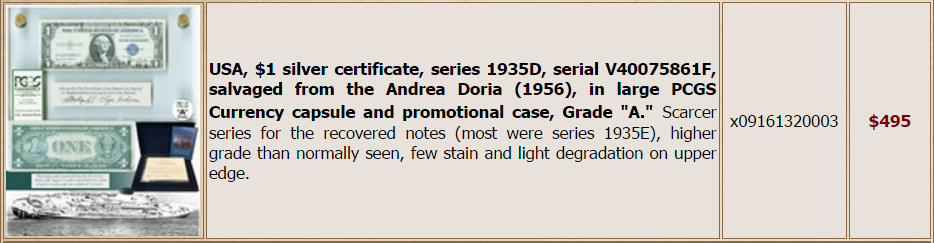
  • Lot 1786, a series 1935E $1 silver certificate “star note” graded PCGS Grade A recovered from the Andrea Doria, sunk in 1956 off Massachusetts, estimated at $500 to $750.
  • Lot 653, three British India 10 rupees recovered from the SS Camberwell, sunk in 1917 by a German mine off the Isle of Wight, England, estimated at $100 to $150.
  • Lot 1869, a 1936 Costa Rican 2 colones “Mona Lisa” note graded PCGS VF 30, estimated at $1,750 to $2,500.
  • Lot 1819, a series 1912 Philippines 50 pesos graded PCGS VF 35 Net – Toning, estimated at $1,400 to $2,100.
  • Lot 1965, a complete set of eight high grade Mexican Banco Yucateco specimens graded by PMG, estimated at $3,000 to $4,500.
  • Lot 1844, a set of five 1929 Bulgarian specimens from 200 levas to 5,000, estimated at $3,000 to $4,000.

Bidders can register for the auction at auction.sedwickcoins.com. The auction catalog is available for ordering at www.sedwickcoins.com. For more details, please contact Daniel Frank Sedwick, LLC at office@sedwickcoins.com.

Sunken luxury: the loss of the SS Andrea Doria

3 Jan

The SS Andrea Doria name invokes tragedy now, but at the time of construction, she represented the hopes of Italian recovery after World War II. Construction began in 1950 with the ship launching in June 16, 1951. In terms of size, she was 697 feet long with a 90 feet beam and had a total tonnage of 29,100 tons. When fully furnished, she represented a source of Italian pride by being one of the finest ships on the Atlantic Ocean at the time. Even her namesake, the 16th-century Genoese admiral Andrea Doria, invokes a sense of Italian maritime power.

tn_andrea_doria

The SS Andrea Doria at sea.

During her three years of service from 1953 to 1956, she had many transatlantic voyages and became popular with passengers for her luxury accommodations and quick speed. Passengers had every form of entertainment at their disposal, from movie to swimming pools, orchestras to modern artworks and mosaics. A lot of money and wealth went into the Andrea Doria, both in terms of construction and her passengers.

On the night of July 25, 1956, the Andrea Doria was on the final leg of a voyage, destined for New York City the following day. Travelling through heavy fog, the bridge officers noted a radar blip ahead. Despite taking evasive maneuvers, the distance between the two ships was too little for any meaningful actions. Out of the fog, the bow of the MS Stockholm, a Swedish American Line passenger liner, plowed into the Andrea Doria’s starboard side, leaving a gaping hole. However, safety measures kept the Andrea Doria afloat for 11 hours, long enough for the survivors to evacuate. All together, 46 people died aboard the Andrea Doria while 6 crew members of the Stockholm were killed, most during the collision itself.

The below newsreel shows images of the doomed ship in the early hours of July 26, 1956. Divers descended upon the wreck just a day after its sinking to find it lying on its starboard side at a depth of about 250 feet, far too deep for recreational diving.

Divers descended upon the wreck just a day after its sinking to find it lying on its starboard side at a depth of about 250 feet, far too deep for recreational diving. Since then, through advances in diving equipment, technical divers are able to reach the wreck.

In 1981, adventurer Peter Gimbel, his wife Elga and a salvage team uncovered the Bank of Rome safe held onboard the ship. When the safe was opened in 1984, thousands of American $1 silver certificates, hundreds of Italian bank notes as well as American Express checks were found, still preserved despite decades of submersion. The Gimbels carefully preserved and encased the banknotes in protective Lucite holders before offering them on the numismatic market. Many silver certificates and Italian lira have since been graded by PCGS Currency according to shipwreck grading standards.

img284ss

An example of a Andrea Doria recovered $1 silver certificate.

As the leading shipwreck coin and artifact dealer, Daniel Frank Sedwick, LLC has a number of $1 silver certificates recovered from the SS Andrea Doria for sale. All notes are graded “A” by PCGS Currency, meaning they are almost entirely intact (despite 30 years of saltwater immersion), with prices dependent upon the eye appeal of the note. They come in a blue case along with a DVD of their recovery by the Gimbels and their crew. To view these notes, please click on the picture below and navigate to the Andrea Doria listing:

ffadfad

Today, heavy currents, silt clouds and the depth still make the Andrea Doria a difficult wreck to dive, earning it the nickname “the Mount Everest of wreck diving.” Regardless, the allure of the ship’s luxury and artifacts still on board bring divers back again and again. For many, a dive to the SS Andrea Doria will never happen. By buying these silver certificates, anyone can own a piece of history from a ship that launched with so much promise only to become a modern tragedy.

Gallery

What You Can’t Live Without Buying in Treasure Auction #20 (part one)

21 Oct

Our upcoming Sedwick Treasure, World, U.S. and Paper Money Auction #20 has something for everyone, and I’ll outline some highlights in upcoming blogs. First off, let’s show off our paper money section, a collectible that we haven’t been able to offer in great amounts but should become a staple of future auctions thanks to the hard work and expertise of our new employee, Connor Falk.

Lot 1522, TA #20, November 2016

At first glance, this colorful 1996 Cayman Islands 10 dollar note is appealing for the beach scene on the reverse, an open treasure chest residing beneath a palm tree as a sailboat moves in the shallow waters. But there’s an interesting backstory on this note: it shouldn’t exist. The X/1 series of notes were test notes printed by De La Rue on experimental paper, analyzed and then destroyed. A small number escaped, making them among the rarest of Cayman Islands notes. Add the fact that PMG certified this note as Gem Uncirculated 65 EPQ and this lot is an impressive rarity sure to be the cornerstone of a Caribbean paper money collection.

Lot 1535, TA #20, November 2016

This 1889 100 pesos Colombian Bond is very rare with only four or five known and is the plate note featured in Compendio Historico del Papel Moneda en Colombia by Danilo Parra Ariza. It features a light blue underprint and a well-executed design including a vignette of a man with a burro cart. Other examples are known to have cancellation marks including punch holes and rhombus-shaped cuts, making this lot all the more attractive for its lack of major marks or cuts.

Lot 1536, TA #20, November 2016

This the 1889 10 pesos, similar in design as the lot above yet featuring a popular vignette of a dog.

Lot 1560 (obverse), TA #20, November 2016

Lot 1560 (reverse), TA #20, November 2016

A very scarce and popular note with a central vignette of a Carib Indian, also featured on other Guadeloupe banknotes and coins. The Caribs called Guadeloupe “Karukera” which translates to “island with beautiful waters.” Connecting with Guadeloupe’s maritime past, the reverse features a large compass rose. There are some folds and soiling, but the numerous and heavy folds that plague large notes like this one are not here, hence why PCGS certified this note as Very Fine 30.

Lot 1578 (reverse), TA #20, November 2016

Lot 1579 (obverse), TA #20, November 2016

These two Mexican notes are extremely popular and in demand due to the beautiful tri-color reverses honoring the colors of the Mexican flag. Printed to commemorate the 100th anniversary of the Mexican War of Independence, they are also the first commemorative banknotes in the world. Examples are scarce with notes in VF and higher rare while collectors give special attention to those with bright colors.
Check out Session 4 lots 1500-1623 for all of our bank note offerings.