Sedwick Auctions is thrilled to announce the successful conclusion of Treasure Auction 38, held November 13–15 at our new headquarters, with total results hitting $5 million.
Bidding shattered previous records across every major category: shipwreck coins and artifacts, gold and silver cobs, colonial coins, world coins, and rare Latin American issues.
Now we invite collectors and consignors to join our next flagship event. Consignments will be open from the beginning of December 2025 through the first week of March 2026. Mark your calendars: Our next live floor auction will take place May 6–9, 2026 at the SpringHill Suites by Marriott Winter Park, Florida.
Check our travel scheduleto consign in person or contact us to arrange a private visit at your location. We look forward to showcasing your collection in our next auction!
Lot 13 – MEXICO, Mexico City, gold cob 8 escudos “quasi-Royal,” 1714 J, “GRAT” variety with date on reverse, very rare, NGC MS 61, ex-McGregor, Flemming Plate. $ 51,000*
Lot 16 – MEXICO, Mexico City, gold cob 8 escudos, 1714 J, struck with Royal dies, very rare, NGC MS 63, finest in NGC census, ex-McGregor, Flemming Plate. $ 96,000*Lot 38 – PERU, Lima, gold cob 8 escudos, 1712 M, flipover double-strike, NGC MS 64 (1715 Fleet Shipwreck Label), ex-McGregor.$ 39,000*
Lot 44 – PERU, Lima, gold cob 4 escudos, 1712 M, rare, NGC MS 63 (1715 Fleet Shipwreck Label), “top pop,” ex-McGregor. $ 42,000*
Lot 79 – Atocha large silver ingot 296 from Potosí, Class Factor 1.0, 86 lb 5.44 oz troy, marked with mint/date Po1621, (1622). $ 90,000*
Lot 319 – Ex-Whydah Wreck – Mexico City, cob 4 reales, Philip V, (J), style of 1712-14, very rare provenance.$ 27,600*
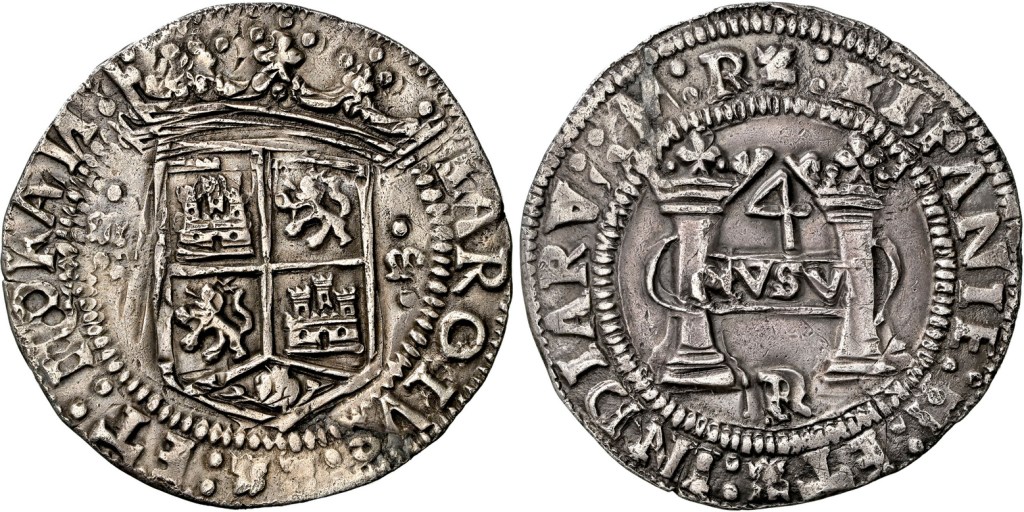
Lot 518 – MEXICO, Mexico City, 4 reales, Charles-Joanna, “Early Series,” assayer Latin R over Gothic R (Rincón), NGC AU 50, ex-Sedwick-Downing $ 45,000*
Lot 932 – COLOMBIA, Bogotá, pillar 8 reales, Ferdinand VI, 1759 JV, very rare, NGC AU 53, ex-Patterson (cover). $ 42,000*Lot 954 – CUBA, struck at the Gorham Mint, proof 1 peso, 1898, NGC PF 63, “top pop.”$ 36,000*
Lot 966 – DOMINICAN REPUBLIC, pattern 10 reales in solid silver, 1855, extremely rare, NGC MS 62, ex-Whittier (cover), ex-Byrne, KM Plate. $ 78,000*
Lot 1125 – MEXICO, Mexico City, pillar 8 reales, Philip V, 1732 F, three mouldings atop right pillar, very rare, NGC AU 58, ex-Ortiz $ 156,000*
Lot 1161 – PANAMA, cob ½ real, Philip II, assayer P-M,, extremely rare, NGC mint error AU 50 / flipover double struck. $ 31,200*
Lot 1166 – PANAMA, struck at the Philadelphia mint, proof 50 centésimos, 1904, very rare, NGC PF 63. $ 96,000*
Lot 1167 – PANAMA, copper-nickel 2½ centésimos, 1918, very rare, NGC MS 63 ex-Stuart, finest known.$ 36,000*
Lot 1516 – Gold and red-coral rosary, ex-1715 Fleet. $ 60,000*
The S.B. Pulaski represents one of the earliest of major U.S. shipwrecks to be salvaged and the coins recovered provide a fascinating glimpse back in time to late-1830s America.
The Pulaski explodes; from page 170 of the book The Tragedy of the Seas; or, Sorrow on the ocean, lake, and river, from shipwreck, plague, fire and famine (1848) by Charles Elms
The ship began her brief life in 1837 at the shipyard of John A. Robb located in Fell’s Point, Baltimore, Maryland. Built for the Savannah & Charleston Steam Packet Company, she was a steam packet meant for carrying passengers, cargo, and mail up and down the East Coast. In an interesting historical connection, the shipbuilder John A. Robb also constructed the famous S.S. Republic (launched in 1853 as the S.S. Tennessee), which also ran an East Coast route until her sinking in 1865 with a cargo of gold and silver coins.
The Pulaski was a brand-new and luxurious ship, affording her passengers a comfortable journey. She was favored by wealthy Southern families and businessmen whenever they needed to travel from the South up to the North and back again. Her cargo holds held trade goods and U.S. Post Office mail packets, earning further revenue for her owners.
The Pulaski’s voyage on June 14, 1838, started off normally. She had departed Charleston, South Carolina, at 6 AM, having come up from Savannah, Georgia. Captain John Dubois commanded the ship with a crew of 36 and with around 150 passengers aboard. Now bound for Baltimore, Maryland, the passengers settled in for a day heading out to sea.
At 10 o’clock that night, the Pulaski was about 40 miles off the coast of North Carolina, sailing north at a steady clip in moderate seas. The First Mate, Mr. Hibberd, had charge of the ship and was pacing the promenade deck. As he later told the Wilmington Observer, he “found himself shortly after upon the main deck, lying between the mast and side of the boat.”
Regaining consciousness, Hibberd headed to the midships. There, he found the head of the starboard boiler blown out and the decks above torn apart. The hull was also damaged and Hibberd observed water rushing in whenever the ship heeled to starboard. Later accounts would blame the ship’s engineer for the explosion by letting the boilers run dry then refilling them with cold seawater while hot.
The boiler explosion killed many passengers and crew instantly in their cabins. Captain Dubois was lost, presumed killed in the explosion. First Mate Hibberd began launching the lifeboats, initially telling passengers they were to inspect the ship’s hull, so as not to raise a panic. One of the lifeboats was in poor condition due to sun exposure; after several attempts to bail it out, it capsized. The other two lifeboats, loaded with 21 survivors including First Mate Hibberd, stayed near the Pulaski until it broke up and sank just 45 minutes after the explosion.
The 21 survivors in the two lifeboats made their way to the North Carolina shore. After paddling north for some time, hoping to find a way into the intercoastal waterway, they attempted to land on the beach. The rough waves overturned the first lifeboat near shore and five of the eleven survivors on board that boat drowned in the surf. Three hours later, the second lifeboat made a successful landing. The survivors then made their way to Stump Sound where a local took them in. Two days later, First Mate Hibberd and two other passengers left for Wilmington where they reported Pulaski’s sinking. They were initially thought to be the only survivors of the wreck.
On the morning of Tuesday, June 19, the crew of the schooner Henry Camerdon came across a sight: a large portion of the deck of the S.B. Pulaski, barely afloat, containing 23 survivors. Once taken aboard, the survivors mentioned another piece of the wreck was floating nearby with more survivors. An hour later, the Henry Camerdon rescued a further seven survivors who were clinging to a piece of the wreck. The survivors, suffering from exposure and dehydration over four days, were brought back to Wilmington. The Fayetteville Observer newspaper then reported that a further thirteen survivors had come ashore at New Inlet. Of the 37 crew and over 150 passengers aboard, 59 were saved.
The Newbernian newspaper of New Bern, North Carolina, eulogized those who died in the S.B. Pulaski sinking in their Friday, June 29, 1838, edition as follows:
“Dreadful Steam Boat Disaster!
“Thus have we hurriedly sketched the most painful catastrophe that has ever occurred upon the American coast. Youth, age, and infancy have here been cut off in a single night, and found a common death under the same billow.
“Days, months, years and ages will circle away, and still the vast waters will over them roll.”
It wasn’t until 2017 that the wreck site of the S.B. Pulaski was located. Discovered by Swordfish Partners, the salvors filed an admiralty claim on the then unknown wreck. In partnership between Blue Water Ventures International and Endurance Exploration, the salvage work began with the main goal of definitively identifying the wreck. Divers sent down to the 120 foot-deep site found a scattered wreck covered in several feet of sand. In early 2018, a single brass tag was found bearing the name S.B. Pulaski.
With the wreck thus confirmed as the Pulaski, salvage began in earnest. Over the course of a few salvage seasons, many small artifacts such as silverware, pocket watches, and jewelry were found. Several larger artifacts found included ship’s tackle and a silver religious altar decoration.
Silver and gold U.S. coins were also discovered along with world coins that circulated in the United States during the 1830s. However, unlike the famous S.S. Central America, S.S. Brother Jonathan, or S.S. Republic, which mainly carried coins as their cargo, vast quantities of coins were never found on the S.B. Pulaski. The few recovered coins were all pocket change from the passenger and crew, representing a sample of coins found in circulation at the time. Thus, every coin from the S.B. Pulaski has a very real connection to those who sailed on her during her final voyage.
For me, beauty and interest outweigh value, although it’s satisfying when the first two intersect with the third. Years ago, I started researching a robust field of coins, the Charles and Joanna coinage of Mexico City, and my interest was quickly piqued. Not only was the story of the first mint in the New World compelling, but the coins minted there were extremely well struck and beautiful, unlike many of the coins that came after that period. I was also taken with the simple “castles and lions” shield on one side and “pillars and waves” motif on the other.
Like any hobbyist who aspires to fill in his or her collection in a purposeful way, I learned as much as I could about the coins that had caught my attention. I bought a copy of Robert A. Nesmith’s 1955 book, The Coinage of the First Mint of the Americas at Mexico City, 1536-1572, and read it cover to cover. It’s still a great reference 70 years after publication! I read the transcript of the Tello de Sandoval investigation into possible mint improprieties during the tenure of assayer G, Juan Gutiérrez, which gave me a lot of information about the inner workings of the mint and who was there. I read about Hernán Cortés’ conquest of the Aztecs, which set the stage for a mint to be established in Mexico in 1536. I read about the Spanish monarchy to know why the coins bear the names of two rulers: Charles and Joanna. The former was the son of the latter, who by all accounts was crazy and certainly wasn’t capable of ruling over an empire. It was like a soap opera!
I began to keep census of all the varieties of all the denominations of coins from what Nesmith termed the “Early Series” and the “Late Series” assayers. The pinnacle of my work came when we were privileged to handle the sale of the Clyde Hubbard collection of Mexican Charles and Joanna coins, several of which were plate coins in Nesmith’s book.
My collection is not exhaustive because I decided early on to concentrate on rare and sometimes unique varieties and smaller denominations, which are harder to find. I never chased grades because I find it more important to have a coin in whatever condition it was found if there are only one or two known. There are so many varieties that you could spend a lifetime trying to acquire each one! Like the coins, I hope the results of my years-long study—which should be available soon and will feature most of the coins in my collection—helps further interest by avid collectors and people like me who just happen to find these coins beautiful.
This exceptionally broad-flan four reales coin represents one of the earliest issues under Francisco del Rincón, the first assayer of the Mexico City Mint. Bearing a doubled R/R mark at the base of the pillars, it displays a bold strike with clear legends and a rich toning. The coin’s design—castles and lions on one side, pillars and waves on the other—captures the aesthetic ideals of the Early Series. Its die pairing reveals the reuse of shield dies by subsequent assayers, underscoring continuity in early minting practice. Pedigreed to the Sedwick–Downing Collection and graded NGC AU 50, it remains one of the finest known examples of the Rincón type.
Among the rarest of the entire Charles and Joanna series, this 4 reales piece struck by the elusive Assayer F is both a Nesmith Plate Coin and a former holding of the Huntington Collection at the Hispanic Society of America. The issue, known by very few specimens, is distinguished by full legends, golden toning, and only minor surface corrosion. As one of the rarest assayers represented, it has been used in modern die-linkage studies to clarify the chronological sequence of early mint operations. The specimen is a cornerstone piece for understanding the earliest evolution of mint production following Rincón’s tenure.
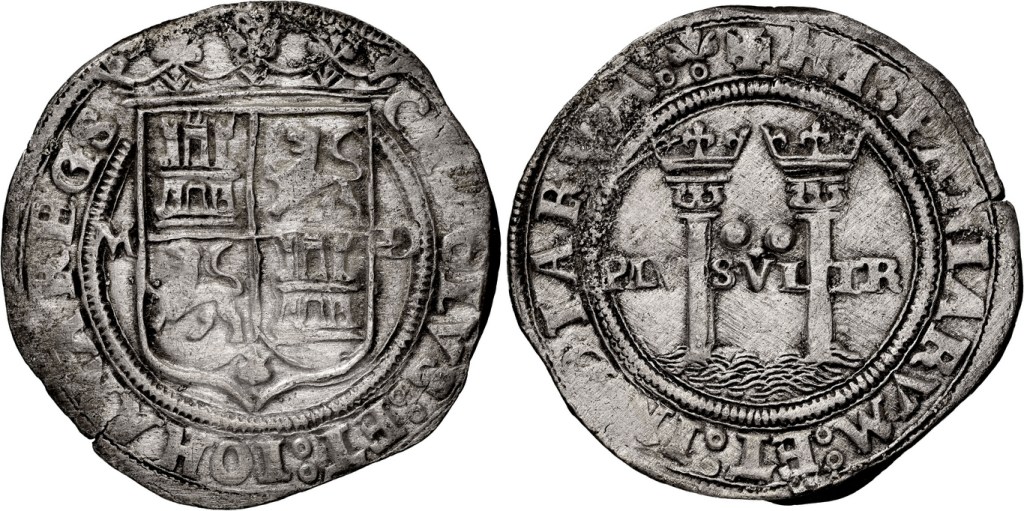
This unique 2 reales coin exhibits an unprecedented rhomboid motto panel enclosing the inscription PLVS. The specimen, attributed to Assayer Rincón, is the only known example of its kind, pairing a rhomboid design with Gothic lettering and a later die used by Assayer P. Its discovery bridges stylistic transitions within the Early Series, providing crucial evidence of experimentation at the Mexico City Mint during the late 1530s. The coin’s rarity and stylistic innovation make it one of the collection’s most academically valuable pieces.
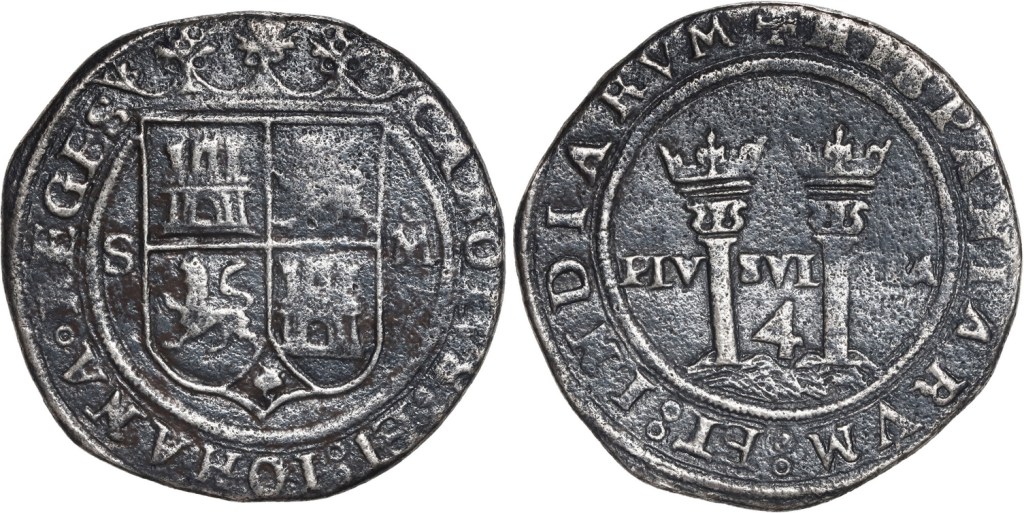
This 1 real coin represents a transitional issue showing evidence of an over-assayer strike, in which an earlier die from Assayer F was repurposed under Gutiérrez. The piece features full interiors, deep toning, and minimal wear. Its die linkage to both preceding and subsequent issues makes it a key specimen for understanding the mint’s workflow and reusability of dies. Such examples are indispensable for reconstructing chronological mint sequences of the Early Series.
A rare survivor of the 1554 Spanish Fleet wrecked off Padre Island, Texas, this 4 reales piece from the rare Assayer S illustrates the culmination of the Charles and Joanna coinage before the reforms of Philip II. Its well-preserved surfaces and dark patina testify to its maritime provenance. Few coins of this assayer are known, and its presence in this collection adds both archaeological and numismatic significance. Graded NGC VF details, it is one of the most compelling shipwreck-related specimens of the Late Series.
This intriguing 2 reales coin from the Late Series displays the assayer’s initial G punched upside down—a remarkable minting blunder known in only eight examples. The coin is cited in Dr. Peter Jones’s *The First Coins of the Americas* (2020) and is considered among the best preserved of its type. Its existence underscores the human variability inherent in early minting, as well as the challenges faced by the Mexico City engravers in maintaining die consistency under growing production demands.
This auction brings together one of the most complete and exciting selections we have ever offered, combining important named collections with individual rarities from all across the world of numismatics. The result is a sale that captures the full story of coinage in the Americas and beyond. As usual, it is consignors and bidders who make this possible, so we thank you all!
Our business was built on cobs and shipwreck treasure, for which we remain the world’s foremost experts, so it is no surprise that this auction is loaded with shipwreck ingots, coins, and artifacts. We run a very clean operation—everything is checked carefully for proper provenance and certification, and in most cases the material we offer comes straight from the source. In fact, our auctions are better than buying from the source directly, as everything we sell is guaranteed and certifiable at any time. In today’s fly-by-night world, this is a critical difference.
First, it is our privilege to presen the Sedwick-Downing Collection of Charles-Joanna Coinage of Mexico City, the result of more than a decade of study and collecting. What began as curiosity grew into a deep passion for the beauty, history, and meaning behind the first coins of the New World. This catalog marks an important milestone in that journey, with the full publication of Cori’s research to follow soon.
For this auction, we hit the ground running with the McGregor Collection of Gold Cobs from the 1715 Fleet, a vivid reminder of the beauty and adventure tied to Spanish colonial treasure. While this collection showcases a full range of denominations of gold cobs from Mexico City (including a fabulous Royal-dies 1714 8 escudos) and Lima, it also contributes to significant offerings from Cuzco and Cartagena, the latter including a coin that will be featured in Daniel Sedwick’s upcoming book, Arce’s Doubloons. Of course, our treasure coverage is certainly not limited to Spanish colonial cobs. In fact, in this sale we feature all of the famous United States shipwrecks, namely S.B. Pulaski (1838), S.S. New York (1846), S.S. Central America (1857), S.S. Brother Jonathan (1865), and S.S. Republic(1865).
Highlighting our usual silver-cob offerings are several key collections, in addition to the aforementioned Sedwick–Downing Collection. In Lima cobs you will find theJorge Ugaz Collection of Lima Cob 2 Reales, and in Guatemala cobs is the Darby Collection of Guatemala Cobs, both the result of decades of study and selectivity by devoted specialists. As always, “Royals” (galanos) steal the attention in all three cob sections (Mexico, Lima, Potosí), including a unique Mexican 4 reales Royal dated 1612/1, expanding the cob market into a rarified level of special pieces for truly dedicated collectors.
Outside of cobs, this auction presents an enviable selection of Latin American trophy coins, including two concentrated collections in Chile (the Val y Mexía Collection of Chilean Bust 4 Reales) and Peru (the Almenara Collection of Peruvian Republic Gold Coins), plus key rarities in Spanish colonial pillar dollars (Mexico 1732 and Nuevo Reino 1759), Cuba (unique Guanabacoa medal dated 1747 plus many rare or unique modern proofs), Dominican Republic (10 reales silver pattern 1855), and Panama (1904 proof set), and a veritable panoply of types from around the world, not just the Americas (including some key U.S. coins) but also Europe, Asia, and even Africa. The mix extends from ancients and early hammered types to classic milled crowns and gold issues, all the way to modern proofs, and every section offers key pieces selected for rarity and quality in a range that rarely appears at auction.
The other side of numismatics is paper money, and in Latin America we continue a strong auction presence, here with a selection of incredibly rare and high-grade Dominican Republic notes issued between 1857 and 1865, all new to the market.
Finally, our auctions are unique for offering treasures in coin jewelry and shipwreck artifacts in a wide range of time periods (over two centuries), particularly from the Atocha (1622), Concepción (1641), Bannister’s pirate ship Golden Fleece (1686), 1715 Fleet, and S.S. Central America(1857).
As yet another exciting auction from the Sedwick company, this one is sure to get everyone’s collecting juices flowing, demonstrating that numismatics and treasure transform history and artistry into excitement and positive human collaboration, something our world can surely use more of today.
The Sedwick & Associates, LLC team:
Daniel Sedwick, Augi García-Barneche, Cori Sedwick Downing, Connor Falk,
Michelle Heidt, and Sarah Sproles
Live on the Internet, Thursday-Saturday, November 13, 14, & 15, 2025
Sedwick Auction 37 delivered exceptional results, marked by record-breaking prices for standout rarities and a stellar performance by the Almenara Collection of gold coins from Potosí and Lima. With finest known examples, multiple provenances, and strong historical significance, these colonial treasures drew intense bidding, reaffirming the market’s focus on rarity, condition, and pedigree.
The results confirmed a trend we’ve observed across recent sales: this is a market driven by knowledgeable and discerning collectors—those who seek out the most important pieces and are willing to compete for them. From rare milled coinage to hand-struck cobs, buyers responded strongly to top-tier material. Shipwreck coins continued their momentum, with rising prices across the board and sustained interest from collectors who value both history and preservation.
At the same time, Auction 37 offered meaningful opportunities for new and mid-level collectors. Strong bidding across a range of price points demonstrated that there is still room for growth and participation at all levels, making this auction a success not only for established specialists but also for newcomers with a passion for numismatics.
This auction also marked a special milestone—it was the first time we hosted a live sale in our new offices. The in-house event brought together collectors, consignors, and guests for an exclusive and memorable experience.
Over the course of six sessions held from May 7 to 9 at our offices in Maitland, Florida, the following highlights unfolded:
Lot 92 Large silver ingot 728 from Potosí, Class Factor 1.0, 76 lb oz troy, marked with dated 1621 – $66,000*
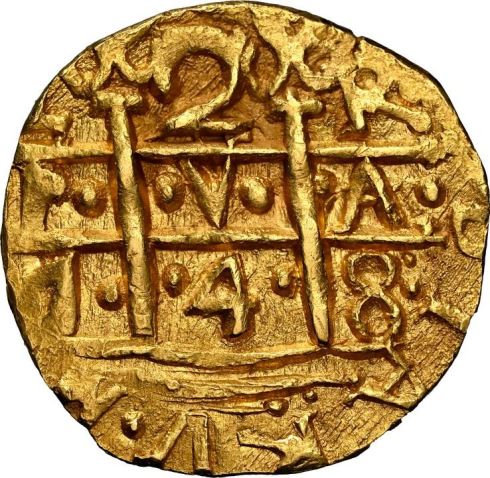
Lot 46 PERU, Lima, gold cob 2 escudos, 1748 R, very rare, NGC MS 65, finest and only example in NGC census – $39,000*
Lot 495 MEXICO, Mexico City, 3 reales, Charles-Joanna, “Early Series,” assayer Rincón – $48,000*
Lot 1037 SANTO DOMINGO, 4 reales, Charles-Joanna, “Early Series,” assayer F to left – $75,000*
Lot 1026 COSTA RICA, San José, gold 20 pesos, 1873 GW, very rare, NGC UNC details – $54,000*
Lot 848 BOLIVIA, Potosí, gold bust 2 escudos, Charles IV (bust of Charles III) 1789 PR AU 58, finest – $48,000*
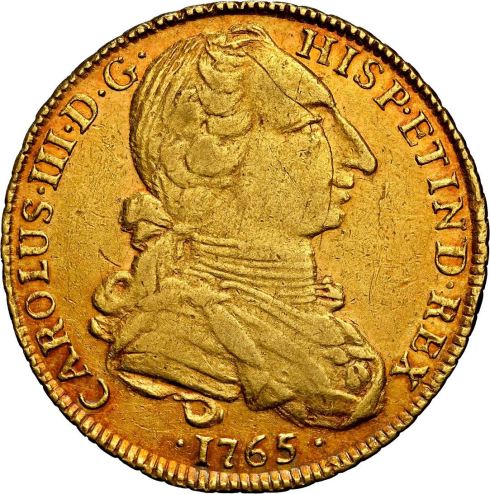
Lot 1216 PERU, Lima, gold bust 4 escudos, Charles III, 1765 JM, second bust (“rat nose”), very rare – $42,000*
Lot 1399 PHILIPPINES, GUAM, and the MARIANA ISLANDS (Spanish East Indies), cast 2 Reales-sized Proclamation – $45,000*
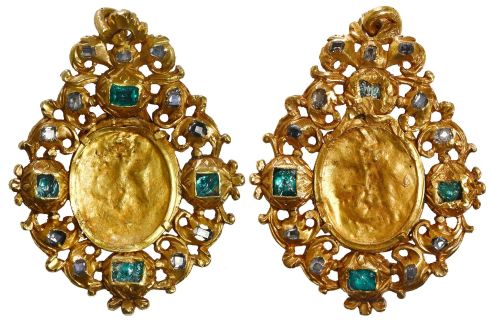
Lot 1665 Gold pendant with diamonds and emeralds, ex-Tolosa (1724), Borrell Plate, Smithsonian Plate – $42,000*
Given the exclusive nature of our auctions, now is the perfect time to start thinking about consigning your collection or select coins for future sales. We thank our consignors and bidders for continuing to choose Sedwick Auctions. More great things are coming soon!









 Our business was built on cobs and shipwreck treasure, for which we remain the world’s foremost experts, so it is no surprise that this auction is loaded with shipwreck ingots, coins, and artifacts. We run a very clean operation—everything is checked carefully for proper provenance and certification, and in most cases the material we offer comes straight from the source. In fact, our auctions are better than buying from the source directly, as everything we sell is guaranteed and certifiable at any time. In today’s fly-by-night world, this is a critical difference.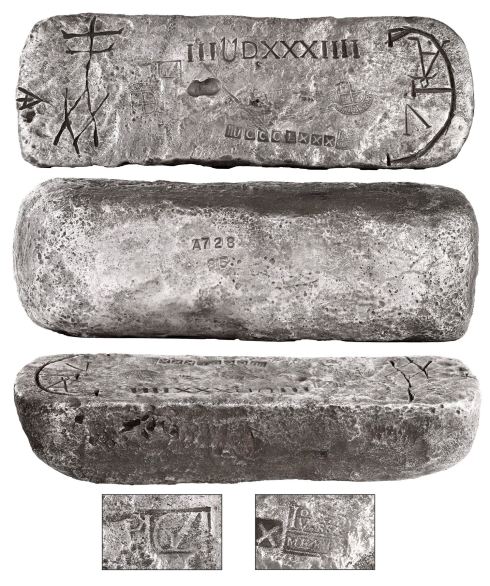






 Numismatic News
 SEDWICKCOINS BLOG