A 300-year-old Spanish colonial gold coin recovered from a 1715 Plate Fleet shipwreck and donated during the Salvation Army’s 2016 Holiday Red Kettle campaign will be auctioned on May 3, 2017.
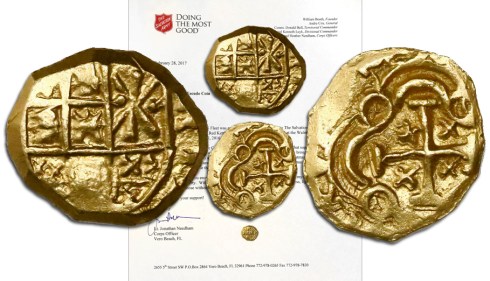
The Bogota cob 1 escudo recovered from the 1715 Fleet and donated to the Salvation Army in December of 2016.
The coin will appear as lot 46 in Daniel Frank Sedwick, LLC’s Treasure, World, U.S. Coin and Paper Money Auction #21, held May 3-4 online at auction.sedwickcoins.com. The lot is estimated at $2,000 to $3,000. The Salvation Army will receive the full final hammer price from the sale.
Also included with the coin is a letter on its provenance from Lt. Jonathan Needham, corps officer of the Salvation Army of Vero Beach, as well as the case the coin was donated in.
The gold escudo was anonymously handed to volunteer bell ringer Jim Bessey on Dec. 23, 2016 outside of a Sebastian, Fla. Walmart store. The donation made national news as one of the more interesting pieces given to the Salvation Army during the holiday season.
The donated coin was minted at the Spanish colonial mint in Bogota, Colombia sometime between 1700 and 1715 as a posthumous issue of King Charles II (1661-1700).
In 1715, the escudo, along with many others, was shipped aboard the 1715 Plate Fleet, one of the largest treasure fleets of its time. Several ships from the fleet sank during a storm off the east coast of Florida. Much of the treasure remained on the ocean floor until modern day salvage operations recovered many coins and artifacts, which are in demand on the collectibles market.
Rare U.S., world and even shipwreck recovered bank notes will appear in Daniel Frank Sedwick, LLC’s Treasure, World, U.S. Coin and Paper Money Auction 21. The sale will be held live online on May 3-4 at auction.sedwickcoins.com.
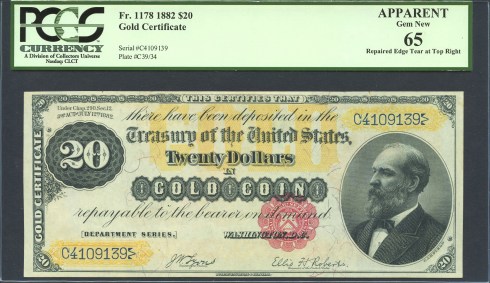
The U.S. paper money section contains federal and obsolete issues in addition to Texas, Confederate and Philippine notes. The top U.S. piece is lot 1782, an 1882 $20 gold certificate graded PCGS Apparent Gem New 65, estimated at $7,500 to $11,000. The note features then recently assassinated President Garfield on the obverse and an eagle on the reverse clutching electric bolts over the ocean, symbolizing the transatlantic telegraph lines of the time.
A 1882 $20 gold certificate graded PCGS Gem New 65 Apparent, estimated at $7,500 to $11,000.
The world paper money section features a key Puerto Rican note: lot 1994, a 1909 Banco de Puerto Rico $5 graded PCGS Fine 12 and pedigreed to the Eric P. Newman collection. Newman collected Puerto Rican currency because of their close ties to U.S. history and this example, authorized just after the Spanish-American War, fits the bill. The note has an estimate of $2,000 and up.
A 1909 Banco de Puerto Rico $5 graded PCGS Fine 12 and pedigreed to the Eric P. Newman collection, estimated at $2,000 and up.
A high grade 1922 Canadian La Banque Nationale specimen set will also appear in the sale as lot 1845. The set features all five denominations certified by PMG in grades ranging from UNC 62 to 66 and has a $2,000 to $3,000 estimate.
A 1936 Costa Rican 2 colones “Mona Lisa” note graded PCGS VF 30, estimated at $1,750 to $2,500.
Other important lots in the sale include:
Lot 1786, a series 1935E $1 silver certificate “star note” graded PCGS Grade A recovered from the Andrea Doria, sunk in 1956 off Massachusetts, estimated at $500 to $750.
Lot 653, three British India 10 rupees recovered from the SS Camberwell, sunk in 1917 by a German mine off the Isle of Wight, England, estimated at $100 to $150.
Lot 1869, a 1936 Costa Rican 2 colones “Mona Lisa” note graded PCGS VF 30, estimated at $1,750 to $2,500.
Lot 1819, a series 1912 Philippines 50 pesos graded PCGS VF 35 Net – Toning, estimated at $1,400 to $2,100.
Lot 1965, a complete set of eight high grade Mexican Banco Yucateco specimens graded by PMG, estimated at $3,000 to $4,500.
Lot 1844, a set of five 1929 Bulgarian specimens from 200 levas to 5,000, estimated at $3,000 to $4,000.
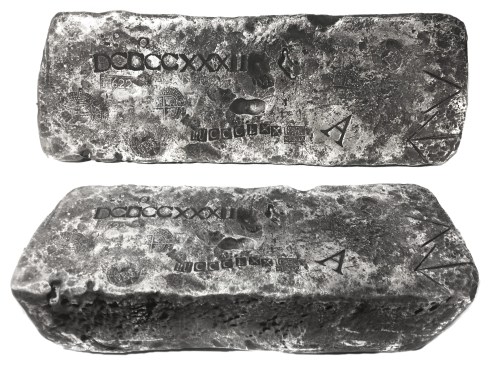
A massive 83 troy-pound, 7.52 troy-ounce silver bar recovered from the shipwreck of the Atocha and estimated at $35,000-up is just one of many treasures to appear in Daniel Frank Sedwick, LLC’s Treasure, World, U.S. Coin and Paper Money Auction 21. The online live auction will be held May 3-4 at www.auction.sedwickcoins.com. Lots can be previewed on the site in the first week of April.
An 83 troy-pound, 7.52 troy-ounce silver bar from the Atocha
The large silver bar comes from one of the richest Spanish treasure galleons lost at sea, the Atocha, which sank in 1622 west of Key West, Florida. One month after sinking, a hurricane scattered the wreck, preventing the Spanish authorities from recovering its treasure. However, modern salvage operations conducted by Mel Fisher in the 1970s uncovered approximately 1,000 silver ingots and over 100,000 shield-type cobs. Coins from the Atocha will be offered in the Sedwick auction as well.
A gold and red-coral rosary recovered from the Atocha, photo credit to Carol Tedesco, Key West, FL
Another treasure find from the Atocha appearing in the auction is a gold and red-coral rosary. The rosary was featured in the June 1976 issue of National Geographic Magazine and is pedigreed to a 1988 Christie’s auction. The rosary is estimated at $25,000-up.
Other top lots include:
A 1713 Mexico gold 8 escudo from the 1715 Fleet, graded NGC MS 66, estimated at $15,000-up
An MS 66 1713 Mexico gold 8 escudos from the 1715 Fleet
An NGC-graded denomination set of gold Lima escudos dated 1710 recovered from the 1715 Fleet, estimated at $30,000 to $50,000 total
A Bogota gold 1 escudo recovered from the 1715 Fleet and famously placed in a Salvation Army red kettle during the 2016 holiday season, estimated at $2,000 to $3,000
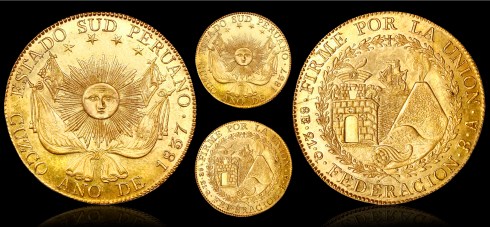
An 1837 Cuzco gold 8 escudos, graded NGC MS 64 and tied for finest known, estimated at $20,000 to $30,000
An MS 64 1837 Cuzco gold 8 escudos
A 35 troy-pound, 1.81 troy-ounce silver bar from the Maravillas shipwreck of 1656, estimated at $10,000 to $15,000
Four silver bars recovered from the “Tumbaga Wreck” (ca. 1528)
Over 200 Central American coins pedigreed to the Richard Stuart Collection
An 1882 $20 Gold Certificate, graded PCGS UNC 65 – Repaired Edge Tear, estimated $8,000 to $12,000
A PCGS Gem New 65 Apparent – Repaired Edge Tear at Top Right 1882 $20 Gold Certificate
There was a notable buzz at the recent Florida United Numismatists (FUN) coin show held Jan. 5-8 at the Broward County Convention Center in Fort Lauderdale, Fla.
A young collector, Jacquelyn Proctor, reviews our selection of shipwreck coins.
The show was busy, especially on Thursday, where sales and purchases were made all the way up to closing time, said Daniel Sedwick.
“We experienced a large volume of sales despite the incident at the Fort Lauderdale Airport on Friday,” he said. “We bought and sold well across all world coin sectors and paper money.”
Other dealers commented on the increase in motivated buyers, saying collector confidence in the economy and the numismatics market was on the rise.
The show’s timing also mattered, said Augi Garcia.
“The fact that the New York International Numismatic Convention (NYINC) and the FUN show are not conflicting for the first time in several years gave a new air to the show,” he said. “Overseas dealers that only go to NYINC were at FUN this time and making purchases.”
Areas of particular collector interest include shipwreck coins. Coins recovered from the 1715 Plate Fleet did well due to the historical connection between Florida and the Fleet. Our friends with the 1715 Fleet Society were in attendance and hosted a group dinner which we attended on Thursday night.
Gold cobs were hot but new supplies from Europe allowed us to refill our inventory. Expect to see them on our online store soon.
A number of bank notes sold, and we purchased many more at the show. A number of Latin American reverse proofs from the American Bank Note Company are new additions to our inventory.
Ben Costello, the 1715 Fleet Society director, spoke at the group’s dinner.
Many interesting consignments came in during the show for our Treasure, World, U.S. Coin and Paper Money Auction #21. We obtained many fascinating shipwreck coins and artifacts during the show, but can always use more. If you’d like to consign to the next auction, please email us at office@sedwickcoins.com or call us at 407-975-3325.
In a closing note, our thoughts go out to all those affected by the shooting incident at the Fort Lauderdale Airport. Special thanks to the Broward County Police and Sheriff’s Departments for providing security and presence in the area.
Our next trip will take us to the NYINC show on Jan. 12-15 in New York, followed by the Treasure Coast Coin Show on Jan. 14-15 in Vero Beach, Fla., and the Long Beach Expo on Feb. 16-18 in Long Beach, Calif. We hope to see you there!
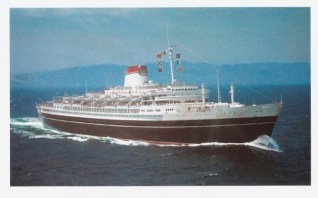
The SS Andrea Doria name invokes tragedy now, but at the time of construction, she represented the hopes of Italian recovery after World War II. Construction began in 1950 with the ship launching in June 16, 1951. In terms of size, she was 697 feet long with a 90 feet beam and had a total tonnage of 29,100 tons. When fully furnished, she represented a source of Italian pride by being one of the finest ships on the Atlantic Ocean at the time. Even her namesake, the 16th-century Genoese admiral Andrea Doria, invokes a sense of Italian maritime power.
The SS Andrea Doria at sea.
During her three years of service from 1953 to 1956, she had many transatlantic voyages and became popular with passengers for her luxury accommodations and quick speed. Passengers had every form of entertainment at their disposal, from movie to swimming pools, orchestras to modern artworks and mosaics. A lot of money and wealth went into the Andrea Doria, both in terms of construction and her passengers.
On the night of July 25, 1956, the Andrea Doria was on the final leg of a voyage, destined for New York City the following day. Travelling through heavy fog, the bridge officers noted a radar blip ahead. Despite taking evasive maneuvers, the distance between the two ships was too little for any meaningful actions. Out of the fog, the bow of the MS Stockholm, a Swedish American Line passenger liner, plowed into the Andrea Doria’s starboard side, leaving a gaping hole. However, safety measures kept the Andrea Doria afloat for 11 hours, long enough for the survivors to evacuate. All together, 46 people died aboard the Andrea Doria while 6 crew members of the Stockholm were killed, most during the collision itself.
The below newsreel shows images of the doomed ship in the early hours of July 26, 1956. Divers descended upon the wreck just a day after its sinking to find it lying on its starboard side at a depth of about 250 feet, far too deep for recreational diving.
Divers descended upon the wreck just a day after its sinking to find it lying on its starboard side at a depth of about 250 feet, far too deep for recreational diving. Since then, through advances in diving equipment, technical divers are able to reach the wreck.
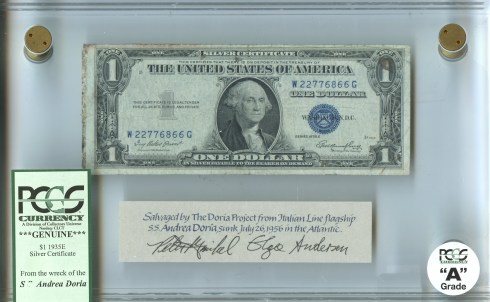
In 1981, adventurer Peter Gimbel, his wife Elga and a salvage team uncovered the Bank of Rome safe held onboard the ship. When the safe was opened in 1984, thousands of American $1 silver certificates, hundreds of Italian bank notes as well as American Express checks were found, still preserved despite decades of submersion. The Gimbels carefully preserved and encased the banknotes in protective Lucite holders before offering them on the numismatic market. Many silver certificates and Italian lira have since been graded by PCGS Currency according to shipwreck grading standards.
An example of a Andrea Doria recovered $1 silver certificate.
As the leading shipwreck coin and artifact dealer, Daniel Frank Sedwick, LLC has a number of $1 silver certificates recovered from the SS Andrea Doria for sale. All notes are graded “A” by PCGS Currency, meaning they are almost entirely intact (despite 30 years of saltwater immersion), with prices dependent upon the eye appeal of the note. They come in a blue case along with a DVD of their recovery by the Gimbels and their crew. To view these notes, please click on the picture below and navigate to the Andrea Doria listing:
Today, heavy currents, silt clouds and the depth still make the Andrea Doria a difficult wreck to dive, earning it the nickname “the Mount Everest of wreck diving.” Regardless, the allure of the ship’s luxury and artifacts still on board bring divers back again and again. For many, a dive to the SS Andrea Doria will never happen. By buying these silver certificates, anyone can own a piece of history from a ship that launched with so much promise only to become a modern tragedy.









 SEDWICKCOINS BLOG