Tag Archives: History

Collecting Mexican Charles-Joanna Coinage: My Journey

14 Oct

by Cori Sedwick Downing

Collector: someone who collects objects because they are beautiful, valuable, or interesting.

Direct link to the Collection

For me, beauty and interest outweigh value, although it’s satisfying when the first two intersect with the third. Years ago, I started researching a robust field of coins, the Charles and Joanna coinage of Mexico City, and my interest was quickly piqued.  Not only was the story of the first mint in the New World compelling, but the coins minted there were extremely well struck and beautiful, unlike many of the coins that came after that period. I was also taken with the simple “castles and lions” shield on one side and “pillars and waves” motif on the other.

Like any hobbyist who aspires to fill in his or her collection in a purposeful way, I learned as much as I could about the coins that had caught my attention. I bought a copy of Robert A. Nesmith’s 1955 book, The Coinage of the First Mint of the Americas at Mexico City, 1536-1572, and read it cover to cover. It’s still a great reference 70 years after publication! I read the transcript of the Tello de Sandoval investigation into possible mint improprieties during the tenure of assayer G, Juan Gutiérrez, which gave me a lot of information about the inner workings of the mint and who was there. I read about Hernán Cortés’ conquest of the Aztecs, which set the stage for a mint to be established in Mexico in 1536. I read about the Spanish monarchy to know why the coins bear the names of two rulers: Charles and Joanna. The former was the son of the latter, who by all accounts was crazy and certainly wasn’t capable of ruling over an empire. It was like a soap opera!

I began to keep census of all the varieties of all the denominations of coins from what Nesmith termed the “Early Series” and the “Late Series” assayers. The pinnacle of my work came when we were privileged to handle the sale of the Clyde Hubbard collection of Mexican Charles and Joanna coins, several of which were plate coins in Nesmith’s book.

My collection is not exhaustive because I decided early on to concentrate on rare and sometimes unique varieties and smaller denominations, which are harder to find. I never chased grades because I find it more important to have a coin in whatever condition it was found if there are only one or two known. There are so many varieties that you could spend a lifetime trying to acquire each one! Like the coins, I hope the results of my years-long study—which should be available soon and will feature most of the coins in my collection—helps further interest by avid collectors and people like me who just happen to find these coins beautiful.

Selected Featured Lots:
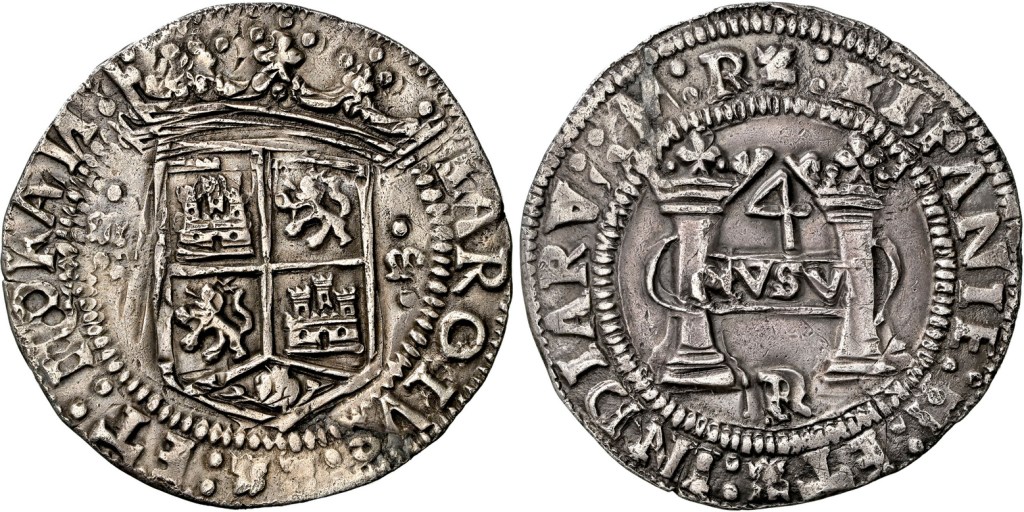
Lot 518 – 4 Reales, Early Series, Assayer R/R (Francisco del Rincón)

This exceptionally broad-flan four reales coin represents one of the earliest issues under Francisco del Rincón, the first assayer of the Mexico City Mint. Bearing a doubled R/R mark at the base of the pillars, it displays a bold strike with clear legends and a rich toning. The coin’s design—castles and lions on one side, pillars and waves on the other—captures the aesthetic ideals of the Early Series. Its die pairing reveals the reuse of shield dies by subsequent assayers, underscoring continuity in early minting practice. Pedigreed to the Sedwick–Downing Collection and graded NGC AU 50, it remains one of the finest known examples of the Rincón type.

Lot 527 – 4 Reales, Early Series, Assayer F, ex-Huntington, Nesmith Plate Coin

Among the rarest of the entire Charles and Joanna series, this 4 reales piece struck by the elusive Assayer F is both a Nesmith Plate Coin and a former holding of the Huntington Collection at the Hispanic Society of America. The issue, known by very few specimens, is distinguished by full legends, golden toning, and only minor surface corrosion. As one of the rarest assayers represented, it has been used in modern die-linkage studies to clarify the chronological sequence of early mint operations. The specimen is a cornerstone piece for understanding the earliest evolution of mint production following Rincón’s tenure.

Lot 533 – 2 Reales, Early Series, Unique Rhomboid Motto Panel

This unique 2 reales coin exhibits an unprecedented rhomboid motto panel enclosing the inscription PLVS. The specimen, attributed to Assayer Rincón, is the only known example of its kind, pairing a rhomboid design with Gothic lettering and a later die used by Assayer P. Its discovery bridges stylistic transitions within the Early Series, providing crucial evidence of experimentation at the Mexico City Mint during the late 1530s. The coin’s rarity and stylistic innovation make it one of the collection’s most academically valuable pieces.

Lot 543 – 1 Real, Early Series, Assayer G, Over-Assayer Type

This 1 real coin represents a transitional issue showing evidence of an over-assayer strike, in which an earlier die from Assayer F was repurposed under Gutiérrez. The piece features full interiors, deep toning, and minimal wear. Its die linkage to both preceding and subsequent issues makes it a key specimen for understanding the mint’s workflow and reusability of dies. Such examples are indispensable for reconstructing chronological mint sequences of the Early Series.
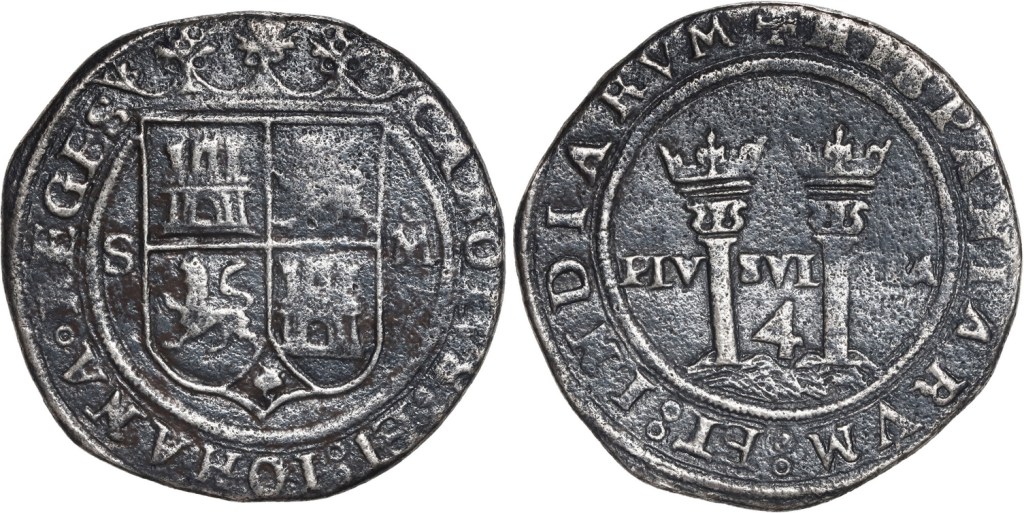
Lot 556 – 4 Reales, Late Series, Assayer S, Padre Island Shipwreck

A rare survivor of the 1554 Spanish Fleet wrecked off Padre Island, Texas, this 4 reales piece from the rare Assayer S illustrates the culmination of the Charles and Joanna coinage before the reforms of Philip II. Its well-preserved surfaces and dark patina testify to its maritime provenance. Few coins of this assayer are known, and its presence in this collection adds both archaeological and numismatic significance. Graded NGC VF details, it is one of the most compelling shipwreck-related specimens of the Late Series.
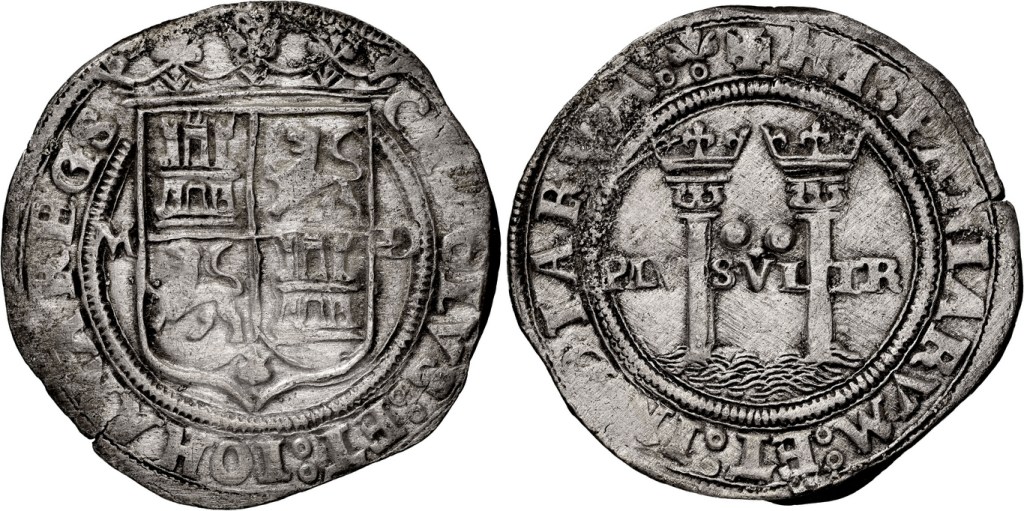
Lot 564 – 2 Reales, Late Series, Inverted G Die Error, ex-Dr. Peter Jones

This intriguing 2 reales coin from the Late Series displays the assayer’s initial G punched upside down—a remarkable minting blunder known in only eight examples. The coin is cited in Dr. Peter Jones’s *The First Coins of the Americas* (2020) and is considered among the best preserved of its type. Its existence underscores the human variability inherent in early minting, as well as the challenges faced by the Mexico City engravers in maintaining die consistency under growing production demands.

The Great Cob Collector: Luis Roberto Ponte Puigbó

13 Oct

We are honored to present the second part of the remarkable collection of Luis Roberto Ponte Puigbó, focusing on rare 4 reales and 8 reales cobs from Lima and Potosí. Luis Roberto’s passion for South American cobs was unmatched, and his collection reflects years of dedication to acquiring some of the finest and rarest examples. It’s a privilege for us to now offer these exceptional pieces to collectors around the world.

In this publication, we also share a tribute from his brother, Alejandro, which beautifully captures Luis Roberto’s love for numismatics and the legacy he leaves behind.

Luis Roberto Ponte Puigbó

Luis Roberto Ponte Puigbó
17/04/1962 – 14/03/2023

“Born in Caracas, Venezuela, descended from an ancient lineage linked to the culture, history, and science of his country, he was a passionate numismatist and historian, a respected lawyer, graduating with Honors from the prestigious Universidad Católica Andrés Bello in 1986. He pursued his profession successfully and brilliantly, being one of the best lawyers in Venezuela, legally representing major companies of the country, demonstrating his dedication and commitment to excellence. His legal background, combined with his passion for history, provided him with a unique and valuable perspective that he applied both in his professional life and in his personal interests.
“Numismatics fascinated him so much that he became an eminent researcher and one of the most outstanding collectors in the world, with vast knowledge of macuquinas (cobs), Hispano-American mints such as Lima, Potosí, and expertise in Venezuelan coins. He presented countless conferences, publications in national and international forums, contributing significant discoveries to this world. He served as Secretary and Legal Advisor of the Venezuelan Numismatic Society. He was a Corresponding Member, Secretary, and Legal Advisor of the Venezuelan Numismatic Society (Sonuve); Lifetime Member of the American Numismatic Society (ANS); Corresponding Member and District Representative for Venezuela of the American Numismatic Association (ANA); Member of the Spanish Numismatic Association (ANE); Member of the Numismatic Association of Chile (ANUCH), Member of Colombian Numismatists (Numiscol); Member of the Philatelic and Numismatic Circle of Barcelona (CNFB); Corresponding Member of the Federal Institute of Numismatic Researchers of the Argentine Republic (IFINRA); Number Member of the Dominican Numismatic Society (SND); among others.
“Luis Roberto dedicated the last years of his life to meticulous research in the historical archives of the Indies in Seville, Spain, leaving several of his findings in progress, which will be published in the near future. He was not just a coin collector; he was an investigator and explorer of the past. Each coin in his collection told a story, which was a small piece of the puzzle of our civilization. As a historian, his insatiable curiosity and meticulous attention to detail allowed him to delve into the mysteries of the past in a way that few could. Luis was always an exemplary, virtuous, cultured, brilliant, dedicated, and enthusiastic human being, whose generosity, simplicity, and humility transcended in all those who had the opportunity to know him. Despite the sadness we feel, he will be remembered for his love of life, his dedication, and passion for history and numismatics. His loss is irreparable, but his legacy will endure for decades in his research, his coins, and in our memories.”

ALEJANDRO LUIS PONTE PUIGBÓ

Link to his collection

Sedwick’s Treasure, World & U.S. Coin Auction 35 is in Full Swing BID NOW!

16 Apr

Sedwick’s Treasure, World, U.S. Coin & Paper Money Auction 35 Live Online Auction May 7, 8, & 9, 2024

The variety of rare, historical, and even unique coins, currency, and artifacts within this auction offer a great opportunity to add valuable pieces to your collection! 

Gold Cobs: Includes a number of 1715 Fleet shipwreck coins such as a Mexico City, Mexico, (1714) J gold cob 8 escudos struck with Royal dies graded NGC MS 64, pedigreed to Kip Wagner’s 1965 National Geographic article “Drowned Galleons Yield Spanish Gold” (Lot 40), as well as two beautiful Mint State Mexico gold cob 8 escudos dated 1715 J (Lots 43 and 44). Peru gold from the 1715 Fleet is also notable with the finest known Lima, Peru, 1705 H gold cob 8 escudos graded NGC MS 64 (Lot 57) and the unique Lima, Peru, 1709 M 2 escudos struck with the pillars-side die meant for a Royal 2 reales graded NGC MS 65 (Lot 72).

Shipwreck Ingots: Features an impressive, uncut gold ingot weighing 2,274 grams recovered from the famous Atocha shipwreck (Lot 96) and a rare silver piña ingot, one of just three known from the wreck (Lot 107).
Shipwreck Coins: Packed with over 600 lots including treasures such as two Seville, Spain, gold cob 2 escudos from the Santa Margarita shipwreck (Lots 278 and 279), a “top pop” Bogota, Colombia, gold cob 2 escudos graded NGC MS 65 from the Maravillas shipwreck (Lot 425), and an NGC-slabbed set of Spanish colonial 1/2, 1, 2, and 8 reales from the “Coconut Wreck,” AKA “Blue Abyss Shipwreck” (Lot 695). Notable collections include the Bill Barman Collection of Atocha Research Coins (Lots 136 to 155) and selections from the Silver Banks Treasures Collection of silver cobs recovered from the Concepcion shipwreck (Lots 315 to 373). Ever-popular shipwreck coin clumps from wrecks such as the Concepcion, the 1733 Fleet, and the Hollandia (just to name a few) should not be missed.
Silver Cobs of Mexico: Includes many high-grade Charles-Joanna and Philip II pieces such as the extremely rare Charles-Joanna “Late Series” assayer S 4 reales (Lot 732) and a high-grade 1733 MF klippe 8 reales (Lot 766).
Silver Cobs of Lima: Hosts a key rarity, the Lima, Peru, assayer R (Rincon) cob 8 reales of Philip II the first “dollar” coin struck in South America (Lot 768).This piece is one of just sixteen known and represents a crowning achievement in the Luis R. Ponte Collection being offered in this sale. A knowledgeable numismatist and longtime friend, Luis built his collection with an eye for rarity and quality in Spanish colonial coinage, which readily shows in this catalog, from a stunning group of “Star of Lima” coinage (Lots 801 to 814) to an exceptional and extremely rare Lima, Peru, 1686 R cob 8 reales Royal (galano) graded NGC XF 40 (Lot 817).

Silver Cobs of Potosi: Features more rarities from the Luis R. Ponte Collection, including the finest-ever assemblage of countermarked shield type cob 8 reales (Lots 934 to 1033) and a very rare first-issue Potosi, Bolivia, assayer R (Rincon) cob 8 reales of Philip II (Lot 825), as well as the only known Potosi, Bolivia, 1732 M cob 8 reales Royal (Lot 1067).

World Coins: A beautiful selection of high-grade Vintage Chinese Coin Rarities such as the Hupeh Year 30 (1904) tael graded PCGS MS 62 (Lot 1190) and the gorgeously designed Hsu Shih-chang Year 10 (1921) Pavilion dollar graded PCGS SP 61 (Lot 1198). Also featured is a choice selection of Colombian Republic silver minors from Gregorio Toulemonde Collection Be sure to look for the rare one-year type La Rioja, Argentina, 1842 R Rosas gold 2 escudos graded NGC MS 63 (Lot 1095), the lustrous “top pop” Santiago, Chile, 1820 FD gold 8 escudos graded NGC MS 62 (Lot 1162), and the wonderfully toned Santiago, Chile, 1817 FJ “Volcano” peso graded NGC MS 61 from the Val y Mexia Collection (Lot 1157)—just to name a few of the many choice rarities to be found.

U.S. Coins, Medals, and Tokens: hosts a selection of gold and silver coins recovered from the Marblehead Hoard buried in Massachusetts in the early 1800s (Lots 1482 to 1488) plus a handsome example of the 1795 Draped Bust silver dollar (Lot 1475). Be sure to check out the gold lifesaving medal awarded by President McKinley in 1900 (Lot 1480).

U.S. Paper Money: Features a colorful Rainbow $2 series of 1869 Legal Tender note graded PMG VF 35 (Lot 1497) and colonial and continental currency marked by two Fugio notes of 1776 (Lots 1493 and 1494).

World Paper Money: Includes two great sets of banknote rarities: the finest known PMG-graded San Juan, Argentina, Banco de Cuyo pesos fuertes specimen set (Lot 1499) and an original Thomas de la Rue & Co. Ltd. specimen banknote album (Lot 1510). Also watch for the 1811-dated Venezuela 2- and 1-peso notes that represent Venezuela’s first paper money (Lots 1508 and 1509).

Ancient Coins and Coin Jewelry: Features several nice Ancient Gaul and Greek silver coins and several eye-catching gold cob 8 escudos mounted in gold bezels (Lots 1527 to 1529).

Shipwreck Artifacts: Stands out for two shipwreck-pedigreed gold chains, one from the 1715 Fleet and the other from the Leocadia (Lots 1562 and 1565), as well as a hefty bronze cannon breech block salvaged from the 1733 Fleet (Lot 1564). The Non-Shipwreck Artifacts section holds various historical artifacts like flintlock pistols and signal cannons.

Express Session: The third day of the auction hosts the Express session, where a variety of numismatic rarities is sure to attract many different bidders.

SPECIAL ARTICLES:

 A NEW Introduction to the “Star of Lima” Coinage of 1659-1660

The 1649-52 Countermarked Shield-Type Coinage of Potos , Bolivia

In MemoriamLuis Roberto Ponte Puigbo 1962 – 2023

Team Acknowledgment: We wish good luck to all our bidders, with much gratitude to our consignors from the whole Sedwick team:

– Daniel Frank Sedwick – Augi Garcia Barneche – Cori Sedwick Downing – Connor Falk – Michelle Heidt

400-year-old twist of fate uniting Cartagena, Colombia, and Florida Keys history to be celebrated

15 Sep

When the primary cultural deposit – the motherlode – of the 1622 fleet galleon Nuestra Señora de Atocha was discovered by divers working for treasure hunter Mel Fisher near Key West, Florida in 1985, among its riches was a vast cargo of silver coins the likes of which had never been seen before. The discovery also delivered a bombshell surprise of evidence for historians: confirmation that hand-struck silver coins were produced in the Nuevo Reino de Granada – today’s Colombia – as early as 1621, a fact that some had suspected, but none had proof to substantiate.

This year, from December 1 to December 5, 2021, 400 years after the conflict-ridden establishment of minting houses in both Cartagena and Santa Fe de Bogota, coin experts and history enthusiasts from all over the world – including six from Florida – will gather in Colombia’s romantic sea-port city for “Cartagena MMXXI – the 3rd International Convention of Historians and Numismatists” where they will examine and celebrate this fascinating point in time along with other key moments in numismatic history.

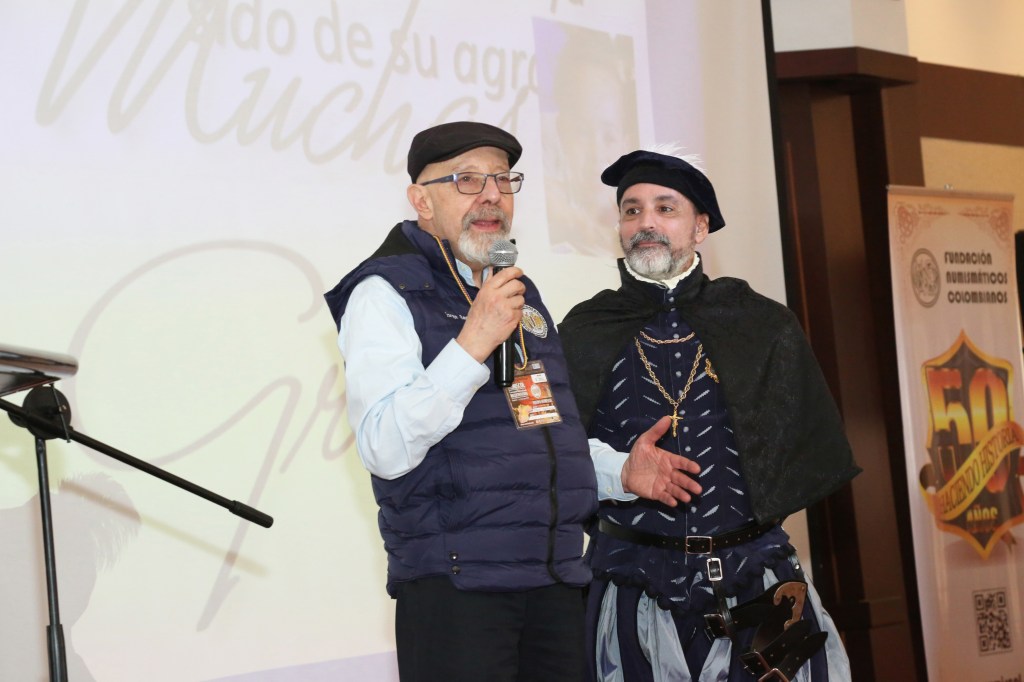
Noted Colombian historian, numismatist and San José shipwreck expert Jorge Becerra de Leon, left, and historic research expert/numismatist Jorge Proctor, in period costume, address an audience at a previous conference. Both will be featured speakers at Cartagena MMXXI – the 3rd International Convention of Historians and Numismatists, taking place December 1-5, 2021, in Cartagena, Colombia. (Photo by Carol Tedesco)

Open to the public, the convention features presentations by some of the world’s leading experts, including Florida’s Jorge Proctor of Pompano Beach, an archival research expert, numismatist and head of the convention’s academic committee; noted marine archaeologist, anthropologist, author and retired professor Dr. R. Duncan Mathewson III of Little Torch Key, who led the Atocha’s archaeological recovery process; Orlando-based professional numismatist and convention V.P. of North American relations, Augi Garcia; Orlando-based professional numismatist and author Daniel Frank Sedwick, Tampa-based professional numismatist Colin M. Blyth, and Key West and Gainesville-based shipwreck coin curation expert, author and International Conventions founding member Carol Tedesco.

Though researchers reported that coins were minted in Colombia as early as 1622, until the discovery of the Atocha, none dated earlier than 1625 were known to exist. Archival records documented that in 1620 a military engineer by the name of Don Alonso Turrillo de Yebra had been authorized by King Philip III of Spain to establish a mint in what was then known as the Nuevo Reino de Granada – the New Kingdom of Granada. Documents also revealed that the undertaking, which included a mint in Santa Fe de Bogota and an ancillary one in Cartagena, was fraught with beauracratic complications and delays. Nonetheless, Turrillo persisted, and in a letter to the King he confirms that at some point prior to the sailing of the 1622 fleet he had indeed struck coins, of “much more perfection than that which is styled in some of the other mints,” and he lamented that some of these “were on one of the galleons which were flooded.” Yet the question remained, were coins also struck in Nuevo Reino de Granada in 1621 as some documents seemed to imply? The answer was eventually revealed among recoveries from the Atocha and another ship of the fleet.

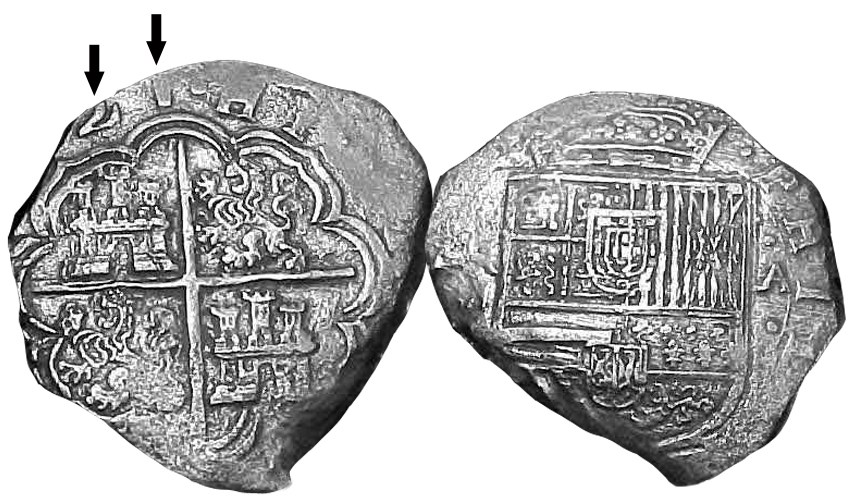
Reverse and obverse sides of a partially dated 1621 silver coin, struck at the Cartagena, Colombia mint that went down on the galleon Atocha near Key West, Florida in 1622, and is one of a small group of coins that altered the known numismatic history of Colombia. A December 1-5, 2021 event in Cartagena will celebrate the 400 year anniversary of the opening of that mint. Events recognizing the 400 year anniversary of the Atocha’s sinking will take place in Key West in 2022. (Photo provided by Bill Pearson)

A Cartagena MMXXI conference presentation by Turrillo authority Proctor, titled “Alonso Turrillo – hero or villain?” will address key questions as well as examine some of the shenanigans undertaken over the course of years by the wiley and resourceful “entrepreneur.” Other notable experts from Colombia, Argentina, Bolivia, Brazil, Chile, Ecuador, El Salvador, Mexico, Paraguay, Peru, Panama, Puerto Rico, Spain, the U.S., and Venezuela will offer a combination of live and virtual presentations as well as book presentations on a variety of historic numismatic themes.

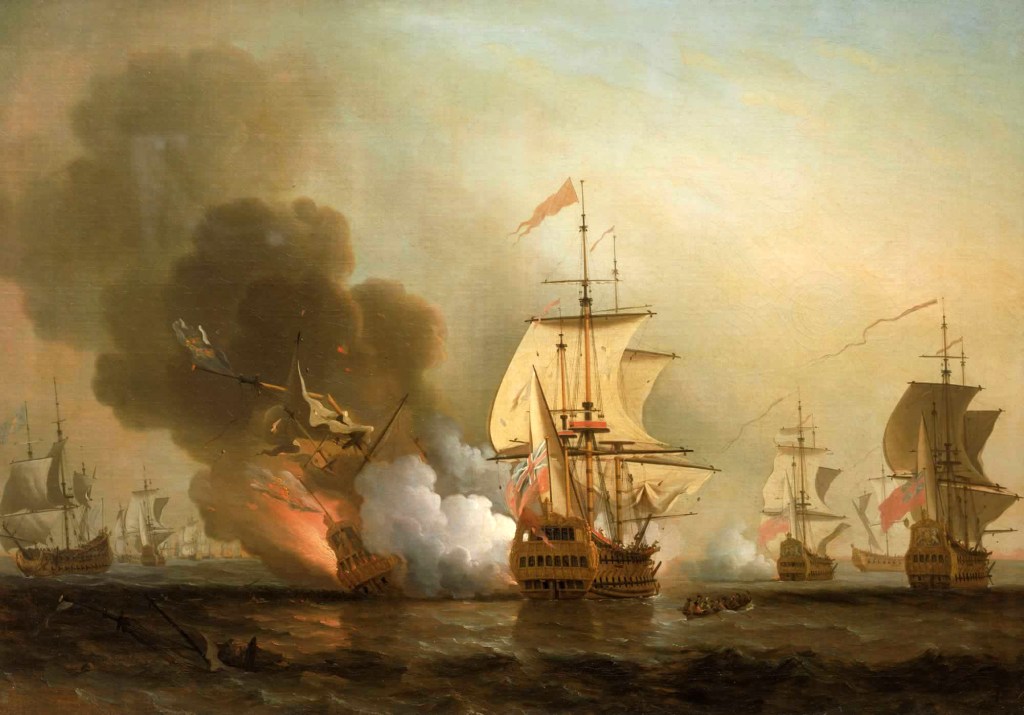
Of particular interest to sunken shipwreck historians and enthusiasts will be updates and discussions on Colombia’s famous San José shipwreck, which was sunk by British Naval forces in 1708, taking hundreds of people and a cargo of New World produced wealth estimated in the billions to a resting place in nearly 2000 feet/600 meters of sea water from Cartagena. Under discussion will be prospects for recovery of the vessel, and establishment of a museum to house and display its artifacts.

For registration and other conference information, including a gala, ceremonies, social events, and a commercial numismatic component for collectors and sellers, visit cartagena2021.com. The website is in Spanish but offers an English translation feature and English language registration guide. English/Spanish translation for all presentations will be provided. Covid-19 safety protocols will be in place for the duration of the conference; scheduling may be subject to change. Attendees are encouraged to check the website regularly for updates. For in-person guests and participants, facemasks and proof of vaccination will be required, and social distancing will be observed.

A painting by Samuel Scott (1702-1772) depicts the destruction in 1708 of the treasure galleon San José off the coast of Cartagena, Colombia. Prospects for recovery of the vessel and establishment of a museum to house and display its artifacts is to be one of the topics under discussion at Cartagena MMXXI – the 3rd International Convention of Historians and Numismatists. (Image source: Wikimedia Commons)

##

Press contact: Augi Garcia / prensa@cartagena2020.com