Tag Archives: countermark

Now Online! Treasure, World, U.S. Coin and Paper Money Auction 38

13 Oct

This auction brings together one of the most complete and exciting selections we have ever offered, combining important named collections with individual rarities from all across the world of numismatics. The result is a sale that captures the full story of coinage in the Americas and beyond. As usual, it is consignors and bidders who make this possible, so we thank you all!

Our business was built on cobs and shipwreck treasure, for which we remain the world’s foremost experts, so it is no surprise that this auction is loaded with shipwreck ingots, coins, and artifacts. We run a very clean operation—everything is checked carefully for proper provenance and certification, and in most cases the material we offer comes straight from the source. In fact, our auctions are better than buying from the source directly, as everything we sell is guaranteed and certifiable at any time. In today’s fly-by-night world, this is a critical difference.

First, it is our privilege to presen the Sedwick-Downing Collection of Charles-Joanna Coinage of Mexico City, the result of more than a decade of study and collecting. What began as curiosity grew into a deep passion for the beauty, history, and meaning behind the first coins of the New World. This catalog marks an important milestone in that journey, with the full publication of Cori’s research to follow soon.

For this auction, we hit the ground running with the McGregor Collection of Gold Cobs from the 1715 Fleet, a vivid reminder of the beauty and adventure tied to Spanish colonial treasure. While this collection showcases a full range of denominations of gold cobs from Mexico City (including a fabulous Royal-dies 1714 8 escudos) and Lima, it also contributes to significant offerings from Cuzco and Cartagena, the latter including a coin that will be featured in Daniel Sedwick’s upcoming book, Arce’s Doubloons. Of course, our treasure coverage is certainly not limited to Spanish colonial cobs. In fact, in this sale we feature all of the famous United States shipwrecks, namely S.B. Pulaski (1838), S.S. New York (1846), S.S. Central America (1857), S.S. Brother Jonathan (1865), and S.S. Republic(1865).

Highlighting our usual silver-cob offerings are several key collections, in addition to the aforementioned Sedwick–Downing Collection. In Lima cobs you will find the Jorge Ugaz Collection of Lima Cob 2 Reales, and in Guatemala cobs is the Darby Collection of Guatemala Cobs, both the result of decades of study and selectivity by devoted specialists. As always, “Royals” (galanos) steal the attention in all three cob sections (Mexico, Lima, Potosí), including a unique Mexican 4 reales Royal dated 1612/1, expanding the cob market into a rarified level of special pieces for truly dedicated collectors.

Outside of cobs, this auction presents an enviable selection of Latin American trophy coins, including two concentrated collections in Chile (the Val y Mexía Collection of Chilean Bust 4 Reales) and Peru (the Almenara Collection of Peruvian Republic Gold Coins), plus key rarities in Spanish colonial pillar dollars (Mexico 1732 and Nuevo Reino 1759), Cuba (unique Guanabacoa medal dated 1747 plus many rare or unique modern proofs), Dominican Republic (10 reales silver pattern 1855), and Panama (1904 proof set), and a veritable panoply of types from around the world, not just the Americas (including some key U.S. coins) but also Europe, Asia, and even Africa. The mix extends from ancients and early hammered types to classic milled crowns and gold issues, all the way to modern proofs, and every section offers key pieces selected for rarity and quality in a range that rarely appears at auction.


The other side of numismatics is paper money, and in Latin America we continue a strong auction presence, here with a selection of incredibly rare and high-grade Dominican Republic notes issued between 1857 and 1865, all new to the market.

Finally, our auctions are unique for offering treasures in coin jewelry and shipwreck artifacts in a wide range of time periods (over two centuries), particularly from the Atocha (1622), Concepción (1641), Bannister’s pirate ship Golden Fleece (1686), 1715 Fleet, and S.S. Central America(1857).

As yet another exciting auction from the Sedwick company, this one is sure to get everyone’s collecting juices flowing, demonstrating that numismatics and treasure transform history and artistry into excitement and positive human collaboration, something our world can surely use more of today.


The Sedwick & Associates, LLC team:

Daniel Sedwick, Augi García-Barneche, Cori Sedwick Downing, Connor Falk,

Michelle Heidt, and Sarah Sproles

Live on the Internet, Thursday-Saturday, November 13, 14, & 15, 2025

CLICK HERE TO REGISTER NOW!

Gallery

Sedwick Treasure, World and US Coin Auction #20 Preview

7 Sep

christmas-packages

While all of us at Daniel Frank Sedwick, LLC, are diligently working on making our November Treasure World & US Coin Auction #20 the BEST ever, I thought I would pause to tell you about some of the cool stuff we will have for you to bid on and *hopefully* buy. First off, make sure your Christmas wish list is empty because there are lots and lots of goodies you’ll want! I’m already making my list.

In the upcoming auction, we have a Maravillas Research Collection of countermarked Potosi cobs. Here’s a refresher about the Maravillas from our website (abridged):

Maravillas, sunk in 1656 off Grand Bahama Island

shipwreck

As the almiranta (“admiral’s ship,” or rear guard) of the homebound Spanish fleet in January of 1656, the Nuestra Señora de las Maravillas was officially filled with over five million pesos of treasure (and probably much more in contraband, as was usually the case). That treasure included much of the silver salvaged from the South Seas Fleet’s Capitana of 1654 that wrecked on Chanduy Reef off Ecuador. The ill-fated treasure sank once again when the Maravillas unexpectedly ran into shallow water and was subsequently rammed by one of the other ships of its fleet, forcing the captain to try to ground the Maravillas on a nearby reef on Little Bahama Bank off Grand Bahama Island. In the ensuing chaos, exacerbated by strong winds, most of the 650 people on board the ship died in the night, and the wreckage scattered. Spanish salvagers soon recovered almost half a million pesos of treasure quickly, followed by more recoveries over the next several decades, yet with over half of the official cargo still unfound. The first re-discovery of the Maravillas in the 20th century was by Robert Marx and his company Seafinders in 1972. The second big salvage effort on the Maravillas was by Herbert Humphreys and his company Marex in the late 1980s and early 1990s. The wreck area is still being searched today, but officially the Bahamian government has not granted any leases on the site since the early 1990s.

roberto_mastalir

Roberto Mastalir Divisek


In addition to the above Potosi shipwreck cobs, we are honored to present a collection of “Transitional” 1652 Potosi 8 reales cobs put together and written about extensively by Robert Mastalir. All of his coins in the upcoming auction are featured (photographed) in his book The Great Transition at the Potosi Mint, 1649-1653, the 1652 Transitional 8 Reales, which is out of print already, but we plan to re-print it for the auction soon.


Unfortunately, sometimes collections come to us after the death of the collector, and that’s the case for the Charles Eidel collection of shipwreck coins and ancient Greek and Roman coins. Charlie was a genial retired NYC policeman whose appetite for coins was wide ranging. His meticulous record keeping and coin descriptions reflect his love for the hobby. It’s now time for him to posthumously pass along his gems for the next generation of collectors.

Near and dear to my heart is our major offering of Charles and Joanna coinage (both Early and Late Series) in this auction. We have a smattering of coins from several different sources which complement each other very well and will give you a lot of opportunities to enrich your collection…or start one! While we generally feature 4 reales from shipwrecks, this time we will have a large selection of the very hard-to-find smaller denominations. We will even have an early series Assayer R 1 real. And when’s the last time you saw Assayer S in any denomination? We’ve got a 2 reales for sale!

That’s it for now, but it should help you decide on what you’d like to see under the Christmas tree this year (or before)! Happy bidding.

bidders-at-fudraising-auction

Chop Chop: Quick Guide to Chopmarks, Countermarks and Counterstamps

2 Mar

Last week, a reader asked about chopmarks on cobs and how they impact their value. That’s a field unto itself, isn’t it? But I thought it would provide a good platform to discuss the types of markings you might see on cobs and coins, namely counterstamps and countermarks (as well as chopmarks).

What’s a chopmark?

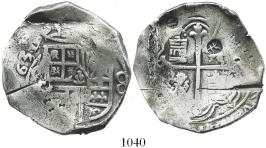
Chopmark coin, Lot 1040, TA 9

Chopmark coin, Lot 1040, Auction #9

This is a small mark or marks, sometimes recognizable as a Chinese character, that can appear on either or both sides of a coin. Typically these were made by Chinese bankers when Spanish-American coins circulated in the Orient to ensure that the composition of the coin was genuine. The coin may even have passed from one banker to another who verified its authenticity with a different mark and hence some coins bear several unrelated markings. And, chopmarks may have been added in other areas of southeast Asia such as Vietnam, so while we might say that a coin bears a Chinese chopmark, that chopmark might not necessarily have been put on the coin in China. As you might expect, there are collector groups (the Chopmark Collectors Club, for example) and books (Chopmarked Coins, A History, by Colin Gullberg) that are devoted to the topic. While chopmarks are interesting, they generally do not add value to the coin.

What’s a countermark?

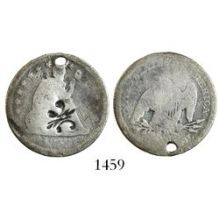
Puerto Rico countermark

Puero Rico countermark, Lot 1459 Treasure Auction #15

Unlike chopmarks which were added to coins by a banker or merchant verifying the genuineness of a coin, countermarks were put on coins by a government or by official permission to a merchant to allow a coin to be circulated in the country where the mark originated. It was a way to use another country’s currency. Sometimes countermarks are more valuable than the host coin: for example, the Puerto Rican fleur-de-lis mark on a coin increases its value because there are very few Puerto Rican coins for collectors to collect. The countermark is the next best thing! Also, with countermarks, you’re adding another layer to the value of the coin since without the mark, you have one country’s coin to examine and with the countermark you have another country or merchant to add to the mix. Hence, countermarks can add numismatic value. If you want to learn something about merchant countermarks, Merchant Countermarks on World Coins by Gregory G. Brunk is a good place to start.

What’s a counterstamp?

Counterstamp coin, Lot 842, Treasure Auction #16

Counterstamp coin, Lot 842, Treasure Auction #16

These odd creatures are double-sided countermarks, sort of like using an incomplete hole puncher to punch both sides of a coin. Like countermarks, a counterstamp can add numismatic value since there are now two countries or an important merchant that are represented on one coin. Unlike countermarks, the stamp on each side of the coin is different.

We will feature a few coins from each category (chopmarked, countermarked, counterstamped) in our upcoming auction, Sedwick Treasure Auction #17, in April.