Archive | Other Articles RSS feed for this section

Sedwick & Associates: Upcoming Treasure, World, & U.S. Coin & Paper Money Auction 37 – May 7-9 

16 Apr

While we always stress that numismatics is a hobby, there is no denying it can be financially profitable as well. Why? Obviously, soaring precious metal prices help, but there is more to the story. The answer is that rare old coins, paper money, ingots, and artifacts are limited commodities. They were made in a certain quantity and survived at a certain rate, but that’s it: No more will be made. So then it becomes a matter of demand, and when demand is high, there is no limit as to what something rare can be worth.

Our auctions are packed with unique or near-unique items whose current value depends on you, the bidders. Our consignors depend on us to present these coins and artifacts in their best light, but only the bidders can decide the prices. At a time when the world is very concerned about financial matters, this is the time for collectors to put idle money into rare assets.

Shipwreck items are particularly good performers these days. In many cases, certain items are only available from shipwrecks, hence their already limited population is further restricted by whether they were legally commercially recovered, hardly a sure bet these days. That is why original certificates (or those from qualified professionals) are such a big deal.

The other big concern for coins and paper money is quality, which is where third-party certification companies like NGC and PCGS come in. It is not an exact science, to be sure, but just having an unbiased professional opinion about relative quality posted in a public census adds significant value. Anything presented in our auctions with notations like “top pop” or “finest known in the XYZ census” has even more potential value beyond its baseline rarity and demand.

The moral of the story is that we at Sedwick & Associates run a tight ship with academic and ethical integrity, and we bring you the best the market has to offer with the cleanest pedigree and certification possible. Bid with confidence.

Several important collections stand out in this auction, literally from A to Z. Probably the most significant is the Almenara Collection of Colonial Peruvian Gold Coins, including Lima cobs and Potosí bust gold (as the latter mint fell under Peru in colonial times). The run of Lima cob 1 escudos seen here is the most complete ever offered, and the bust series from both Lima and Potosí contain many “finest knowns” and important pedigrees. And at the end of the alphabet you will find the Zbar Collection of Maravillas coins.

You will also find several great offerings of colonial Peruvian silver coins (O’Brien Collection), as well as Colombian colonial and Republic gold and silver (JEAS and Becerra Collections), pillar dollars of most of the colonial mints (Brameld Collection), Mexican cobs (Hubbard Collection), Potosí cob 8 reales plated in the Calbetó reference, Potosí cob 4 reales (Ponte Collection), and even paper money (Busto Collection) from Cuba, the Dominican Republic, and Disney (yes, Walt Disney World is like its own country).

In addition, there are several important one-off coin trophies scattered throughout that should not be missed, even if you are not a buyer but want to witness numismatic history being made:

-Lot 495, a Mexico 3 reales of Charles-Joanna in XF 40

-Lot 1026, a Costa Rica gold 20 pesos dated 1873 in UNC details

-Lot 1037, a Santo Domingo 4 reales of Charles-Joanna in AU 55

-Lot 1399, a Spanish East Indies proclamation 2 reales dated 1747 in VF20

As always, we also have many important shipwreck gold cobs, including the following standouts:

-Lot 22, a 1715-Fleet Mexico 8 escudos 1714 struck with a Royal obverse die in MS 63

-Lot 60, a 1715-Fleet Cuzco 2 escudos dated 1698 in MS 63

-Lot 124, an Atocha Seville 2 escudos dated 1619 in AU55
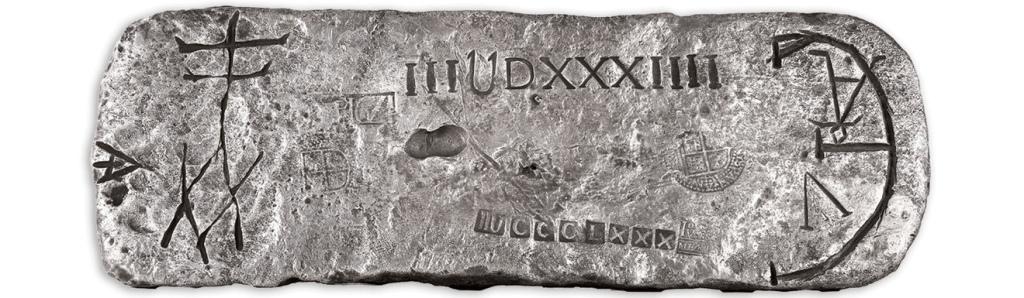
ngots include two massive (each almost 1000 troy oz) Atocha silver bars Class -Factor 1.0 (lots 92 and 93) as well as a 21.5-troy oz gold “finger” bar from the “Golden Fleece Wreck” (lot 85).

But best of all, a showpiece for the ages, is lot 1665, an ornate pendant (reliquary or noble neck-badge) made of gold, diamonds, and emeralds from the Tolosa (1724), a fabulous jewel that appeared in multiple publications in the late 1970s and early 1980s.

Many thanks to all our consignors, and best of luck to all our bidders. We hope you find your treasure!

Sedwick & Associates, LLC
Day 2 of Sedwick & Associates Auction 36 Reaches New Heights with Record-Breaking Success

10 Nov

Orlando, FL — November 8, 2024

Building on the strong foundation set by Day 1, Day 2 of Sedwick & Associates Auction 36 surpassed expectations with remarkable record-breaking results and standout performances across numerous categories. This historic day showcased an array of Spanish colonial coins, especially the coveted pieces from the Luis Roberto Ponte Collection of Lima & Potosí Cobs, as well as shipwreck coins & ingots, Latin American rarities, and vintage Chinese coins. For the first time in Sedwick & Associates’ history, sales topped $5 million, marking an exciting new milestone and ushering in an era of expansion and continued success.

The day featured these prominent collections:

  • The John M. O’Brien Reference Collection of Peruvian Coins
  • The Emilio M. Ortiz Collection of Cuban Gold Coins, Part I
  • The Jorge Becerra Collection of Colombian Colonial Coins
  • The JEAS Collection of Gold Coins of Independent Colombia

Sedwick & Associates extends its heartfelt gratitude to our consignors for their trust and to our bidders, both in person and online, for making this auction such an outstanding success. Closing out 2024 with this achievement fuels our excitement as we head into 2025, ready to embrace new offices, talented additions, and ambitious growth. Here’s to more excellence and innovation ahead. Thank you for being an essential part of this journey. – Prices realized Auction 36

SOME TOP HIGHLIGHTS SOLD AT AUCTION 36 – November 7-8, 2024:

Gold bar ingot from Colombia, 915 grams, marked with fineness XXII (22K), circular tax stamp, and fo

75 – Gold bar ingot from Colombia, 915 grams, marked with fineness XXII (22K), circular tax stamp, and fo

Sedwick & Associates, LLC

Gold bar ingot from Colombia, 915 grams, marked with fineness XXII (22K), circular tax stamp, and foundry stamp (B)ARBACO(A)S, ex-1715 Fleet, ex-AnderBidding Has Concluded

Estimate : 60,000.00 – 90,000.00

Sold for (95,000.00 + 19,000.00BP) = 114,000.00

Large silver ingot 632 from Potosi, 84 lb 5.12 oz troy, Class Factor 1.0, with markings of mine/date

82 – Large silver ingot 632 from Potosi, 84 lb 5.12 oz troy, Class Factor 1.0, with markings of mine/date

Sedwick & Associates, LLC

Large silver ingot 632 from Potosi, 84 lb 5.12 oz troy, Class Factor 1.0, with markings of mine/date Po1622, manifest IULXXIX (1079), fineness IIUCCCLBidding Has Concluded

Estimate : 35,000.00 – 70,000.00

Sold for (70,000.00 + 14,000.00BP) = 84,000.00

PERU, Lima, "Star of Lima" type, cob 8 reales presentation strike, 1659 V, mintmark * above LIMA, V

263 – PERU, Lima, “Star of Lima” type, cob 8 reales presentation strike, 1659 V, mintmark * above LIMA, V

Sedwick & Associates, LLC

PERU, Lima, “Star of Lima” type, cob 8 reales presentation strike, 1659 V, mintmark * above LIMA, V to left and 8 to right, rare, NGC AU d…Bidding Has Concluded

Estimate : 25,000.00 – 50,000.00

Sold for (70,000.00 + 14,000.00BP) = 84,000.00

Gold oval ingot, 645.26 grams, tested at 0.819 fine gold (19.656K), marked with V-over-upside-down-V

77 – Gold oval ingot, 645.26 grams, tested at 0.819 fine gold (19.656K), marked with V-over-upside-down-V

Sedwick & Associates, LLC

Gold oval ingot, 645.26 grams, tested at 0.819 fine gold (19.656K), marked with V-over-upside-down-V monogram and XXIII, ex-Luz (1752), ex-Sotheby&#…Bidding Has Concluded

Estimate : 40,000.00 – 60,000.00

Sold for (55,000.00 + 11,000.00BP) = 66,000.00

CHINA, Kansu, Kanzhou mint, dollar, Sun Yat-sen, Year 17 (1928), 民国17年

908 – CHINA, Kansu, Kanzhou mint, dollar, Sun Yat-sen, Year 17 (1928), 民国17年

Sedwick & Associates, LLC
CHINA, Kansu, Kanzhou mint, dollar, Sun Yat-sen, Year 17 (1928), 民国17年甘肃省造Bidding Has Concluded

Estimate : 20,000.00 – 30,000.00

Sold for (55,000.00 + 11,000.00BP) = 66,000.00

CHINA, Tientsin mint, dollar, Tsao-Kun, (1923), military attire, very rare, 曹锟[x

906 – CHINA, Tientsin mint, dollar, Tsao-Kun, (1923), military attire, very rare, 曹锟[x

Sedwick & Associates, LLC
CHINA, Tientsin mint, dollar, Tsao-Kun, (1923), military attire, very rare, 曹锟像宪法成Bidding Has Concluded

Estimate : 50,000.00 – 75,000.00

Sold for (47,500.00 + 9,500.00BP) = 57,000.00

PERU, Cuzco, gold cob 1 escudo, 1698 M, extremely rare, NGC AU 58 (1715 Fleet Shipwreck Label).

311 – PERU, Cuzco, gold cob 1 escudo, 1698 M, extremely rare, NGC AU 58 (1715 Fleet Shipwreck Label).

Sedwick & Associates, LLC

PERU, Cuzco, gold cob 1 escudo, 1698 M, extremely rare, NGC AU 58 (1715 Fleet Shipwreck Label). S-CZ1; KM-A27; Cal-811; Fr-6. 3.36 grams. Excellent fuBidding Has Concluded

Estimate : 30,000.00 – 60,000.00

Sold for (45,000.00 + 9,000.00BP) = 54,000.00

SPAIN, Seville, gold milled 8 escudos, Philip V, 1714 M, NGC MS 65, finest known in NGC census.

1429 – SPAIN, Seville, gold milled 8 escudos, Philip V, 1714 M, NGC MS 65, finest known in NGC census.

Sedwick & Associates, LLC

SPAIN, Seville, gold milled 8 escudos, Philip V, 1714 M, NGC MS 65, finest known in NGC census. Cal-2284; KM-260; Fr-247. A very lustrous and pristineBidding Has Concluded

Estimate : 50,000.00 – 100,000.00

Sold for (45,000.00 + 9,000.00BP) = 54,000.00

PERU, Cuzco, gold cob 2 escudos, 1698 M, HISPANIRVM error, broad flan ("Lima" cut), very rare, NGC M

310 – PERU, Cuzco, gold cob 2 escudos, 1698 M, HISPANIRVM error, broad flan (“Lima” cut), very rare, NGC M

Sedwick & Associates, LLC

PERU, Cuzco, gold cob 2 escudos, 1698 M, HISPANIRVM error, broad flan (“Lima” cut), very rare, NGC MS 64 (1715 Fleet Shipwreck Label), &qu…Bidding Has Concluded

Estimate : 20,000.00 – 40,000.00

Sold for (37,500.00 + 7,500.00BP) = 45,000.00

BOLIVIA, Potosí, cob 8 reales Heart, 1709 Y, NGC XF details / environmental damage, finest and only

655 – BOLIVIA, Potosí, cob 8 reales Heart, 1709 Y, NGC XF details / environmental damage, finest and only

Sedwick & Associates, LLC

BOLIVIA, Potosí, cob 8 reales Heart, 1709 Y, NGC XF details / environmental damage, finest and only example in NGC census, ex-von Schuckmann. S…Bidding Has Concluded

Estimate : 25,000.00 – 50,000.00

Sold for (36,250.00 + 7,250.00BP) = 43,500.00

PERU, Lima, gold cob 8 escudos, 1711 M, legend starting at 6 o'clock, NGC MS 64 (1715 Fleet Shipwrec

307 – PERU, Lima, gold cob 8 escudos, 1711 M, legend starting at 6 o’clock, NGC MS 64 (1715 Fleet Shipwrec

Sedwick & Associates, LLC

PERU, Lima, gold cob 8 escudos, 1711 M, legend starting at 6 o’clock, NGC MS 64 (1715 Fleet Shipwreck Label). S-L28; KM-38.2; Cal-2119; Fr-7. 26…Bidding Has Concluded

Estimate : 20,000.00 – 30,000.00

Sold for (32,500.00 + 6,500.00BP) = 39,000.00

BOLIVIA, Potosí, cob 8 reales Royal (galano), 1704/3 Y, rare, NGC AU 55, finest known in NGC census.

654 – BOLIVIA, Potosí, cob 8 reales Royal (galano), 1704/3 Y, rare, NGC AU 55, finest known in NGC census.

Sedwick & Associates, LLC
BOLIVIA, Potosí, cob 8 reales Royal (galano), 1704/3 Y, rare, NGC AU 55, finest known in NGC census. S-P43a; KM-unl (R31 for type); Cal-unl (Ty…Bidding Has Concluded

Estimate : 15,000.00 – 30,000.00

Sold for (30,000.00 + 6,000.00BP) = 36,000.00

The Great Cob Collector: Luis Roberto Ponte Puigbó

13 Oct

We are honored to present the second part of the remarkable collection of Luis Roberto Ponte Puigbó, focusing on rare 4 reales and 8 reales cobs from Lima and Potosí. Luis Roberto’s passion for South American cobs was unmatched, and his collection reflects years of dedication to acquiring some of the finest and rarest examples. It’s a privilege for us to now offer these exceptional pieces to collectors around the world.

In this publication, we also share a tribute from his brother, Alejandro, which beautifully captures Luis Roberto’s love for numismatics and the legacy he leaves behind.

Luis Roberto Ponte Puigbó

Luis Roberto Ponte Puigbó
17/04/1962 – 14/03/2023

“Born in Caracas, Venezuela, descended from an ancient lineage linked to the culture, history, and science of his country, he was a passionate numismatist and historian, a respected lawyer, graduating with Honors from the prestigious Universidad Católica Andrés Bello in 1986. He pursued his profession successfully and brilliantly, being one of the best lawyers in Venezuela, legally representing major companies of the country, demonstrating his dedication and commitment to excellence. His legal background, combined with his passion for history, provided him with a unique and valuable perspective that he applied both in his professional life and in his personal interests.
“Numismatics fascinated him so much that he became an eminent researcher and one of the most outstanding collectors in the world, with vast knowledge of macuquinas (cobs), Hispano-American mints such as Lima, Potosí, and expertise in Venezuelan coins. He presented countless conferences, publications in national and international forums, contributing significant discoveries to this world. He served as Secretary and Legal Advisor of the Venezuelan Numismatic Society. He was a Corresponding Member, Secretary, and Legal Advisor of the Venezuelan Numismatic Society (Sonuve); Lifetime Member of the American Numismatic Society (ANS); Corresponding Member and District Representative for Venezuela of the American Numismatic Association (ANA); Member of the Spanish Numismatic Association (ANE); Member of the Numismatic Association of Chile (ANUCH), Member of Colombian Numismatists (Numiscol); Member of the Philatelic and Numismatic Circle of Barcelona (CNFB); Corresponding Member of the Federal Institute of Numismatic Researchers of the Argentine Republic (IFINRA); Number Member of the Dominican Numismatic Society (SND); among others.
“Luis Roberto dedicated the last years of his life to meticulous research in the historical archives of the Indies in Seville, Spain, leaving several of his findings in progress, which will be published in the near future. He was not just a coin collector; he was an investigator and explorer of the past. Each coin in his collection told a story, which was a small piece of the puzzle of our civilization. As a historian, his insatiable curiosity and meticulous attention to detail allowed him to delve into the mysteries of the past in a way that few could. Luis was always an exemplary, virtuous, cultured, brilliant, dedicated, and enthusiastic human being, whose generosity, simplicity, and humility transcended in all those who had the opportunity to know him. Despite the sadness we feel, he will be remembered for his love of life, his dedication, and passion for history and numismatics. His loss is irreparable, but his legacy will endure for decades in his research, his coins, and in our memories.”

ALEJANDRO LUIS PONTE PUIGBÓ

Link to his collection

Unprecedented Offering of Spanish Colonial 8 Reales Cobs in Sedwick’s Auction 35

29 Apr

The Luis R. Ponte Collection, a featured collection in Daniel Frank Sedwick, LLC’s Treasure, World, U.S. Coin and Paper Money Auction 35, features a vast array of 1500s-1600s Spanish colonial cob 8 reales.

“We hope this unique offering of exquisite and well-studied material from one of the greatest cob collectors of all time will inspire other great collectors for the next few decades and more.” says company Founder and President Daniel Sedwick, a longtime expert in cobs.

The collection consists of silver cobs from the two most prolific Spanish colonial mints in South America to produce silver cobs, Lima and Potosí. Only a small percentage of the coins were made well and stayed in undamaged condition through the centuries. This collection of top examples could only be assembled by a knowledgeable collector with an eye for rarities and access to special offerings and auctions around the world.

“It is a pleasure to work with such a well-curated collection,” Sedwick continues. “Coins like these are assembled only through decades of attentive acquisition with judicious upgrading and augmentation as opportunities arise.”

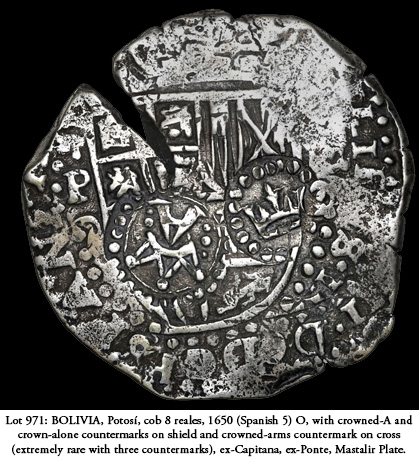
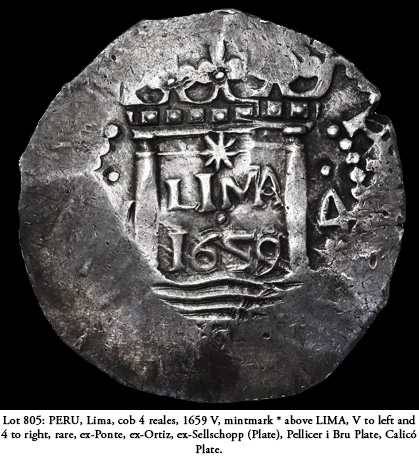
Some particular highlights from the Lima mint include a very rare assayer Rincón 8 reales of 1568, a selection of assayer Diego de la Torre pieces from 1577-88, a choice run of rare “Star of Lima” varieties from 1659-60, and a massive round 1686 R “Royal” (galano) 8 reales. The Potosí offerings include a long run of shield-types from 1574-1652 including a Rincón 8 reales and several fully dated pieces plus a vast collection of Potosí countermarked coins from the Great Transition of 1649-52. This last group comprises the choicest and most advanced assemblage of rare countermarks we have ever offered, including quite a few extremely rare multiple-countermarked pieces, mostly from the Capitana (1654) and Maravillas (1656) shipwrecks. Many of the coins feature old and extensive collector pedigree histories and some are trophies never to be seen on the market again. For this important occasion, Daniel Frank Sedwick has added two special articles: one a variety list of “Star of Lima” coinage and the other a practical summary of exhaustive data on the Potosí 1649-52 countermarks presented in multiple volumes by expert Robert Mastalir.

Here is a selection of choice pieces from the Luis R. Ponte Collection:

The three-day auction will be held live online at auction.sedwickcoins.com.

Daniel Frank Sedwick, LLC / Licensed Florida Auctioneer #AU3635, AB2592 (since 2007)
P.O. BOX 1964 | Winter Park, Florida 32790 | Phone: 407.975.3325 | Fax:407.975.3327  


Unique Congressional Gold Medal owned by two Presidents to sell in Sedwick’s Treasure Auction 34

31 Oct

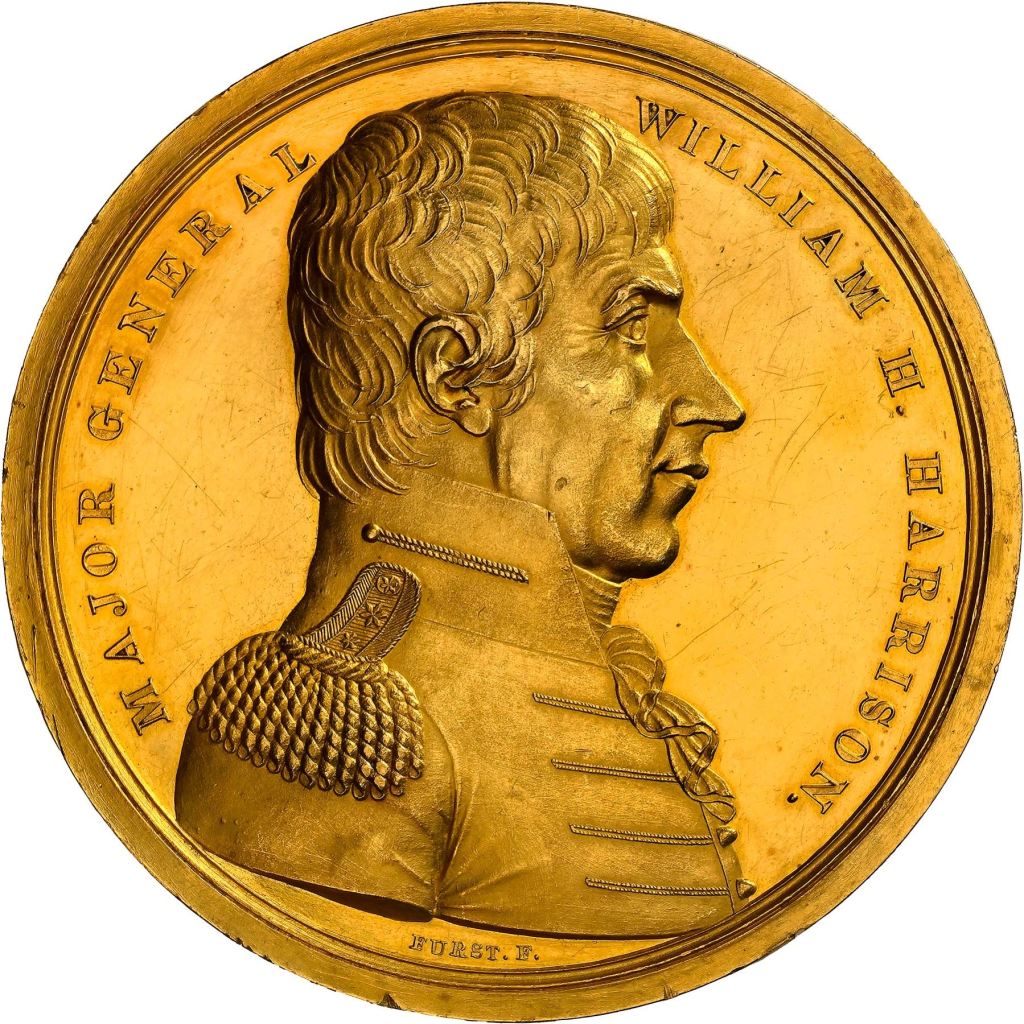
It is a great honor for us to offer this early Congressional Gold Medal awarded to Major General and later U.S. President William Henry Harrison for his role in safeguarding the territory that would later become six of our American Midwest states. This is the highest civilian award in the United States, a large display piece denoting “national appreciation for distinguished achievements and contributions” that has been awarded to individuals and organizations since the first one given to George Washington in 1776. Most of these medals have found homes in museums and other institutions over the years, chiefly via donation or loan from generous collectors who have the means to purchase such valuable pieces. In any case, whenever one is sold, it does not go unnoticed.

The medal is featured in our Treasure Auction 34 as lot 1609. The sale will be held live in-person and online at auction.sedwickcoins.com. Graded NGC MS 60 Prooflike and still accompanied by its original box of issue, this large and heavy medal represents an extremely rare chance to own a unique and special relic from America’s early days.

Obverse of William Henry Harrison’s Congressional Gold Medal

William Henry Harrison’s early career

One can be forgiven for not recognizing Harrison’s name today. As President, he earned the dubious distinction of holding office for the shortest amount of time by dying just one month into his term in 1841, in fact the first U.S. President ever to die in office. He also holds the record for the longest inaugural address in U.S. history—two hours in cold and rain—which some believe contributed to his early demise. Most rankings of U.S. Presidents omit William Henry Harrison because he had no time to make anything of his tenure.

Indeed this is far too modest an end to what had been an illustrious career. Born in 1773 into a patriotic Virginian family, William Henry Harrison was the youngest son of Benjamin Harrison V, a signer of the Declaration of Independence and one of our nation’s Founding Fathers. After an education in classics and history, followed by a brief foray into medicine, William Henry Harrison joined the Army in 1791 and spent his first career in the northwest frontier, elbowing out Native Americans for land that eventually became the Midwest states of Ohio, Indiana, Illinois, Michigan, Wisconsin, and Minnesota. Upon resignation from the Army in 1798, Harrison became Secretary of the Northwest Territory and its first delegate to U.S. Congress. In 1800, then-President John Adams (distant ancestor of the current consignor, how amazing is that?) appointed Harrison Governor of Indiana Territory. Though no longer in the Army, Harrison led a successful military campaign against Native resistance under Shawnee leader Tecumseh, culminating in the 1811 Battle of Tippecanoe, for which Harrison would thereafter be remembered with the nickname “Tippecanoe.” For the subsequent War of 1812, Harrison re-joined the Army as Major General and took command in the Northwest, where Tecumseh and his Native confederation had allied with the British.

The War of 1812

While the War of 1812 officially pitted the United States against Great Britain, many of its combatants were the indigenous people that had been subjugated by Harrison in the Northwest region. The U.S. was expanding from the east while the British were bolstering a Native American buffer state from Upper Canada in the north. Disputes over shipping and trade routes made the War a Naval conflict as well. When the War officially ended in 1815 upon the ratification of the Treaty of Ghent, neither side was victorious: The Northwest remained with the U.S., and Canada remained with Britain. The only losers of the War were the Native Americans.

One of the more shocking events of the War of 1812 came in August 1814 when the British captured the city of Washington, D.C. and burned the White House, the Capitol, and the Treasury building. Albeit briefly, this marked the only time a foreign entity ever occupied our capital.

Back on the Northwest front, in 1813 Harrison successfully defended against the British siege of Fort Meigs in Ohio and then defeated Tecumseh in an engagement known as the Battle of Thames in Canada. Tecumseh’s death in that battle ended any substantive Native threat to U.S. expansion into what we now call the Midwest. It was for his success in that battle that Congress awarded Harrison this gold medal.

Reverse of William Henry Harrison’s Congressional Gold Medal

The Medal

The tradition of Congressional Gold Medals started with a series of seven pieces authorized by the Continental Congress from 1776 to 1787 for recognizing the military heroes of the American Revolutionary War, beginning of course with George Washington. Each subsequent Congressional Gold Medal was authorized by a two-thirds majority in the United States Congress, uniquely designed to commemorate the honoree, depicted on the obverse, with a representation of the achievement on the reverse, and struck at the U.S. mint in Philadelphia. For the heroes of the War of 1812, a total of 27 medals were authorized in 1813-1835, engraved by Moritz Fürst and struck by chief coiner Adam Eckfeldt. William Henry Harrison’s medal, authorized in 1818, was not struck until 1824, reportedly due to Harrison’s desire to change the reverse from an allegorical tableau (believed to have been designed by well-known artist Thomas Sully) to an actual battle scene, an idea that was debated but then dismissed. The medal was presented by President James Monroe at the White House on February 26, 1825, and received on Harrison’s behalf by Quartermaster General Thomas S. Jesup.

Only ten of the 27 War of 1812 Congressional Gold Medals are still known to exist, and only four are in private hands: this one awarded to Major General William Henry Harrison and the ones awarded to Major General Alexander Macomb and Naval Captains Isaac Hull and Robert Henly. Of those recipients, of course, only Harrison became President. In fact, only three other U.S. Presidents after Washington have ever received Congressional Gold Medals: Andrew Jackson, Zachary Taylor, and Ulysses S. Grant. Of those, only Zachary Taylor’s medals (he received three) are outside of institutions, once gracing the collections of John J. Ford, Jr and the Norweb Family. It is fitting that the Harrison medal’s pedigree will always be linked to another great collector of our time, John Adams.

The original display box for William Henry Harrison’s Congressional Gold Medal

Harrison’s post-war career

William Henry Harrison retired from the military before the War of 1812 ended and eventually returned to political life, becoming U.S. Representative for the State of Ohio in 1816. Ironically, adding another distinction to his record, Harrison thereby became the only person ever to vote for his own Congressional Gold Medal. From 1819 to 1821 he served as a State Senator, and then in 1824 he became a U.S. Senator. He resigned from Congress when he was appointed Minister Plenipotentiary to Gran Colombia in 1828 by John Quincy Adams.

Harrison’s brief stint in Colombia put him at odds with The Liberator, Simón Bolívar. Recognizing that Bolívar was allowing himself to become a military dictator, Harrison politely admonished the leader of the new Republic that “the strongest of all governments is that which is most free.” The ever-proud Bolívar made sure that Harrison did not continue in that role under incoming President Andrew Jackson in 1829.

Harrison then went into retirement yet again, his large family (at one point as many as ten children) barely supported by a dwindling income. Still politically connected, however, in 1836 “Old Tippecanoe” Harrison became one of four Whig Party candidates for the U.S. Presidency, which instead went to Andrew Jackson’s Vice President, Martin Van Buren. In 1840 Harrison ran again as the sole Whig candidate and defeated Van Buren to become the ninth President of the United States in an electoral college landslide fueled by a popular movement touting “Tippecanoe and Tyler, Too!” (John Tyler being his running mate), one of the most famous political slogans of all time and in effect the origin of modern presidential campaigning focused on personal aspects of the candidates.

Harrison’s lengthy inaugural address attempted to shift his image from a poor rural veteran to an educated man of principle. In fact, he was both, but the point was that he took his office seriously and intended to root out corruption and stifle unbridled power in U.S. government. He was a true public servant in every sense.

Legacy

William Henry Harrison’s political legacy continued with his son John Scott Harrison, who served as a U.S. Representative from Ohio in 1853-57. John’s son Benjamin Harrison continued the family’s military and political traditions and was elected U.S. President in 1889. He was among generations of Harrison descendants who owned and cherished his grandfather’s Congressional Gold Medal as a family heirloom for nearly two centuries, even retaining its original box of issue, until it was sold in 2015.

The buyer was The Raab Collection, a well-known Pennsylvania historical document and autograph company. After an aggressive publicity campaign, Raab sold it to an anonymous buyer “from the American South” (presumably the “Mr. Ficquette” to whom the accompanying letter of authenticity is addressed), who brought it back to Raab to resell it six years later. It was then consigned to auction for the first time, hammering for more than double its 2015 price in a Stack’s Bowers U.S. Coins and Medals auction to the current consignor, John Adams.

The famous Harrison medal is now being sold for the first time in a World Coin auction with different, worldwide exposure, and for the first time in an NGC slab.

While no early Congressional Gold Medals have been sold since 2021, we can trace six others that changed hands in prior decades. Major General Winfield Scott’s 1814 medal was sold in 1996 and subsequently donated to the National Museum of the United States Army; Captain Robert Henley’s 1814 medal was sold in 2004; Major General Alexander Macomb’s 1814 medal was sold in 2015; and Major General Zachary Taylor’s three medals from 1846, 1847, and 1848 were sold in 2016, 2005, and 2006, respectively.

William Henry Harrison’s Congressional Gold Medal in its NGC holder

A Work of Art

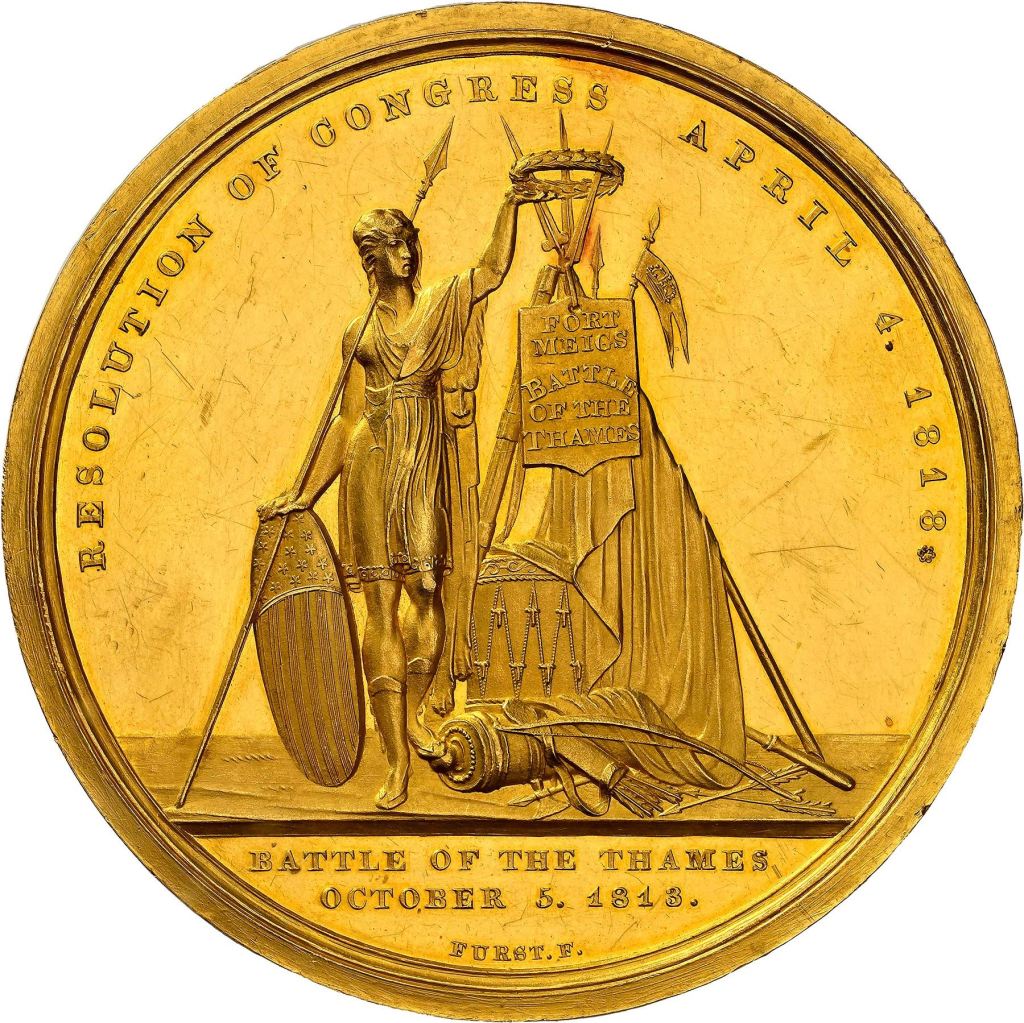
Following tradition, the obverse of this medal features a right-facing portrait of Harrison in uniform with legend reading MAJOR GENERAL / WILLIAM H. HARRISON. On the reverse we see a tunic-clad America personified holding a spear and U.S. shield and placing a wreath on a teepee-like stand of spears and flags suspending a plaque that says FORT / MEIGS / BATTLE / OF THE / THAMES above a drum, cannon, hatchet, bow, and quiver of arrows, with legend above reading RESOLUTION OF CONGRESS / APRIL 4, 1818, and with BATTLE OF THE THAMES / OCTOBER 5, 1813. in exergue below. The engraver’s signature FURST. F. appears at the bottom rim on both sides. The rims are quite wide, and the edge is plain, with angle-drilled holes at top for a suspension ribbon and holes at 3, 6, and 9 o’clock for pins to secure it to its box. XRF testing confirms it is solid, high-karat gold and nearly identical in trace-metal composition to Captain Thomas Truxtun’s War of 1812 medal at the Smithsonian Institution.

The containing box and slipcase from original issue are in red leather, with blue velvet interior framed with gilt scrollwork. Holes at 3, 6, and 9 o’ clock prove the purpose of the corresponding holes in the medal’s edge, with some of the actual pins still present.

Finally we have the medal itself, with Harrison’s high-relief matte-finish portrait practically jumping from the rich mirror surfaces, while the allegorical design on reverse deftly draws the eye to the laurel wreath at the peak of the mountain of trophies, symbolic of a hard-won peace. With hardly more than a handful of rim-nicks, light marks, and an almost imperceptible rub on the very highest points only, its wide blank fields showing inevitable surface hairlines floating like gentle waves on uninterrupted lakes of luster, this masterpiece in rich old gold is a national treasure in every sense of the word.

Lot 1609 – U.S.A., Congressional Gold Medal, William Henry Harrison / Victory at the 1813 Battle of the Thames, dated 1818, issued 1824, by Fuerst, unique and important, NGC MS 60 Prooflike, ex-Harrison, ex-Adams. Julian-MI14; Loubat-50; Wyatt-21; Neuzil-16. 241.64 grams; 64.9mm (up to 4.3mm thick). With original box and copy of letter of authenticity. Estimate: $500,000-up.

The lot can be viewed on the auction site here: https://auction.sedwickcoins.com/U-S-A-Congressional-Gold-Medal-William-Henry-Harrison-Victory-at-the-1813-Battle-of-the-Thames_i50547969.