

by Cori Sedwick Downing

Collector: someone who collects objects because they are beautiful, valuable, or interesting.
For me, beauty and interest outweigh value, although it’s satisfying when the first two intersect with the third. Years ago, I started researching a robust field of coins, the Charles and Joanna coinage of Mexico City, and my interest was quickly piqued. Not only was the story of the first mint in the New World compelling, but the coins minted there were extremely well struck and beautiful, unlike many of the coins that came after that period. I was also taken with the simple “castles and lions” shield on one side and “pillars and waves” motif on the other.
Like any hobbyist who aspires to fill in his or her collection in a purposeful way, I learned as much as I could about the coins that had caught my attention. I bought a copy of Robert A. Nesmith’s 1955 book, The Coinage of the First Mint of the Americas at Mexico City, 1536-1572, and read it cover to cover. It’s still a great reference 70 years after publication! I read the transcript of the Tello de Sandoval investigation into possible mint improprieties during the tenure of assayer G, Juan Gutiérrez, which gave me a lot of information about the inner workings of the mint and who was there. I read about Hernán Cortés’ conquest of the Aztecs, which set the stage for a mint to be established in Mexico in 1536. I read about the Spanish monarchy to know why the coins bear the names of two rulers: Charles and Joanna. The former was the son of the latter, who by all accounts was crazy and certainly wasn’t capable of ruling over an empire. It was like a soap opera!
I began to keep census of all the varieties of all the denominations of coins from what Nesmith termed the “Early Series” and the “Late Series” assayers. The pinnacle of my work came when we were privileged to handle the sale of the Clyde Hubbard collection of Mexican Charles and Joanna coins, several of which were plate coins in Nesmith’s book.
My collection is not exhaustive because I decided early on to concentrate on rare and sometimes unique varieties and smaller denominations, which are harder to find. I never chased grades because I find it more important to have a coin in whatever condition it was found if there are only one or two known. There are so many varieties that you could spend a lifetime trying to acquire each one! Like the coins, I hope the results of my years-long study—which should be available soon and will feature most of the coins in my collection—helps further interest by avid collectors and people like me who just happen to find these coins beautiful.
Selected Featured Lots:
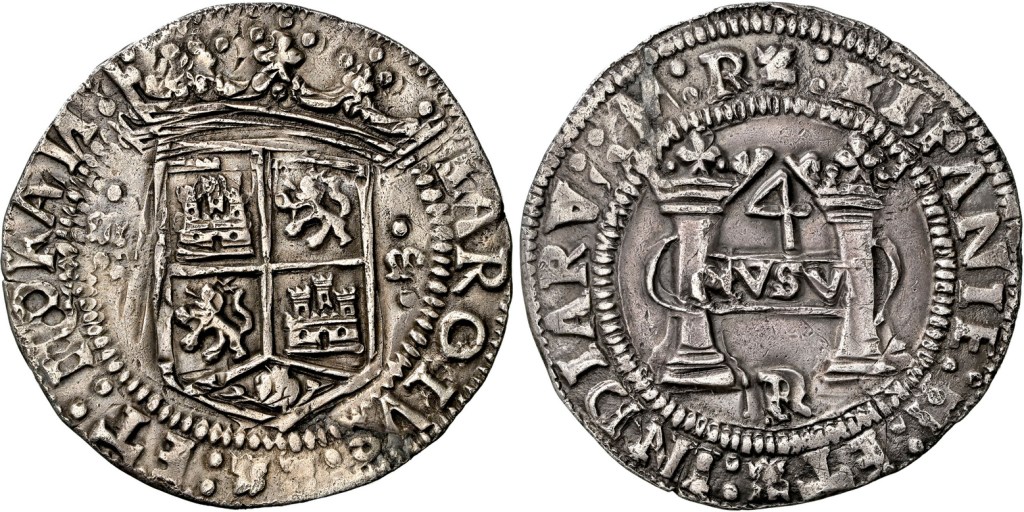
Lot 518 – 4 Reales, Early Series, Assayer R/R (Francisco del Rincón)
This exceptionally broad-flan four reales coin represents one of the earliest issues under Francisco del Rincón, the first assayer of the Mexico City Mint. Bearing a doubled R/R mark at the base of the pillars, it displays a bold strike with clear legends and a rich toning. The coin’s design—castles and lions on one side, pillars and waves on the other—captures the aesthetic ideals of the Early Series. Its die pairing reveals the reuse of shield dies by subsequent assayers, underscoring continuity in early minting practice. Pedigreed to the Sedwick–Downing Collection and graded NGC AU 50, it remains one of the finest known examples of the Rincón type.

Lot 527 – 4 Reales, Early Series, Assayer F, ex-Huntington, Nesmith Plate Coin
Among the rarest of the entire Charles and Joanna series, this 4 reales piece struck by the elusive Assayer F is both a Nesmith Plate Coin and a former holding of the Huntington Collection at the Hispanic Society of America. The issue, known by very few specimens, is distinguished by full legends, golden toning, and only minor surface corrosion. As one of the rarest assayers represented, it has been used in modern die-linkage studies to clarify the chronological sequence of early mint operations. The specimen is a cornerstone piece for understanding the earliest evolution of mint production following Rincón’s tenure.

Lot 533 – 2 Reales, Early Series, Unique Rhomboid Motto Panel
This unique 2 reales coin exhibits an unprecedented rhomboid motto panel enclosing the inscription PLVS. The specimen, attributed to Assayer Rincón, is the only known example of its kind, pairing a rhomboid design with Gothic lettering and a later die used by Assayer P. Its discovery bridges stylistic transitions within the Early Series, providing crucial evidence of experimentation at the Mexico City Mint during the late 1530s. The coin’s rarity and stylistic innovation make it one of the collection’s most academically valuable pieces.

Lot 543 – 1 Real, Early Series, Assayer G, Over-Assayer Type
This 1 real coin represents a transitional issue showing evidence of an over-assayer strike, in which an earlier die from Assayer F was repurposed under Gutiérrez. The piece features full interiors, deep toning, and minimal wear. Its die linkage to both preceding and subsequent issues makes it a key specimen for understanding the mint’s workflow and reusability of dies. Such examples are indispensable for reconstructing chronological mint sequences of the Early Series.
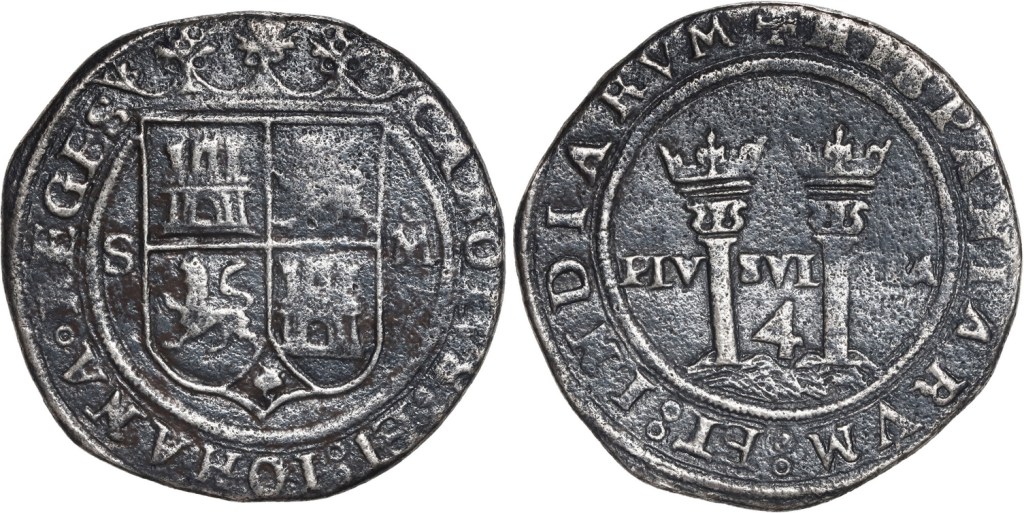
Lot 556 – 4 Reales, Late Series, Assayer S, Padre Island Shipwreck
A rare survivor of the 1554 Spanish Fleet wrecked off Padre Island, Texas, this 4 reales piece from the rare Assayer S illustrates the culmination of the Charles and Joanna coinage before the reforms of Philip II. Its well-preserved surfaces and dark patina testify to its maritime provenance. Few coins of this assayer are known, and its presence in this collection adds both archaeological and numismatic significance. Graded NGC VF details, it is one of the most compelling shipwreck-related specimens of the Late Series.
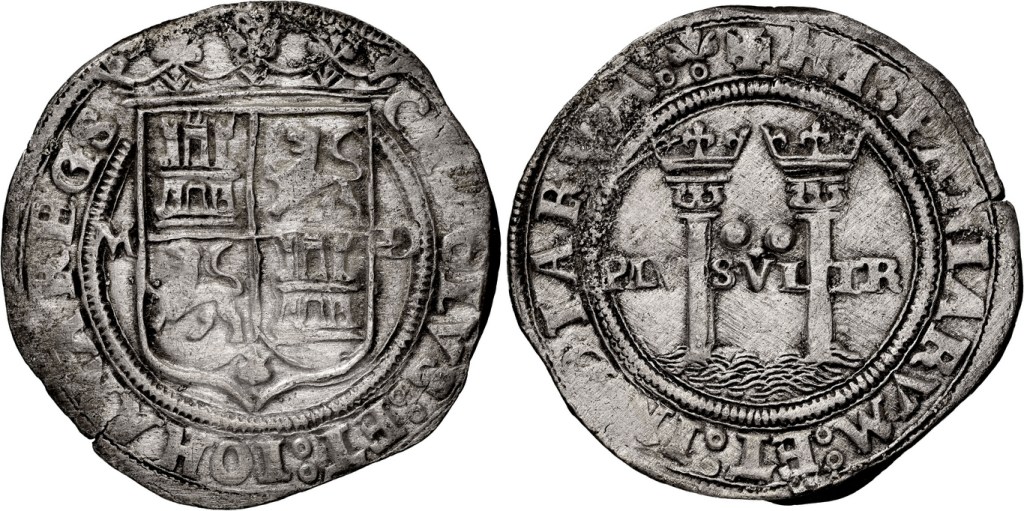
Lot 564 – 2 Reales, Late Series, Inverted G Die Error, ex-Dr. Peter Jones
This intriguing 2 reales coin from the Late Series displays the assayer’s initial G punched upside down—a remarkable minting blunder known in only eight examples. The coin is cited in Dr. Peter Jones’s *The First Coins of the Americas* (2020) and is considered among the best preserved of its type. Its existence underscores the human variability inherent in early minting, as well as the challenges faced by the Mexico City engravers in maintaining die consistency under growing production demands.


 SEDWICKCOINS BLOG