

This auction brings together one of the most complete and exciting selections we have ever offered, combining important named collections with individual rarities from all across the world of numismatics. The result is a sale that captures the full story of coinage in the Americas and beyond. As usual, it is consignors and bidders who make this possible, so we thank you all!
 Our business was built on cobs and shipwreck treasure, for which we remain the world’s foremost experts, so it is no surprise that this auction is loaded with shipwreck ingots, coins, and artifacts. We run a very clean operation—everything is checked carefully for proper provenance and certification, and in most cases the material we offer comes straight from the source. In fact, our auctions are better than buying from the source directly, as everything we sell is guaranteed and certifiable at any time. In today’s fly-by-night world, this is a critical difference.
First, it is our privilege to presen the Sedwick-Downing Collection of Charles-Joanna Coinage of Mexico City, the result of more than a decade of study and collecting. What began as curiosity grew into a deep passion for the beauty, history, and meaning behind the first coins of the New World. This catalog marks an important milestone in that journey, with the full publication of Cori’s research to follow soon.
For this auction, we hit the ground running with the McGregor Collection of Gold Cobs from the 1715 Fleet, a vivid reminder of the beauty and adventure tied to Spanish colonial treasure. While this collection showcases a full range of denominations of gold cobs from Mexico City (including a fabulous Royal-dies 1714 8 escudos) and Lima, it also contributes to significant offerings from Cuzco and Cartagena, the latter including a coin that will be featured in Daniel Sedwick’s upcoming book, Arce’s Doubloons. Of course, our treasure coverage is certainly not limited to Spanish colonial cobs. In fact, in this sale we feature all of the famous United States shipwrecks, namely S.B. Pulaski (1838), S.S. New York (1846), S.S. Central America (1857), S.S. Brother Jonathan (1865), and S.S. Republic(1865).
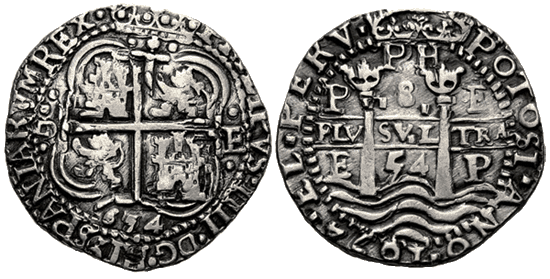
Highlighting our usual silver-cob offerings are several key collections, in addition to the aforementioned Sedwick–Downing Collection. In Lima cobs you will find the Jorge Ugaz Collection of Lima Cob 2 Reales, and in Guatemala cobs is the Darby Collection of Guatemala Cobs, both the result of decades of study and selectivity by devoted specialists. As always, “Royals” (galanos) steal the attention in all three cob sections (Mexico, Lima, Potosí), including a unique Mexican 4 reales Royal dated 1612/1, expanding the cob market into a rarified level of special pieces for truly dedicated collectors.
Outside of cobs, this auction presents an enviable selection of Latin American trophy coins, including two concentrated collections in Chile (the Val y Mexía Collection of Chilean Bust 4 Reales) and Peru (the Almenara Collection of Peruvian Republic Gold Coins), plus key rarities in Spanish colonial pillar dollars (Mexico 1732 and Nuevo Reino 1759), Cuba (unique Guanabacoa medal dated 1747 plus many rare or unique modern proofs), Dominican Republic (10 reales silver pattern 1855), and Panama (1904 proof set), and a veritable panoply of types from around the world, not just the Americas (including some key U.S. coins) but also Europe, Asia, and even Africa. The mix extends from ancients and early hammered types to classic milled crowns and gold issues, all the way to modern proofs, and every section offers key pieces selected for rarity and quality in a range that rarely appears at auction.
The other side of numismatics is paper money, and in Latin America we continue a strong auction presence, here with a selection of incredibly rare and high-grade Dominican Republic notes issued between 1857 and 1865, all new to the market.
Finally, our auctions are unique for offering treasures in coin jewelry and shipwreck artifacts in a wide range of time periods (over two centuries), particularly from the Atocha (1622), Concepción (1641), Bannister’s pirate ship Golden Fleece (1686), 1715 Fleet, and S.S. Central America(1857).
As yet another exciting auction from the Sedwick company, this one is sure to get everyone’s collecting juices flowing, demonstrating that numismatics and treasure transform history and artistry into excitement and positive human collaboration, something our world can surely use more of today.
The Sedwick & Associates, LLC team:
Daniel Sedwick, Augi García-Barneche, Cori Sedwick Downing, Connor Falk,
Michelle Heidt, and Sarah Sproles
Live on the Internet, Thursday-Saturday, November 13, 14, & 15, 2025



 SEDWICKCOINS BLOG