Archive | Shipwrecks RSS feed for this section

The Wreck of the S.B. Pulaski (1838)

10 Nov

By Connor Falk

The S.B. Pulaski represents one of the earliest of major U.S. shipwrecks to be salvaged and the coins recovered provide a fascinating glimpse back in time to late-1830s America.

The Pulaski explodes; from page 170 of the book The Tragedy of the Seas; or, Sorrow on the ocean, lake, and river, from shipwreck, plague, fire and famine (1848) by Charles Elms

The ship began her brief life in 1837 at the shipyard of John A. Robb located in Fell’s Point, Baltimore, Maryland. Built for the Savannah & Charleston Steam Packet Company, she was a steam packet meant for carrying passengers, cargo, and mail up and down the East Coast. In an interesting historical connection, the shipbuilder John A. Robb also constructed the famous S.S. Republic (launched in 1853 as the S.S. Tennessee), which also ran an East Coast route until her sinking in 1865 with a cargo of gold and silver coins.

The Pulaski was a brand-new and luxurious ship, affording her passengers a comfortable journey. She was favored by wealthy Southern families and businessmen whenever they needed to travel from the South up to the North and back again. Her cargo holds held trade goods and U.S. Post Office mail packets, earning further revenue for her owners.

The Pulaski’s voyage on June 14, 1838, started off normally. She had departed Charleston, South Carolina, at 6 AM, having come up from Savannah, Georgia. Captain John Dubois commanded the ship with a crew of 36 and with around 150 passengers aboard. Now bound for Baltimore, Maryland, the passengers settled in for a day heading out to sea.

At 10 o’clock that night, the Pulaski was about 40 miles off the coast of North Carolina, sailing north at a steady clip in moderate seas. The First Mate, Mr. Hibberd, had charge of the ship and was pacing the promenade deck. As he later told the Wilmington Observer, he “found himself shortly after upon the main deck, lying between the mast and side of the boat.”

Regaining consciousness, Hibberd headed to the midships. There, he found the head of the starboard boiler blown out and the decks above torn apart. The hull was also damaged and Hibberd observed water rushing in whenever the ship heeled to starboard. Later accounts would blame the ship’s engineer for the explosion by letting the boilers run dry then refilling them with cold seawater while hot.

The boiler explosion killed many passengers and crew instantly in their cabins. Captain Dubois was lost, presumed killed in the explosion. First Mate Hibberd began launching the lifeboats, initially telling passengers they were to inspect the ship’s hull, so as not to raise a panic. One of the lifeboats was in poor condition due to sun exposure; after several attempts to bail it out, it capsized. The other two lifeboats, loaded with 21 survivors including First Mate Hibberd, stayed near the Pulaski until it broke up and sank just 45 minutes after the explosion.

The 21 survivors in the two lifeboats made their way to the North Carolina shore. After paddling north for some time, hoping to find a way into the intercoastal waterway, they attempted to land on the beach. The rough waves overturned the first lifeboat near shore and five of the eleven survivors on board that boat drowned in the surf. Three hours later, the second lifeboat made a successful landing. The survivors then made their way to Stump Sound where a local took them in. Two days later, First Mate Hibberd and two other passengers left for Wilmington where they reported Pulaski’s sinking. They were initially thought to be the only survivors of the wreck.

On the morning of Tuesday, June 19, the crew of the schooner Henry Camerdon came across a sight: a large portion of the deck of the S.B. Pulaski, barely afloat, containing 23 survivors. Once taken aboard, the survivors mentioned another piece of the wreck was floating nearby with more survivors. An hour later, the Henry Camerdon rescued a further seven survivors who were clinging to a piece of the wreck. The survivors, suffering from exposure and dehydration over four days, were brought back to Wilmington. The Fayetteville Observer newspaper then reported that a further thirteen survivors had come ashore at New Inlet. Of the 37 crew and over 150 passengers aboard, 59 were saved.

The Newbernian newspaper of New Bern, North Carolina, eulogized those who died in the S.B. Pulaski sinking in their Friday, June 29, 1838, edition as follows:

“Dreadful Steam Boat Disaster!

“Thus have we hurriedly sketched the most painful catastrophe that has ever occurred upon the American coast. Youth, age, and infancy have here been cut off in a single night, and found a common death under the same billow.

“Days, months, years and ages will circle away, and still the vast waters will over them roll.”

It wasn’t until 2017 that the wreck site of the S.B. Pulaski was located. Discovered by Swordfish Partners, the salvors filed an admiralty claim on the then unknown wreck. In partnership between Blue Water Ventures International and Endurance Exploration, the salvage work began with the main goal of definitively identifying the wreck. Divers sent down to the 120 foot-deep site found a scattered wreck covered in several feet of sand. In early 2018, a single brass tag was found bearing the name S.B. Pulaski.

With the wreck thus confirmed as the Pulaski, salvage began in earnest. Over the course of a few salvage seasons, many small artifacts such as silverware, pocket watches, and jewelry were found. Several larger artifacts found included ship’s tackle and a silver religious altar decoration.

Silver and gold U.S. coins were also discovered along with world coins that circulated in the United States during the 1830s. However, unlike the famous S.S. Central America, S.S. Brother Jonathan, or S.S. Republic, which mainly carried coins as their cargo, vast quantities of coins were never found on the S.B. Pulaski. The few recovered coins were all pocket change from the passenger and crew, representing a sample of coins found in circulation at the time. Thus, every coin from the S.B. Pulaski has a very real connection to those who sailed on her during her final voyage.

To view two rare coins recovered from the wreck of the S.B. Pulaski, please visit our November 13-15, 2025 Auction 38 here: https://auction.sedwickcoins.com/Treasure-World-U-S-Coin-Paper-Money-Auction-38_as110855?p=1&ps=50&so=1&q=pulaski&hi=0&vm=1

400-year-old gold bar from famous shipwreck to be sold in May auction

26 Apr

When the Spanish treasure galleon Nuestra Señora de Atocha sank in 1622 off what is now Key West, Florida, she took down untold treasures in gold and silver. And now a particularly famous piece of treasure from the wreck is crossing the auction block.

One of the largest gold bars ever recovered from a Spanish colonial shipwreck is up for sale on May 7th in an auction conducted by Daniel Frank Sedwick, LLC in Winter Park, Florida.

The gold bar, listed in the sale as lot 96, weighs over 5 pounds (2,274 grams), measures 8-3/4” x 1-1/2” x ¾”, and consists of 17-karat gold mined in the New World. The unique bar features eight circular royal tax stamps bearing the King of Spain’s name as PHILIPPVS III along with five XVII (17-karat) gold fineness markings. The bar also possesses a single foundry and assayer mark reading SEBATN / ESPANOL at the center, a mark that is both unattributed and only found on two gold bars recovered from the Atocha.

This 5-pound gold bar recovered from the famous Atocha shipwreck sunk in 1622 is up for auction on May 7th in Daniel Frank Sedwick, LLC’s Treasure Auction 35

The gold bar’s pre-auction estimate is $200,000 and up.

“This Atocha gold bar is a crowning treasure piece from the most popular salvaged shipwreck treasure ever,” said Daniel Frank Sedwick, owner and founder of the auction firm. “With its high intrinsic value in Spanish colonial gold plus its incredible historical value, it will be a trophy piece for its next owner.”

The gold bar was created in the early 1600s at a Spanish colonial foundry processing gold and silver mined throughout South America. After being transported overland to Panama City, this gold bar, among others, was loaded in mid-1622 aboard the Spanish treasure galleon Nuestra Señora de Atocha. The Atocha, a three-masted galleon constructed just two years prior, was to carrya vast treasure of gold and silver ingots, Colombian emeralds, and silver coins all bound for mainland Spain.

When the Atocha departed her final port at Havana, Cuba on September 4th, 1622, she was the almiranta, the lead ship, of the 28-ship 1622 Fleet. The Fleet was a vital link in Spain’s finances as the gold and silver from the New World funded the royal treasuries. In addition to the treasures on board, the Atocha carried her crew along with soldiers and passengers, around 265 people in all, intending to cross the Atlantic Ocean and return to Europe.

Just two days out from Havana, the Fleet was engulfed by a hurricane while approaching the Florida Straits. Amid the storm, the Atocha was wrecked and torn apart upon a reef off the Florida Keys. Only five people survived the sinking, having clung to the highest remaining mast of the ship as it sank. The wreck of the Atocha was further scattered just a month later during another storm, preventing the Spanish colonial authorities from salvaging any of her precious cargo spilled across the ocean floor.

“Atocha Meets Her Fate,” by Ralph Curnow (2009)

The treasure of the Atocha did not see light again until 1971, when the first coins were found by the now-famous salvager Mel Fisher and his divers. Throughout legal battles and personal tragedies, the salvage group eventually recovered the bulk of the treasure in 1985 and thereby unleashed the largest supply of silver cobs and ingots the market has ever seen.

This gold bar will be auctioned along with its photo-certificate issued by the Fisher salvage company in 1985. The bar also boasts a pedigree to the Christie’s Atocha auction of June 1988 as lot 90.

Other treasures from the Atocha in the upcoming Sedwick auction include:

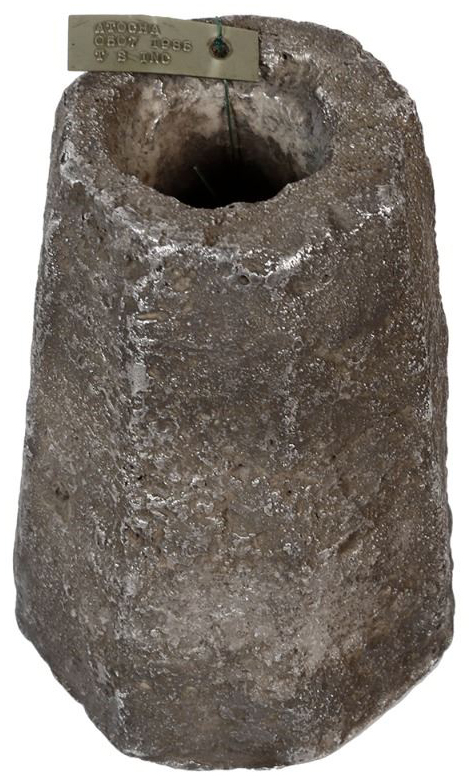
– a large silver ingot from Oruro weighing over 88 troy pounds (Lot 105) estimated at $30,000 and up.

– a silver ingot from Potosí weighing over 82 troy pounds (Lot 106) estimated at $25,000 and up.

This large silver “piña” ingot weighing 5,335 grams, one of just three recovered from the Atocha shipwreck, is also featured in auction

– a very rare silver piña ingot, one of only three known from the Atocha, weighing 5,335 grams (Lot 107) estimated at $15,000 and up.

– over 180 silver coins from Potosí, Mexico City, and Lima including 19 high grade pieces from the Bill Barman Collection of Atocha Research Coins

“To have this amazing gold bar alongside all these other treasure pieces from Atocha in a single auction is a feat not seen on this market in decades,” said Sedwick. “And it won’t be seen again anytime soon.”

The three-day auction will be held live online at auction.sedwickcoins.com. The Atocha gold bar can be viewed on the auction site here: https://auction.sedwickcoins.com/Large-gold-ingot-77-2274-grams-marked-with-fineness-XVII-17K-foundry-assayer-cartouche-SEBATN_i52415344. For more information, contact Daniel Frank Sedwick, LLC by email at office@sedwickcoins.com.

Sunken luxury: the loss of the SS Andrea Doria

3 Jan

The SS Andrea Doria name invokes tragedy now, but at the time of construction, she represented the hopes of Italian recovery after World War II. Construction began in 1950 with the ship launching in June 16, 1951. In terms of size, she was 697 feet long with a 90 feet beam and had a total tonnage of 29,100 tons. When fully furnished, she represented a source of Italian pride by being one of the finest ships on the Atlantic Ocean at the time. Even her namesake, the 16th-century Genoese admiral Andrea Doria, invokes a sense of Italian maritime power.

tn_andrea_doria

The SS Andrea Doria at sea.

During her three years of service from 1953 to 1956, she had many transatlantic voyages and became popular with passengers for her luxury accommodations and quick speed. Passengers had every form of entertainment at their disposal, from movie to swimming pools, orchestras to modern artworks and mosaics. A lot of money and wealth went into the Andrea Doria, both in terms of construction and her passengers.

On the night of July 25, 1956, the Andrea Doria was on the final leg of a voyage, destined for New York City the following day. Travelling through heavy fog, the bridge officers noted a radar blip ahead. Despite taking evasive maneuvers, the distance between the two ships was too little for any meaningful actions. Out of the fog, the bow of the MS Stockholm, a Swedish American Line passenger liner, plowed into the Andrea Doria’s starboard side, leaving a gaping hole. However, safety measures kept the Andrea Doria afloat for 11 hours, long enough for the survivors to evacuate. All together, 46 people died aboard the Andrea Doria while 6 crew members of the Stockholm were killed, most during the collision itself.

The below newsreel shows images of the doomed ship in the early hours of July 26, 1956. Divers descended upon the wreck just a day after its sinking to find it lying on its starboard side at a depth of about 250 feet, far too deep for recreational diving.

Divers descended upon the wreck just a day after its sinking to find it lying on its starboard side at a depth of about 250 feet, far too deep for recreational diving. Since then, through advances in diving equipment, technical divers are able to reach the wreck.

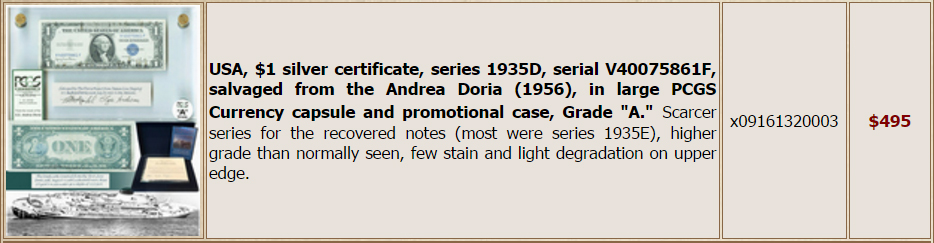
In 1981, adventurer Peter Gimbel, his wife Elga and a salvage team uncovered the Bank of Rome safe held onboard the ship. When the safe was opened in 1984, thousands of American $1 silver certificates, hundreds of Italian bank notes as well as American Express checks were found, still preserved despite decades of submersion. The Gimbels carefully preserved and encased the banknotes in protective Lucite holders before offering them on the numismatic market. Many silver certificates and Italian lira have since been graded by PCGS Currency according to shipwreck grading standards.

img284ss

An example of a Andrea Doria recovered $1 silver certificate.

As the leading shipwreck coin and artifact dealer, Daniel Frank Sedwick, LLC has a number of $1 silver certificates recovered from the SS Andrea Doria for sale. All notes are graded “A” by PCGS Currency, meaning they are almost entirely intact (despite 30 years of saltwater immersion), with prices dependent upon the eye appeal of the note. They come in a blue case along with a DVD of their recovery by the Gimbels and their crew. To view these notes, please click on the picture below and navigate to the Andrea Doria listing:

ffadfad

Today, heavy currents, silt clouds and the depth still make the Andrea Doria a difficult wreck to dive, earning it the nickname “the Mount Everest of wreck diving.” Regardless, the allure of the ship’s luxury and artifacts still on board bring divers back again and again. For many, a dive to the SS Andrea Doria will never happen. By buying these silver certificates, anyone can own a piece of history from a ship that launched with so much promise only to become a modern tragedy.