Archive | Other Articles RSS feed for this section

Having a (Blue) Devil of a Good Time

8 Apr

Many people know that my brother, Dan, and I attended Duke University and some may remember that our father, Frank Sedwick, graduated from Duke way back in 1944. But the legacy doesn’t end with us. Our sister went to Duke Medical School, our older brother graduated from Duke, and we have a nephew who graduated a couple of years ago. Do we bleed Duke blue? Yes, we do!! Duke University

Naturally Monday’s NCAA men’s basketball final game between Duke and Wisconsin was a big hit in our households. Perfect timing for us: the hot-off-the-presses Treasure Auction #17 catalogs were in the mail to bidders and customers. We could take a breath and enjoy the victory.

This week, it’s back to business as Dan and Augi leave for the Chicago International Coin Fair. You can view auction lots there, so make plans to attend!

As for the auction, here are some of my favorite items that you might want to check out:

  1. Did you read the 2007 interview between Dan and Lou Ullian (now deceased) that appears on page 8? It’s a great read.
  2. The section on Shipwreck and Hoard Histories on p. 12 is always enlightening.
  3. Gold, gold, and more gold starting with coins on p. 23 and bars on p. 63.
  4. Do your tastes run to silver instead of gold? How about silver bars starting on p. 69?
  5. The shipwreck coins section begins on p. 73.
  6. Check out the VERY SPECIAL “First dollar coin of South America,” the 8R Rincon Lima (Lot 711) and other denominations of the Rincon series on pp. 152-155.
  7. Then check out the Roman-Egyptian clump, lot 267 on p. 73. When will you ever see something like that again??
  8. I love Royals (what’s not to like?) and there are plenty in this auction: Lot 706 (1/2R Mexico), Lot 707 (1/2R Mexico), Lot 753 (2R Lima), Lot 897 (8R Potosi), Lot 909 (8R Potosi), Lot 910 (8R Potosi), Lot 914 (8R Potosi), Lot 928 (8R Potosi), and Lot 945 (8R Potosi).
  9. For those who like their coins non-sea salvage, check out coins starting on p. 145.
  10. DO NOT MISS Dan’s article that includes a table of Potosi 8R of Philip II on p. 164!
  11. Ancients begin on p. 215.
  12. World coins begin on p. 219.
  13. Medals and tokens can be found starting on p. 268.
  14. Documents are on p. 275. Maps are always fun and a wonderful wall adornment (I have an antique map of Peru on my office wall to remind me of a trip I took there with my husband).
  15. The ever-popular shipwreck artifacts section begins on p. 278 and some of my favorites in this section include a stunning gold-and-red-coral rosary (Lot 1400), a sweet olive blossom chain (Lot 1466), a very large olive jar (Lot 1486), and an impressive Spanish brass cannon (Lot 1504).

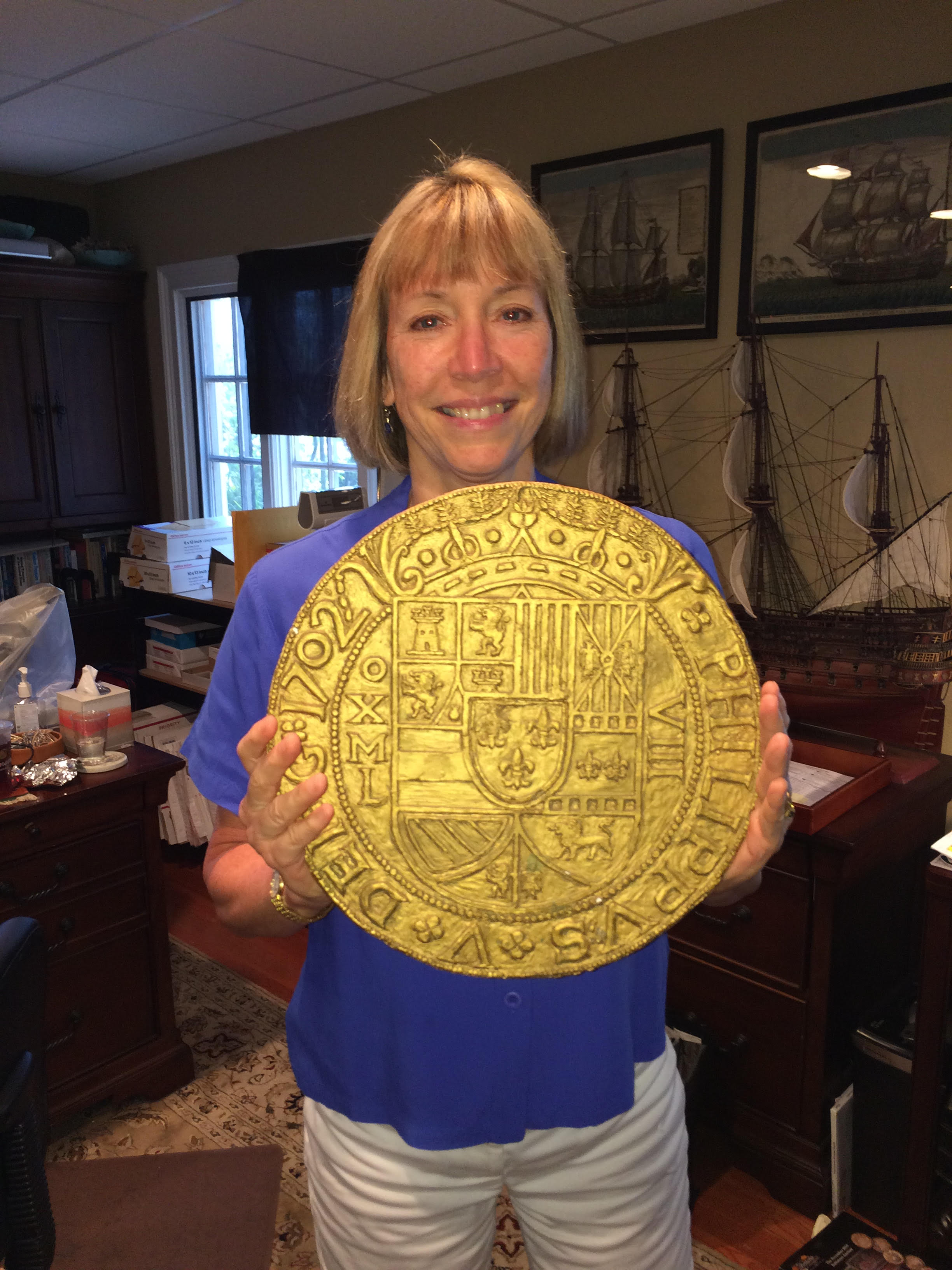
And don’t miss the last lot, Lot 1560, with a picture of yours truly holding a GIGANTIC plaster reproduction of an 8 escudos Mexico royal!

Happy Bidding to all.
So You Think You Can Dance (or Produce an Auction Catalog)

25 Mar

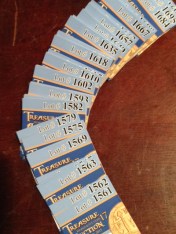
We’re in the home stretch with our Sedwick Treasure and World Coin Lot cards for TA #17Auction #17 catalog! Let me tell you why it’s a Herculean effort by a few people…and a job best left to the pros.
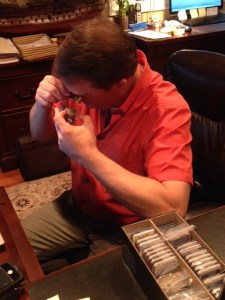
Auction and catalog production begins many months prior to the auction date as we reach out to consignors to send or bring their consignments to us for evaluation and approval. This is the really fun part of the auction process because we never know what’s going to come through the door, and picking up packages at the post office seems a bit like Christmas. While most consignments consist of coins, there are also great consignments of artifacts and good old-fashioned pirate stuff:  swords, cannons, cannonballs, blunderbusses. Each coin and artifact is weighed and measured.Dan working on TA #17 (2)

Once we’ve decided that enough is enough and the deadline for consignments has drawn to an end, the real work begins. The order of lots is established (see the table of contents of any one of our catalogs for how we concatenate), and lot cards are designed and printed. Now we can shuffle lots from their temporary order to the lot-card order, and Dan can begin to study each auction lot to write up a description for the catalog. At the same time, Augi fires up his photography studio to begin the time-consuming process of photographing each lot. He will finish the process on the computer to arrive at the beautiful images you see in our catalogs.

In between we must find time to go to shows to promote auction items and give buyers a chance to see coins first hand. This is the best opportunity for anyone who has an interest to really be sure that a coin is what we say it is, so if you want to view auction lots for our upcoming auction on April 29-30, 2015, come see us at either the Whitman Baltimore Spring Expo on March 26-29, 2015, at the Baltimore Convention Center or at Chicago International Coin Fair on April 9-12, 2015, at the Crown Plaza Chicago O’Hare.

After our auction catalog is professionally printed, we quickly send catalogs out to many, many potential bidders. Are you one of them? The link to the auction will be available soon on our website, so stay tuned!Last lot TA #17

In Professionals We Trust

16 Feb
Chef David

Chef David

Last weekend, when my husband and I (and Augi and his wife too!) spent a sumptuous Valentine’s dinner at a cooking school with a chef, we learned a great deal about food preparation and cooking. And here I thought I was pretty good in the kitchen! It just goes to show that a professional beats an amateur any day of the week, and if you want to learn a lot, find a pro and become his mentor. It doesn’t matter whether you’re talking about cooking or coins, the same principle applies. Bon appetit!

Last week, a reader asked what features in a given coin are sufficient enough to affect its value relative to another similar coin? While that’s a very hard question to answer because it’s so general, I can tell you something about judging cobs by way of an article my brother wrote for The Practical Book of Cobs

 How to Judge the Worth of a Cob 

by Daniel Frank Sedwick

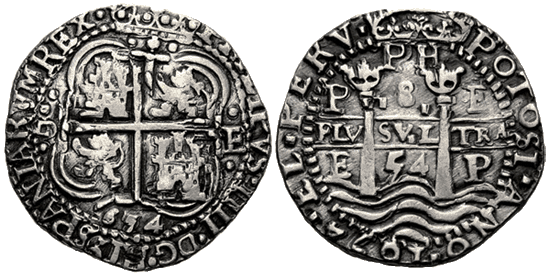
1654roya3l

Judgment of the relative worth of a gold or silver cob, within the market range of its category at any given time, should reflect a composite evaluation of these factors:

  • 1.   What is the mint?
  • 2.   Is the mintmark visible, and how clearly so?  How many indications of mintmark are visible?  (Up to three are possible on silver cobs of the pillars-and-waves type.)
  • 3.   Is the full date visible?  In the case of a partial date, the final one or two digits are more important than the first one or two digits.  Or is the cob of a period when cobs were not dated, hence the absence of a date is no factor?
  • 4.   If dated, how many dates are visible, and how clearly so?  (Two or three dates are possible on some cobs, only one possible on others.)
  • 5.   Is the assayer’s initial visible, and how clearly so?  How many repetitions of the assayer’s initial are visible?  (Up to three are possible on silver cobs of the pillars-and-waves type.)
  • 6.   Is the legend readable?  Completely so?  Partially so?  Not at all?  (The king’s name and ordinal are the most desirable part of the wording to be visible.)
  • 7.   Is the denomination visible, and how clearly so?  (A second indication of denomination is possible on silver cobs of the pillars-and-waves type.)
  • 8.   How complete and clear are the elements of design and other details?  For example, what percentage of the shield, crown, and cross is visible?  How nice, or poor, are the lions and castles?
  • 9.   Are the design and details well centered, and on both sides or on only one side?  If not well centered, as is usually the case, what is gained and what is lost in the expansion of some peripheral details and the resultant reduction of others?
  • 10.  Is the strike bold, average, or weak?  Neatly struck or double struck?
  • 11.  Is the cut of the metal of a shape typical for its period and mint or in some way more, or less, attractive or interesting?  (Cracks in the edge, while natural, lower a cob’s value, although smaller splits are less detrimental.)
  • 12.  How closely does the weight of the coin approximate its original stipulated weight?  Has the coin lost weight from shaving, slinging, or immersion in the sea?
  • 13.  Has the coin been unnecessarily cleaned or polished?  (Cleaning is necessary for silver cobs from sea salvage or land burial, undesirable otherwise.)
  • 14.  Has the coin been holed?  Plugged?  Removed from jewelry?  Mutilated in any other way?  (Holes in silver cobs are frequent, so not as damaging to their value as in the case of machine-made coins, but a cob without a hole is still much preferable to the holed piece.)
  • 15.  What is the overall condition or grade by normal numismatic standards?  (Very few cobs are seen in Uncirculated grade, or even in About Uncirculated.)
  • 16.  Entirely a subjective judgment, how attractive is the overall appearance of the coin (“eye appeal”)?  Does the coin appeal to you?
  • 17.  How many coins of this type—such as mint, assayer, date, specific shipwreck or sea-salvage—have been on the market lately?  (Sometimes a hoard of similar coins is discovered, and what used to be rare can become less rare.)
  • 18.  Are you sure the coin is genuine?  (Its purchase or trade from a cob specialist—be he dealer or advanced collector—is the best guarantee, until you yourself are sufficiently experienced to make the judgment with confidence.)

The few coins that do not fit into the prevailing price ranges are the particularly awful specimens (greatly underweight, very poor details, badly corroded, or mutilated), which will be lower, and the extraordinarily nice ones (singular detail and beauty), which can be higher.

Like all commodities, the overall foreign or domestic coin market oscillates be­tween strength and weakness at a given time.  This can be affected by general economic conditions (rare coins are purchased with discretionary income), or by fad (silver dollars can be hot one month, commemorative half dollars the next; or British coins are in demand one year, Spanish coins the next), or by a temporary and usually accidental surfeit or shortage of certain types of coins.  For example, in the 1983-85 period a huge hoard of gold cobs of the 1715 fleet appeared on the market and depressed prices.  After the material was absorbed, prices rebounded and today are many times their former levels.  The test of a coin worth holding is the ability of its price to recuperate from any temporary depressant.  Buy the best and the rarest and in the long run you will be safe.

Reproduction of the articles in whole or part is strictly prohibited without written permission of the author/s.

Shipping News

11 Feb

Around this time of year, auction consignments arrive daily at our local post office. I know a lot of people complain about the United States Postal Service, but we have had very few problems over the many years that we have received and sent auction material. In fact, one of the major boo-boos we ever had came care of Fedex, when they somehow managed to misplace an 80-pound Atocha bar (the wrapping material which included the address had become divorced from the bar)! Thanks to Augi’s persistence, the bar was recovered and received by the addressee without further incidence. Speaking of packaging material, we have a new winner for most interesting box ever received (see photo below). This was underneath the address label which I  removed to save the box for future use.Interesting shipping label

You may be interested to know how we recommend you send your precious coins and artifacts to us. If your material is worth more than $200, we ask that you use USPS registered mail and disclose full value (up to $25,000). It takes a bit longer to mail this way (up to 2 weeks domestically), but it’s very secure and reliable. The post office is picky about how a registered package is wrapped, too. You’ll need to use paper tape–which is not always easy to find–instead of the usual cellophane tape, and seal all edges. As always, if you have any questions about how to send things to us, just ask.paper tape

Talking about shipping made me think about all the coins, gold and silver bars, and gold chains that were shipped on Spanish galleons from the New World to Spain. Did you know that usually half of what was in the ship’s hold was contraband, or unregistered cargo? And on some ships, like the Capitana which was recovered in its time, there was MORE unregistered cargo than registered aboard!

Knowledge is Power: Online Numismatic Archive Resources

27 Jan

the-vaultIt’s an old adage that seems somewhat quaint, but the notion of equating power with knowledge is an enduring theme and a lesson that many people fail to learn. In the Internet age, there’s no reason for people not to have power through knowledge and thus make sound business decisions. This holds true for building your hobby as well. Why collect something you don’t know much about? When you learn more about it, your future purchases will be smarter. If you can’t get answers from the person from whom you’re thinking of buying something, where can you turn to increase your knowledge? As it turns out, lots of places!
Search engines for all types of coins are freely available on the Internet. One of my favorites is Coin Archives although we use the “pro” version in our office, and it’s not free. Still, the free version is quite powerful. This site tracks coins sold at many auction houses, including ours. As you enter the site, you can choose between looking up ancients or world coins. From there, you can type in some basic information, cob royal for example, or click on “see search tips” to help you narrow your search better. You can also click on “list of auctions available” and “contributing firms” so you know what the parameters of your results will be. Coin Archives will give you a list of 100 results (from most recent backward), but you can expand this number if you find a coin similar to one you’re interested in buying by clicking on “show lots similar to this one.”

The information you’ll glean can be invaluable. You’ll see a description of the coin, the auction date and estimate, the price realized, and a description of the coin including its pedigree and scholarly references if known (this is especially helpful with ancients). So, if you are interested in buying a coin similar to the one you’ve found here, you’ll now be able to make a more informed decision.

Another powerful search engine is acsearch. Many of the same auction houses that post their sales on Coin Archives also post them here and it’s completely free. There is a short, helpful tutorial on the front page which will guide you through the process of searching for coins, but it’s basically very similar to Coin Archives. Your search will be divided between ancient and modern coins. While you will need to create an account in order to see estimates and prices realized, it’s worth doing. You may find some information here that you don’t find elsewhere.

If you are interested in ancient coins, you need to check out Wildwinds which is a free reference website for ancient Greek and Roman coins as well as other ancient types. Once on the homepage, there is a drop-down menu allowing you to search via Sear numbers (a iconic reference for ancients) or by other means such as by city or ruler. When your search has returned results, be sure to click on the “browse with thumbnail images” before moving on. The amount of information here is staggering and the website creators should be lauded for their efforts. If you like ancient coins, you’ll love this website!
bookofcobsThe bastion of knowledge, your local library, can provide you with many of the expensive reference works that a dealer has spent a lifetime accumulating. First, go to WorldCat, a world card catalog of library books, and type in the name of the reference book you’d like to borrow. When I typed in “Practical Book of Cobs,” I was pleased to see that all the library systems within 100 miles of us have our book on their shelves. This is the first step of the process. From here, you will need to visit the reference librarian at your local library and fill out a form to have the book sent to your library, after which, you’ll have one to two weeks to pick up the book, take it home and use it, and then return it to your library. This process may seem a little cumbersome; however, it’s free and more important, for some reference books (particularly references for ancients), it may be the only place you’ll be able to find the book.
Don’t forget the Sedwick auction archive as a resource as well! Here you can browse through all of our catalogs and view prices realized for coins and artifacts. If you receive our catalogs, you know what a great resource they are. And speaking of catalogs, they are a good way to help you start your reference library. Even though you can research coins online all day long, you will still want a library which will contain books you can’t find online or in your library.

One caveat about auctions: you don’t always know why a coin sold for the price it did, especially if it’s so far out of line with an auction estimate. Sometimes it’s simply a matter of two people needing (or wanting) the same coin for their collection.

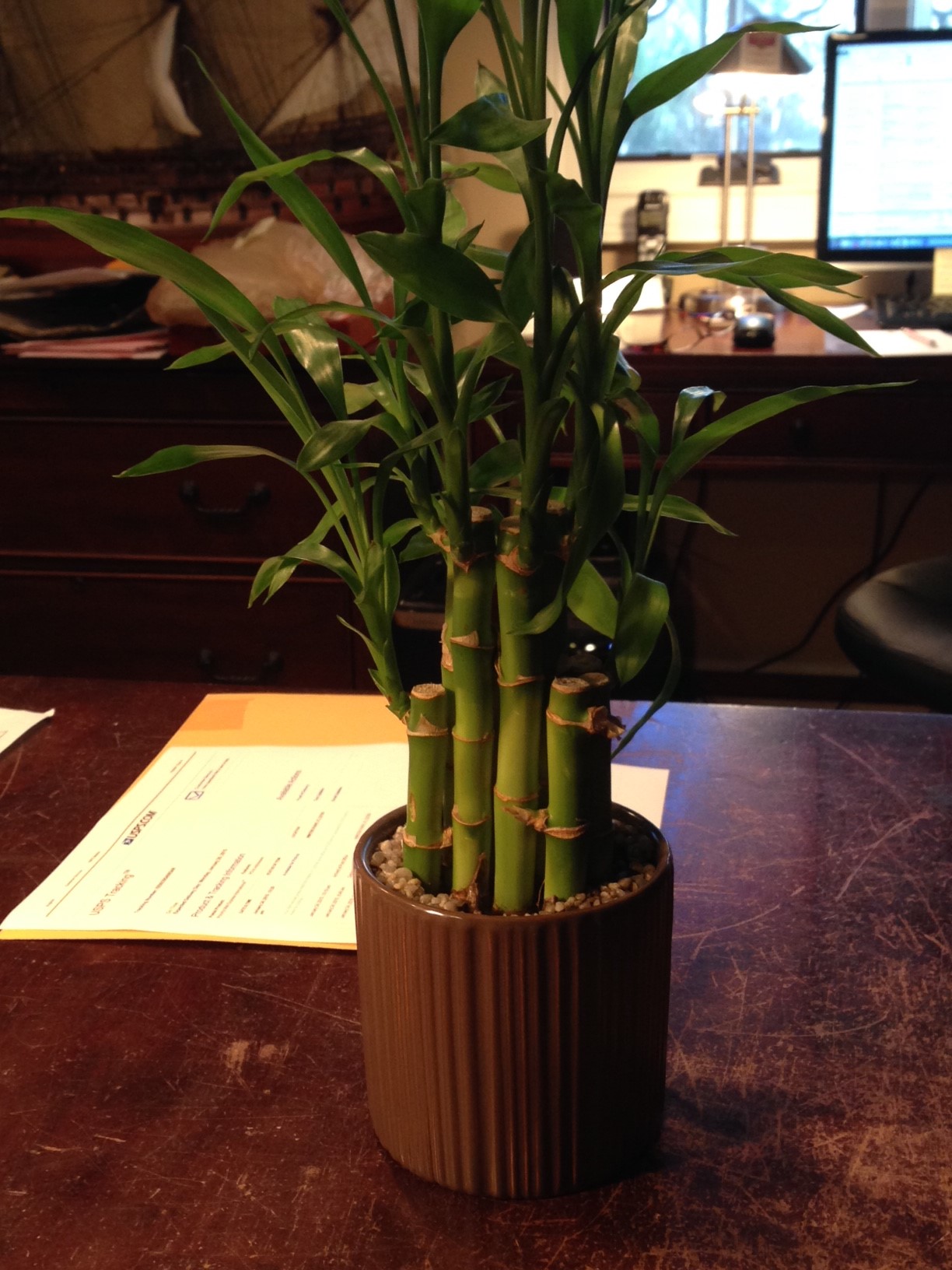
You can’t have power without some luck too, so that’s why we always have our lucky bamboo plant in the office!Lucky Bamboo