Gallery

The Use of Ciphers in Colonial Times

22 Apr
FullSizeRender_PAYDAY

Lot 1748, Sedwick Auction #19

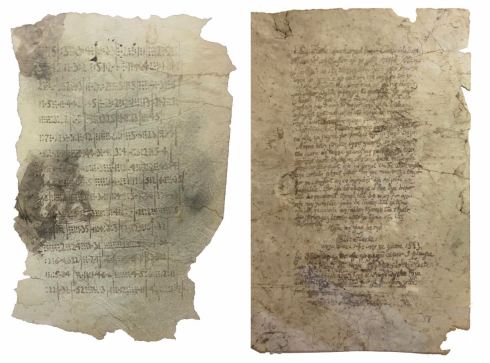
We have a fascinating document in our Treasure, World and U.S. Auction #19 that is unfortunately a counterfeit, but its underlying theory is genuine. Take a look at Lot 1743, a document purporting to be a statement made in 1553 by a pirate Eli Fleete giving details of where he buried his treasure in Barbados or thereabouts so he or his relatives (in case he wasn’t around anymore) would know where to find it again. The statement is coded, and the cipher to read the coding accompanies it. How convenient! None of it is true, so don’t bother to go looking for his treasure. What’s true is that ciphers were in use in colonial times.

24551496_1

Lot 1743, Sedwick Auction #19

Monarchs used ciphers to correspond with ambassadors and viceroys who were their ears and eyes in foreign courts. We have a letter and its accompanying cipher written by Hernan Cortes in early colonial times. We even have evidence of Philip II, the son of Charles I of Spain (also Charles V of the Holy Roman Empire) corresponding with ciphers. If you’re interested, you can read more at http://cryptiana.web.fc2.com. And so, while Lot 1743 is not a genuine letter and cipher, it represents a very well used convention in early colonial times. Nowadays, we call this “encryption,” so maybe there’s nothing new under the sun.

Encrytped letter from Hernan Cortes

Hernan Cortes Letter

Auction bidding for our Treasure, World and U.S. Coin Auction #19 is underway, so please sign up to bid! The auction will go live on the Internet on May 18 and 19. Please consult the catalog for Session times. Remember that the advantage of bidding ahead of time is that if there is a tie bid, the winner is the bidder who bid first.

Like our artwork for the cover? It’s lot 1748, the final lot in the auction and can be yours if you’re the winning bidder! You can read about the artist in the lot description.

Gallery

Sedwick Treasure, World, and U.S. Coin Auction #19 Highlights

24 Mar
FullSizeRender_PAYDAY

Payday by Liliya Skubish, cover for our upcoming Sedwick Treasure Auction #19

We’re busy getting ready for our next auction, which is quite a production! First we collect consignments, then we assign lot numbers to each auction lot, and then we photograph everything. While that’s going on, Dan writes a detailed description about each lot. After layout is complete, catalogs are ordered and voila, the fun really begins.

Dave Horner book

Book by Dave Horner, 1999


Speaking of consignments, we are very proud and pleased that two important collectors, Tom Gray and Dave Horner, are allowing us to auction all or some parts of their collections for them. The coins from Dave Horner’s collection (Dave is a well-known treasure hunter and writer) include 1715 Fleet gold cobs and shipwreck coins from the San Martin, the Capitana, the Maravillas, and the Jupiter Wreck.

Tom Gray’s collection, which was previously exhibited as “Treasures of the Deep: Galleons, Storms and Archeology,” last year at the American

Tom Gray with his mother, Anne Gray

Tom Gray with his mother, Anne Gray

Numismatic Association’s museum in Colorado Springs, concentrates on shipwreck coins and ingots. As a result, our shipwreck coin section features some shipwrecks that you don’t normally see (and many that you do). There are over 50 shipwrecks represented, from ancient Egyptian galley wrecks to the SS Crescent City which sank off Cork, Ireland in 1871. In between there are 16 lots from the previously mentioned San Martin, which at the time of its salvage, was the earliest documented shipwreck ever salvaged off the east coast of Florida. We have coins from famous shipwrecks like the Vergulde Draeck (which sank in 1656 off Western Australia and whose coins must be accompanied by the original Western Australian Museum certificate) and the Whydah (a true pirate ship which sank in 1717 off Cape Cod and whose coins are almost all housed at the Whydah Pirate Museum in Provincetown, MA). Also extremely rare are coins we will auction from such wrecks as the Aguila Volante, which sank in 1701 off Punta Santa Elena, Ecuador;the Wendela, which sank in 1737 off the Shetland Islands, north of Scotland; the Colossus, which sank in 1798 off the Scilly Isles, southwest of England; and the aforementioned S.S. Crescent City.

So, if you’re a collector of shipwreck coins, this is the auction for you!

Next time, I’ll highlight more tidbits from our auction and we’ll be that much closer to catalog publication and online viewing. Back to work now!


Gallery

Newman Numismatic Portal Opens

7 Mar

Newman-Numismatic-Portal-logo

Hot off the press: From the blog at the American Numismatic Society, the Newman Numismatic Portal is now open! This portal, dubbed the NNP, “aims to provide the most comprehensive numismatic resources available on the Internet.”It is funded by Eric P. Newman Numismatic Education Society (EPNNES). As the blog states, “Over 3,000 documents, representing more than 100,000 pages, have been completed to date. The documents represent a mix of auction catalogs, periodicals, reference books, and archival material. Most of this material is unique to the Newman Portal and has not been previously scanned.” It’s well worth your time to wander over to the website and check it out. All of us are indebted to people who have the time and money to enrich our lives and our livelihoods in this way. Pay it forward when you can.


Gallery

Legendary Legends

23 Feb

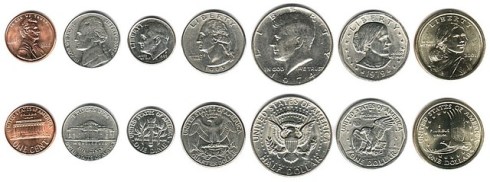
Without looking at your pocket change, can you recite the words on the obverse and reverse of your coins? It’s pretty much the same for each denomination, by the way. Time’s up! Obverse reads “In God We Trust” and “Liberty.” Reverse reads “United States of America,” “E Pluribus Unum,” and the denomination spelled out (like “Five Cents”). The new-fangled quarters have mixed things up a bit but those legends are featured on one side or the other. These are words our founding fathers felt crystallized the sentiment of the inhabitants of a new nation. Can you capsulize feelings about something in a few words? It’s tough.

U.S. coins obverse and reverse

Things were a little different in colonial Spanish America because a king (and queen, in name only, at the outset) was in charge and could call the shots. How do you express in a few words the way in which your new overseas possession should be represented? And what resonance would these words have in 16th century Spain?

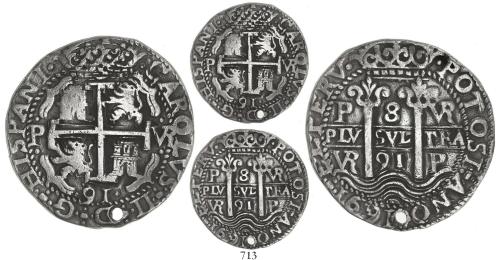
A Spanish royal decree dated May 11, 1535, established some basic designs that coins from the first mint in the New World, in Mexico City, would contain. The legends  would read the words “Carolus et Joana” (for Charles and Joanna) and “Reges Hispanie et Indiarum” (Regents of Spain and the Indies) or “what can be included of this.”  An interior inscription would read “Plus Ultra,” (More Beyond, and often expressed as simply Plus) which was “the device of the Emperor, my lord.” While the names of the rulers would change, the words “Hispanie et Indiarum” and “Reges,” (or Rex in the singular)  lasted for centuries.

8 Reales

Lot 404, Sedwick Treasure Auction #14, November 2014, First Dollar of the New World

How powerful an expression something like “ruler(s) of Spain and the Indies” must have been to those who could read. And “More Beyond” linked with the Pillars of Hercules was another striking image of Spain’s rising superiority overseas. How does this compare with “Liberty” or “E Pluribus Unum”or “In God We Trust”? And how true are these words today? Certainly Spain is no longer the ruler of the Indies and there is no “more beyond” unless you count outer space.


Lot 713, TA# 18, October 2015, 1691 8R Royal

Lot 713, Sedwick Treasure Auction #18, October 2015, 1691 VR 8 reales Royal

Gallery

An Object Lesson for Collectors

10 Feb

When you spend a lifetime collecting coins or artifacts (or both) that bring a smile to your face every time you look at them, why do you drop the ball when deciding what happens to them when you’re no longer around? Why do you spend so much time poring over auction catalogs, visiting shows, and reading references but don’t keep updated lists of what you have and who should have them when you’re gone? I guess it’s in our nature to covet things and fulfill our desire of having them without performing the mundane task of cataloging them and deciding what to do with them once we’re gone. And public storage companies are glad of it!

A recent report from Tom Vanderbilt at Slate.com notes that “according to the Self Storage Association, a trade group charged with monitoring such things, the country now possesses some 1.875 billion square feet of personal storage. All this space is contained in nearly 40,000 facilities owned and operated by more than 2,000 entrepreneurs, including a handful of publicly traded giants like Public Storage, Storage USA, and Shurgard.” Storage Facility logoGranted that there are many reasons for the 75% increase in storage facility use since 1995, but one is that when we clean out the house of a deceased relative, the last thing we want to do is inventory his or her possessions and figure out who gets what.  So we load up the UHaul, sign a rental agreement, and put them in a locked facility until such time (if ever) we want to deal with them.

Coins may not fall into this category as much as artifacts because they are much smaller and more portable, but they definitely find their way to oblivion when no one (but you, the deceased!) knows what they’re worth or who should dispose of them.

Giant Clam ShellArtifacts can be small or quite large. I have a beautiful whole giant clam shell that my father bought many years ago and displayed at my parents’ beach house. I had to arm wrestle my siblings for it, but what if no one wanted it? What would have become of that gorgeous, albeit very heavy, specimen created by Mother Nature?

Recently I was asked to investigate the whereabouts of some shipwreck artifacts that were housed at a local landmark hotel, called the Langford, which was sold around 2000 and razed to make way for….nothing. Well, the developers did manage to build a high-rise condo on part of the site. Then they skipped town without ever fulfilling the other part of their promise to the city, to build a luxury hotel on the rest of the property. I think they got both their money and some priceless artifacts out of the project.
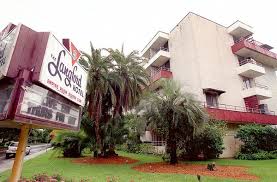
Langford Hotel Marquee

Here’s the story:

Since it was built in 1956, the Langford Hotel was frequented by loyal locals and students at Rollins College, which was only a couple of blocks away, who lounged by its enormous pool, one of the largest (if not the largest) in the area. Sometime after the discovery of the 1715 Spanish Plate Fleet in 1964, the owner and builder of the hotel, Mr. Bob Langford, became smitten with the idea of shipwrecks and shipwreck material. According to an article written several years later by Edward L. Prizer in a local paper, Mr. Langford began collecting “cannonballs, doubloons, nuggets and Spanish weapons” to be housed in one of his dining rooms and elsewhere around the hotel. The dining room name was even changed to the Anchor Room to commemorate a shell-encrusted anchor from the fleet’s flagship which sat outside the room.1715 Fleet Anchor and Cannon

Mr. Langford went on to buy and display many other artifacts that pertained to the Spanish colonial period in Florida’s early history. New dining rooms alongside the Anchor Room were created and named the Treasure Room and the Galleon Room. At some point, the crest of arms for the hotel displayed the iconic “castles and lions” emblematic of the early days of Spain’s occupation and plunder of the New World.

Times changed and the hotel lost its luster, as did its flamboyant owner, and he and his children decided to sell. What they didn’t anticipate, however, is what should become of some of those large, old artifacts. Maybe Mr. Langford didn’t care anymore or maybe he wasn’t competent enough to tell his children what should become of those priceless shipwreck pieces. The only disposition I could find was that the developers said they would “find a prominent place for the old cannons and anchors that frequent visitors will recall from the decor.” I guess if they stuck around and built the hotel instead of abandoning the project, that dream might have come true. The reality is that no one seems to know where anything is, and maybe they’re in some landfill instead of resting majestically in a museum. How much better it would have been had someone cared enough to make provisions for the future of this collection.