
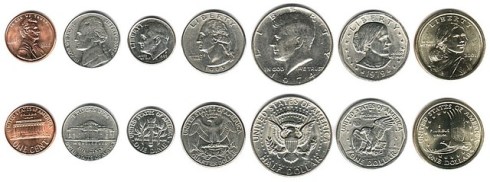
Without looking at your pocket change, can you recite the words on the obverse and reverse of your coins? It’s pretty much the same for each denomination, by the way. Time’s up! Obverse reads “In God We Trust” and “Liberty.” Reverse reads “United States of America,” “E Pluribus Unum,” and the denomination spelled out (like “Five Cents”). The new-fangled quarters have mixed things up a bit but those legends are featured on one side or the other. These are words our founding fathers felt crystallized the sentiment of the inhabitants of a new nation. Can you capsulize feelings about something in a few words? It’s tough.
Things were a little different in colonial Spanish America because a king (and queen, in name only, at the outset) was in charge and could call the shots. How do you express in a few words the way in which your new overseas possession should be represented? And what resonance would these words have in 16th century Spain?
A Spanish royal decree dated May 11, 1535, established some basic designs that coins from the first mint in the New World, in Mexico City, would contain. The legends would read the words “Carolus et Joana” (for Charles and Joanna) and “Reges Hispanie et Indiarum” (Regents of Spain and the Indies) or “what can be included of this.” An interior inscription would read “Plus Ultra,” (More Beyond, and often expressed as simply Plus) which was “the device of the Emperor, my lord.” While the names of the rulers would change, the words “Hispanie et Indiarum” and “Reges,” (or Rex in the singular) lasted for centuries.

Lot 404, Sedwick Treasure Auction #14, November 2014, First Dollar of the New World
How powerful an expression something like “ruler(s) of Spain and the Indies” must have been to those who could read. And “More Beyond” linked with the Pillars of Hercules was another striking image of Spain’s rising superiority overseas. How does this compare with “Liberty” or “E Pluribus Unum”or “In God We Trust”? And how true are these words today? Certainly Spain is no longer the ruler of the Indies and there is no “more beyond” unless you count outer space.
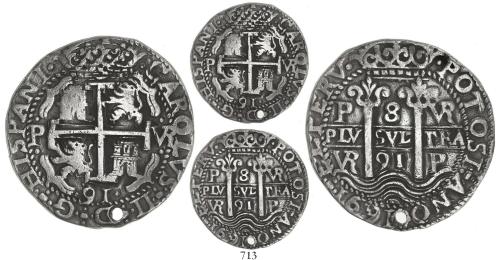
Lot 713, Sedwick Treasure Auction #18, October 2015, 1691 VR 8 reales Royal
 Granted that there are many reasons for the 75% increase in storage facility use since 1995, but one is that when we clean out the house of a deceased relative, the last thing we want to do is inventory his or her possessions and figure out who gets what. So we load up the UHaul, sign a rental agreement, and put them in a locked facility until such time (if ever) we want to deal with them.
 Artifacts can be small or quite large. I have a beautiful whole giant clam shell that my


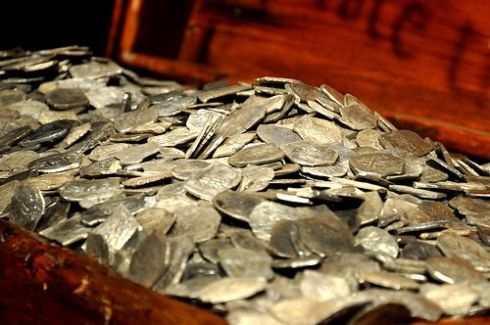 d have become a European colonial superpower. Each quantity of silver or gold mined in the colonial mines around Mexico City, Potosi, Lima, etc. and sent to the mint for smelting and/or coining would have a tax, a fifth (or quinto), charged by the crown and hence referred to as the “king’s fifth.” It all adds up after a while, and the king didn’t appreciate being cheated out of any of his money.
 in you just bought is genuine, weight it! If it’s significantly underweight, then there’s your red flag. The BIG exception is shipwreck silver coins. Silver corrodes in salt water so many shipwreck cobs are underweight, sometimes significantly. This is not true of gold which comes out of the ocean as intact as the day it went down with the ship.


 SEDWICKCOINS BLOG