
Last week, a reader asked about chopmarks on cobs and how they impact their value. That’s a field unto itself, isn’t it? But I thought it would provide a good platform to discuss the types of markings you might see on cobs and coins, namely counterstamps and countermarks (as well as chopmarks).
What’s a chopmark?
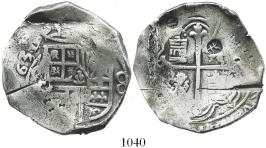
Chopmark coin, Lot 1040, Auction #9
This is a small mark or marks, sometimes recognizable as a Chinese character, that can appear on either or both sides of a coin. Typically these were made by Chinese bankers when Spanish-American coins circulated in the Orient to ensure that the composition of the coin was genuine. The coin may even have passed from one banker to another who verified its authenticity with a different mark and hence some coins bear several unrelated markings. And, chopmarks may have been added in other areas of southeast Asia such as Vietnam, so while we might say that a coin bears a Chinese chopmark, that chopmark might not necessarily have been put on the coin in China. As you might expect, there are collector groups (the Chopmark Collectors Club, for example) and books (Chopmarked Coins, A History, by Colin Gullberg) that are devoted to the topic. While chopmarks are interesting, they generally do not add value to the coin.
What’s a countermark?
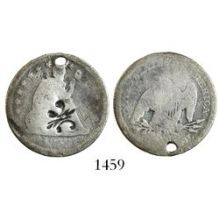
Puero Rico countermark, Lot 1459 Treasure Auction #15
Unlike chopmarks which were added to coins by a banker or merchant verifying the genuineness of a coin, countermarks were put on coins by a government or by official permission to a merchant to allow a coin to be circulated in the country where the mark originated. It was a way to use another country’s currency. Sometimes countermarks are more valuable than the host coin: for example, the Puerto Rican fleur-de-lis mark on a coin increases its value because there are very few Puerto Rican coins for collectors to collect. The countermark is the next best thing! Also, with countermarks, you’re adding another layer to the value of the coin since without the mark, you have one country’s coin to examine and with the countermark you have another country or merchant to add to the mix. Hence, countermarks can add numismatic value. If you want to learn something about merchant countermarks, Merchant Countermarks on World Coins by Gregory G. Brunk is a good place to start.
What’s a counterstamp?

Counterstamp coin, Lot 842, Treasure Auction #16
These odd creatures are double-sided countermarks, sort of like using an incomplete hole puncher to punch both sides of a coin. Like countermarks, a counterstamp can add numismatic value since there are now two countries or an important merchant that are represented on one coin. Unlike countermarks, the stamp on each side of the coin is different.
We will feature a few coins from each category (chopmarked, countermarked, counterstamped) in our upcoming auction, Sedwick Treasure Auction #17, in April.



 SEDWICKCOINS BLOG